Skip to Content Facebook Feature Image

China's trendy toy boom transforms industry with storytelling, design innovation

China

China

China

China's trendy toy boom transforms industry with storytelling, design innovation

2025-06-13 17:25 Last Updated At:18:47

China's booming trendy toy market has invigorated the entire industry, driving significant improvements from manufacturing to creative design.

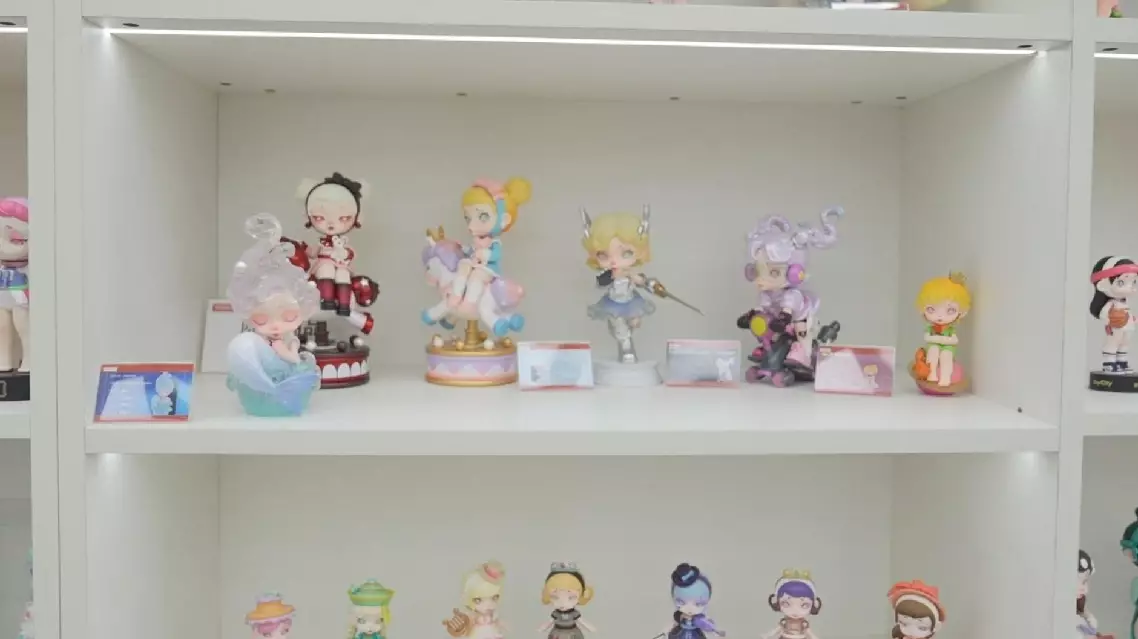
Once known as the global hub for childhood toy production, Dongguan City, south China's Guangdong Province, has recently gained fame as the hometown of a rising star in the designer toy world - a doll named Laura.

Inside a bustling factory there, toys are being produced at a rapid pace.

Zheng Bo, founder of ToyCity, the company behind Laura, said he spent decades in contract manufacturing before launching his own brand.

Laura is not just a single toy but a series of designs, each crafted to appeal to different fan communities.

In 2024 alone, over 10 million units of Laura were sold, marking a shift for ToyCity from a traditional manufacturer to a storyteller.

"To survive, production is a must. To thrive, you need your own brand. The upgrade depends on real-world conditions," Zheng said, acknowledging the challenges of hiring new talent and managing high design and development costs.

Looking ahead, Zheng is expanding beyond Laura, releasing new lines of designer toys. Yet, he remains focused on sustainability.

"Trendy toys may be popular, but what really sustains the trend? We can learn from other successful stories. Designer toy IPs often speak to niche communities, but with low stickiness. For an IP to last, it needs continuous content updates. Just look at Disney, their characters have lived on through stories for nearly 100 years," he said.

China has rapidly emerged as a major player in the global designer toy market, now accounting for nearly a quarter of its value.

According to the 2024 Report on China's Pop Toy and Animation and Comic Industries, the sector is worth about 10.5 billion U.S. dollars, representing 23.53 percent of the global market.

This booming market has sparked a surge in new businesses.

Data from Tianyancha Pro, a professional data provider, shows over 50,000 active companies related to trendy toys in China, with around 3,100 new registrations in 2025 alone.

Brands are now striving to reach beyond core collectors by infusing their toys with stories and cultural significance.

One example is Motor Nuclear, a robot-themed "mecha" brand that draws inspiration from Chinese traditional culture.

"This character (Ao Bing) comes from The Creation of the Gods, a mythological novel from the Ming Dynasty. We kept key features, like the dragon head right here," said Chen Qiang, a designer at Motor Nuclear.

The brand has created a new universe where heroes from different myths collide, proving that storytelling adds depth to toys and fuels fan passion.
China's trendy toy boom transforms industry with storytelling, design innovation
China's trendy toy boom transforms industry with storytelling, design innovation
Chinese President Xi Jinping's New Year message delivered on the New Year Eve has drawn positive responses from scholars and former officials from several countries, who say that the series of global initiatives proposed by Xi have provided fresh momentum for multilateralism and shared development at a time of growing uncertainty.

While the reactions touched on the broader vision outlined in Xi's New Year message, they also focused on the initiatives Xi has put forward over recent years, particularly the Global Development Initiative, the Global Security Initiative, the Global Civilization Initiative and the newly proposed Global Governance Initiative.

Highlighting the significant importance of these initiatives, they have emphasized the need for equality, inclusiveness and a fairer international order.

"We need a more just international order and a truly multilateral system. China stands almost alone today as a global force actively advancing genuine multilateralism. Therefore, these initiatives are most welcome," said Michael Schumann, chairman of the German Federal Association for Economic Development and Foreign Trade.

Former Lebanese Prime Minister Hassan Diab has placed the emphasis on dialogue and trust-building between civilizations.

"It is essential now more than ever to promote communication and understanding between China and the world to enhance cultural exchanges and build mutual trust. As President Xi has repeatedly emphasized, China supports principles of unity, inclusiveness and peacefulness. These values should guide our collective efforts to build bridges rather than walls," he said.

From a governance perspective, Russian scholar Ekaterina Zaklyazminskaya, head of the Center for World Politics and Strategic Analysis at the Institute of China and Modern Asia under the Russian Academy of Sciences, has viewed the Global Governance Initiative as a structured response to global challenges.

"The recently proposed Global Governance Initiative presents a comprehensive framework of ideas. It prioritizes establishing a more just international order, champions multilateralism, and upholds the principle of 'people first.' Through its concrete practices, financial assistance, and tangible support for multilateral bodies like the U.N., China has demonstrated that its commitments are substantive. China is taking tangible steps toward a fairer and more reasonable global governance system," she said.

Scholars from the Global South also have seen historical echoes in the initiatives.

"Some of the developed and developing countries have highly welcomed the Global Development Initiative, because this initiative emphasizes the need for partnerships -- partnerships that commit resources to end global poverty and pursue common and shared development. The Global Governance Initiative, in my view, echoes again the call that was made by Asian [and] African countries at the Bandung Conference in 1955 for equality, for mutual respect, for respect of territorial integrity, [and] for respect of sovereignty," said Bongani Maimele, director of international relations at South Africa's National School of Government.

"These initiatives are revolutionary in nature. They are reshaping the political philosophy of global governance. Today's world is far more complex than it was 80 years ago, and interdependence among nations has deepened. Therefore, we need new philosophical perspectives to examine our world and new models of engagement to foster a new type of international relations," said Sheradil Baktygulov, director of Kyrgyzstan's Institute of World Policy.

Int'l scholars praise Xi's initiatives, call for stronger multilateralism

Int'l scholars praise Xi's initiatives, call for stronger multilateralism

Recommended Articles