China launched an electromagnetic monitoring satellite on Saturday, which is expected to enhance the country's "space-air-ground" integrated monitoring capabilities for major natural disasters.
A Long March-2D carrier rocket lifted off from the Jiuquan Satellite Launch Center in northwest China at 15:56 (Beijing Time), successfully sending the Zhangheng 1-02 satellite into its planned orbit, according to the China National Space Administration (CNSA).
The CNSA said that this marks a significant step forward for China in the field of space-based observation of the Earth's physical fields.
Named after the ancient Chinese inventor Zhang Heng, who created the world's first seismoscope over 1,800 years ago, the satellite was jointly developed by China and Italy. It is the first operational satellite dedicated to exploring the Earth's physical fields under China's medium and long-term civil space infrastructure development plan, according to the CNSA.
With a designed lifespan of six years, the satellite is equipped with nine payloads, including an electric field detector co-developed by China and Italy, as well as a high-energy particle detector developed by Italy.
It will carry out quasi-real-time monitoring of global electromagnetic fields, electromagnetic waves, the ionosphere and the neutral atmosphere, detecting electromagnetic anomalies caused by geological and human activities, as well as monitoring thunderstorm and lightening activity, according to the CNSA.
"One of its functions is to monitor the electromagnetic waves and electromagnetic fields of the Earth, as these influence the crustal activities and electromagnetic patterns on Earth. Another function of the satellite is to detect the ionosphere and the neutral atmosphere structure, mainly serving for [monitoring] extreme weather conditions," said Peng Wei, deputy director of the system engineering department of the CNSA.
Peng said that scientists will use these data to study the correlation between changes in the Earth's physical fields and geological activities, and to support research on the prediction of earthquakes, tsunamis, volcanic eruptions, extreme weather, and space weather disasters.
The satellite will significantly enhance China's early perception, risk assessment, and monitoring and early warning capabilities for major natural disasters, Peng added.
It will also provide data support for emergency management, resource mapping, and communications and navigation industries, while fostering scientific and technological cooperation in related fields among countries and regions involved in the Belt and Road Initiative (BRI).
The Zhangheng 1-02 satellite is an updated version developed based on the Zhangheng 1-01 satellite, which is a scientific research satellite with the main task of verifying related technologies. The 02 satellite, an operational one built on the capabilities of the 01 satellite, will be more extensively involved in practical application.
The Zhangheng 1-01 satellite, launched in 2018, remains in normal operation, while the new satellite has richer physical measurements. Working in tandem, the two satellites will conduct collaborative observations, effectively improving the horizontal spatial and temporal resolution of observations, according to Peng.
"The operational satellite largely inherits the state of the scientific research satellite, with most aspects being similar, but it has a different payload - an ionospheric optical instrument. This payload mainly can measure certain parameters of the ionosphere and neutral atmosphere structure more accurately, and we expect it will improve the precision of these measurements by an order of magnitude," said Peng.
Saturday's launch marked the 581st mission of China’s Long March rocket series.
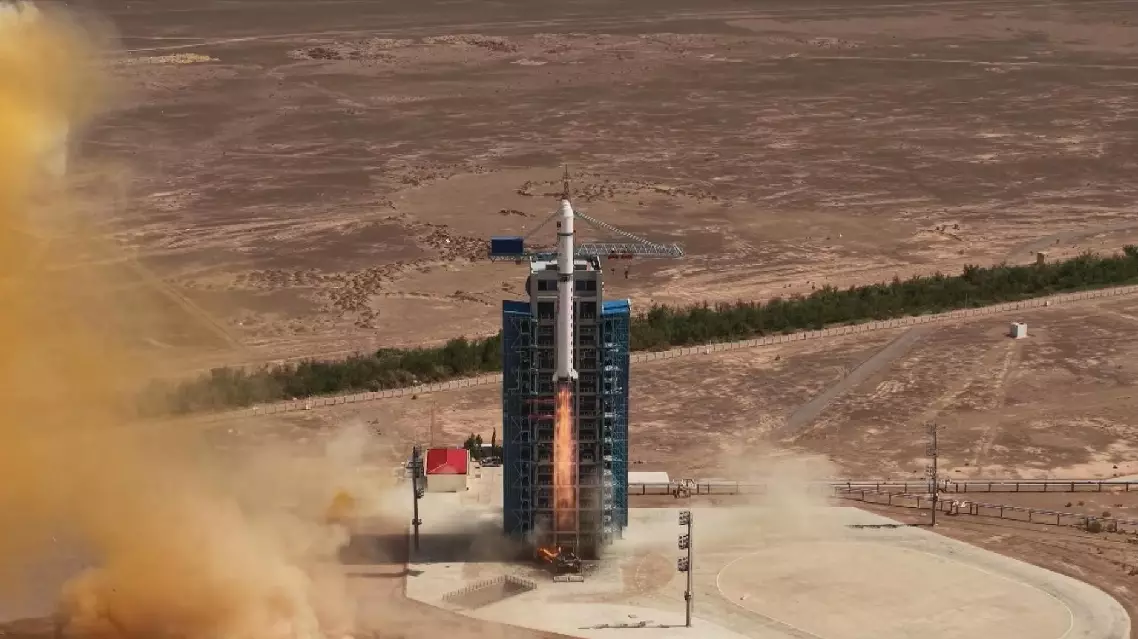
China launches satellite for natural disaster monitoring