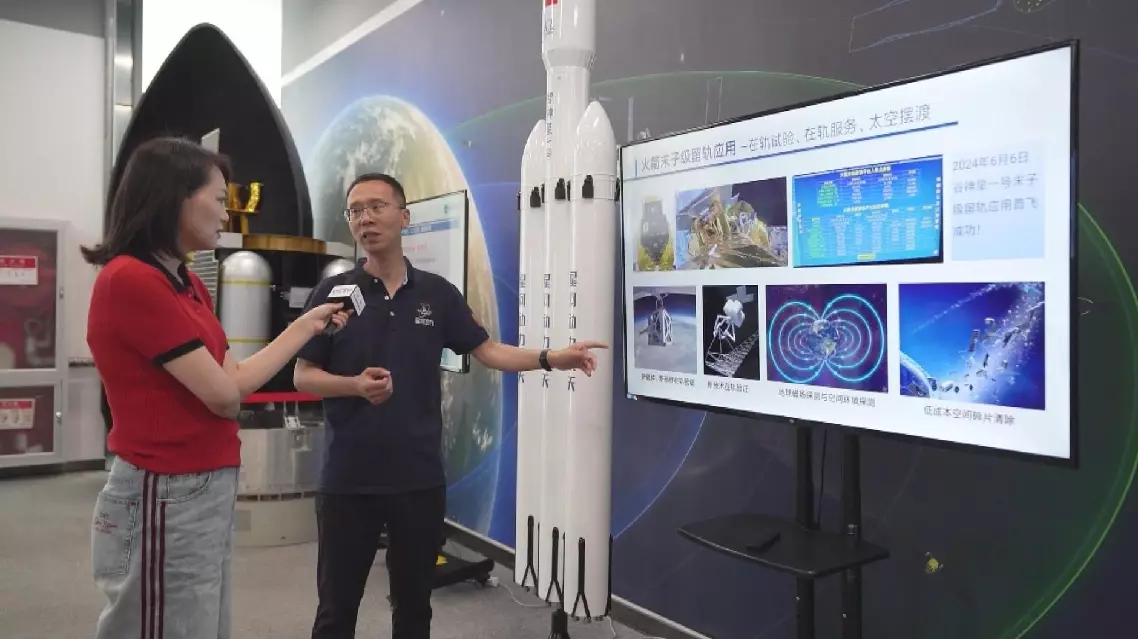
A Chinese private rocket manufacturer has established a foothold in the industry by pioneering innovative solutions to low-cost commercial space launches.
Founded just seven years ago, Galactic Energy has already achieved 19 successful launches, deploying 81 satellites for 25 clients - a record that makes it China's first private firm to achieve successive launch successes.
This remarkable achievement is fueled by radical engineering ingenuity. Galactic Energy has applied 3D printing technology into rocket engine manufacturing, slashing costs while improving efficiency.
"Traditional engines have a long manufacturing cycle and high costs. It takes about six months to make one. Now, by adopting a 3D printing solution, we've shortened the production cycle to less than one month, and the cost is only around 6,000 or 7,000 yuan, nearly one-tenth of the original cost. The weight is also reduced by half," said Liu Baiqi, founder and CEO of the company.
In addition, the Beijing-based firm has also made a bold design of a four-stage integrated rocket that is not divided into different sections, so as to reduce its weight.
"By removing sections from this structure, we reduced its weight by 75 kilograms. That means an extra 75 kilograms of payload capacity. At a typical rate of 100,000 yuan (about 14,000 U.S. dollars) per kilogram, carrying 75 kilograms more satellites generates an additional 7.5 million yuan per launch," Liu said.
Another striking innovation of the Galactic Energy addresses the problem of space debris. Rather than letting spent rocket parts become orbital junk, the company transforms them into functional satellites.
"So we modified it. You can see this panel. We attached a solar panel to the rocket to provide continuous power and added satellite attitude control and communication components. This part of the rocket is thus transformed into a satellite. What can this satellite be used for? First, it can conduct space environment tests and verification for new satellite components and parts. Second, it can perform low-cost space debris removal," Liu said.
Galactic Energy now flies the CERES-1 carrier rockets and is developing the CERES-2, which is expecting its first flight in late August.
Chinese private rocket maker defies the odds through innovation
The two-day European Union (EU) summit concluded in Brussels on Friday without a breakthrough on the bloc's long-term budget, as rising security commitments and soaring energy costs exposed a growing gap between Europe's ambitions and its ability to deliver.
Behind the summit's limited progress lay three pressing challenges: a budget difficult to agree upon, a growing security bill complicated by tensions with Washington, and an energy crisis testing Europe's economic resilience.
The European Commission has proposed a nearly 2-trillion-euro (2.24 trillion U.S. dollars) budget for 2028-2034, seeking to increase investment in competitiveness, defense and technology.
The Irish presidency's latest compromise would reduce the Commission's proposal by around 141 billion euros (158 billion dollars), yet the revised plan has drawn resistance from opposing camps.
European Commission President Ursula von der Leyen warned that the compromise would cut budgetary flexibility by half, leaving 99.5 percent of funds predetermined.
"This proposal puts us in a straitjacket," she said.
According to Brussels-based think tank Bruegel, six fiscally conservative countries led by Germany favor a smaller budget, while 17 "Friends of Cohesion," including Italy and Spain, seek to protect agricultural subsidies and regional development funds.
Brussels-based think tank Bruegel argued that both camps supported greater investment in common European priorities but placed national interests first.
It said that the Irish plan as the "worst possible compromise," warning that it could leave emerging priorities, including competitiveness and defense, severely underfunded while protecting traditional spending.
Fabian Zuleeg, chief executive and chief economist of the European Policy Centre, has likewise argued that Europe's expanding investment needs cannot realistically be financed through national budgets alone, calling for innovative financing arrangements, including new common borrowing.
The disagreements leave European Council President Antonio Costa facing a difficult task as he seeks a budget agreement by year-end.
Europe's fiscal pressures are compounded by a growing security bill and differences with Washington over Ukraine.
Ukrainian President Volodymyr Zelensky said at the summit that the war would cost Ukraine 155 billion euros (173 billion dollars) in 2027 and requested at least another 70 billion euros (78 billion dollars) in assistance.
The EU has already agreed on a 90-billion-euro (100 billion dollars) loan covering 2026-2027. However, Ukraine's additional financing needs remained under assessment, with European leaders seeking further input from the Commission and international financial institutions.
In its final conclusions, the European Council explicitly expressed regret over the U.S. decision to temporarily lift sanctions on Russian diesel, a move also criticized by Zelensky.
Meanwhile, recent restrictions on the U.S.-controlled Starshield satellite communications service disrupted Ukrainian military operations, exposing another vulnerability in Europe's security capabilities.
"Starlink is really necessary for Ukraine, and unfortunately in the short term Europe can't replace this capability," EU foreign policy chief Kaja Kallas acknowledged on Friday.
Analysts noted that this episode highlights Europe's reliance on critical U.S. military technologies even as transatlantic differences over Ukraine become more pronounced.
For Europe, the dilemma is increasingly apparent: greater security responsibilities require additional resources, while some of the capabilities underpinning those commitments remain beyond its immediate control.
Energy has become another source of financial strain. According to von der Leyen, the Middle East conflict has added 106 billion euros (119 billion dollars) to the EU's fossil fuel import bill, highlighting Europe's vulnerability to external energy shocks.
The International Energy Agency is accelerating the release of emergency oil stocks, including diesel, with plans to bring another 100 million barrels to the market over four months, while Brussels is pursuing temporary support for energy-intensive industries and measures to improve refining capacity.
Yet the summit exposed divisions over how far climate policies should be adjusted to ease immediate costs.
Italy, Greece and the four Visegrad countries pushed to postpone the EU's second emissions trading system, ETS2, until 2030, arguing that carbon pricing would impose further burdens on households and businesses.
However, Nordic countries resisted, concerned that weakening the system would undermine investment certainty and longer-term climate objectives.
The summit ended without an agreement on further postponement. Leaders instead requested an updated assessment of ETS2's design, impact and safeguards.
Researchers at the European Council on Foreign Relations argued that Europe's green transition was facing growing political resistance shaped by economic insecurity, competing national interests and the distribution of costs.
The dispute reflects a difficult choice: easing today's energy pressures could weaken incentives for long-term investment, while maintaining ambitious climate policies risks adding to the burden on businesses and households.
For European leaders, agreeing on common goals remains easier than deciding who should bear the costs of achieving them.
EU summit ends with mounting bills, unresolved divisions