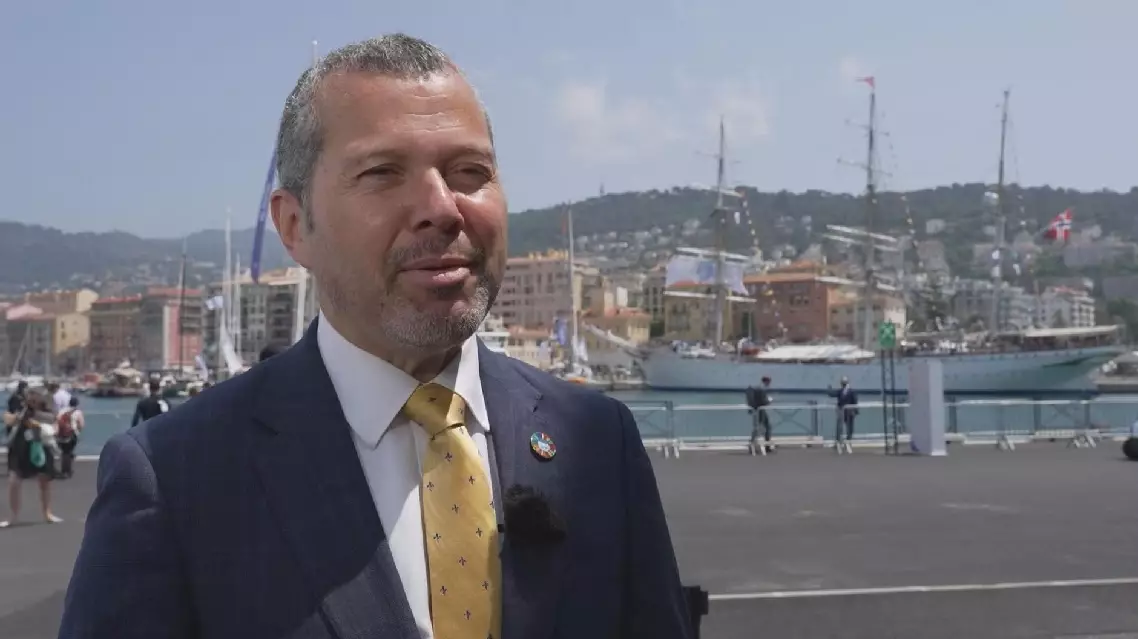
The shipping industry must set a global example in protecting marine ecosystems through cooperation and green initiatives, said International Maritime Organization (IMO) Secretary-General Arsenio Dominguez at the third UN Ocean Conference (UNOC3) on Thursday.
The five-day conference in Nice, France, concluded on Friday, bringing together over 15,000 participants, including 60 heads of state and government. The gathering adopted a political declaration, committing nations to science-based multilateral action for ocean conservation.
In an interview with China Media Group (CMG), Dominguez noted that the IMO's unique role as a UN specialized agency enables it to bring nations together to address maritime challenges.
"Our objectives will always be to enhance the safety, security of shipping, as well as the environmental footprint. And they go hand in hand. The safer, the more efficient the ship is, the greener it will also be. And that is also the training that we provide to the seafarers in all the areas related to shipping, from the environment, liabilities, management, harassment. You name it, that's what we're doing. And these, of course will allow us to continue to evolve as a sector," he said.
The IMO chief detailed three priority action areas: implementing carbon pricing mechanisms to fund decarbonization, scaling up technical assistance for developing nations, and strengthening global standards against marine pollution.
"We have a long record to support member states, particularly small island developing states and least developed countries, through projects or technical cooperation activities. Now, with the economic measures that we are introducing to reduce greenhouse gas emissions, we are going to be able to financially also support the transition to a green shipping. This becomes a model that I hope all the sectors will also follow up and demonstrate that 'yes, there is a cost, but we have to protect the environment'. We can't work in isolation, look at IMO, we have to decarbonize. And for that, we need the energy sector to play their part, the member states, the countries to also enhance not just the training of the people, but also the infrastructures in the port. And we will be able to provide some assistance," said Dominguez.
Highlighting the sector's multifaceted environmental efforts, Dominguez emphasized the IMO's commitment to reducing threats to the ocean and ensuring its sustainability.
"It's a responsibility, the role that we're playing, and how seriously we're taking it. Because there are lot of noise going on about the great achievements that we are making in relation to decarbonization. But we're working in the reduction and elimination of plastic pollution from ships, which we have over three decades of experience on that, biofouling in transboundary species, the reduction of underwater radiated noise, everything that actually contributes to protection of the ocean. We know that we are one of the main users of the oceans. That's why it's our responsibility and opportunity to take every single possible measure to guarantee that the ocean is sustainable," he said.
Co-hosted by France and Costa Rica, UNOC3 marked substantial progress from the 2017 and 2022 summits, yielding actionable agreements on marine protected areas, pollution control, and climate financing for at-risk coastal states. With 450 side events and nearly 100,000 visitors, the conference showcased an unparalleled commitment to tackling ocean conservation challenges.
IMO chief calls for global shipping sector to champion marine protection efforts