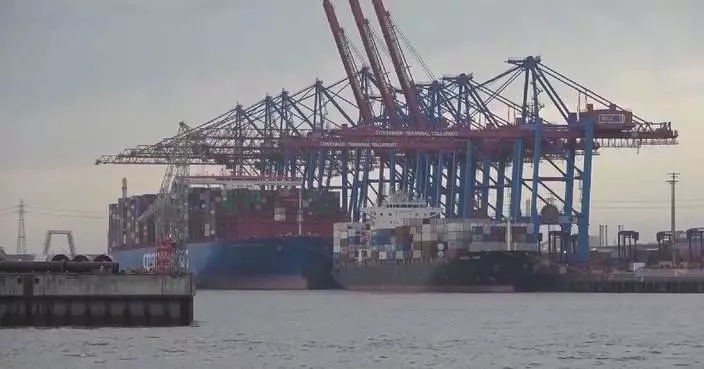
The container hub at the Kazakh port of Aktau, a flagship project of high-quality Belt and Road cooperation between China and Kazakhstan, began operations last week, adding strong vitality to the Trans-Caspian International Transport Route.
The Trans-Caspian International Transport Route stretches from China through Kazakhstan and the Caspian Sea to Azerbaijan and Georgia, with further extensions to Turkey and European countries.
The new container hub, located on the eastern coast of the Caspian Sea, serves as a modern supply and dispatch center for this transport route.
Against the backdrop of profound transformation in global logistics and accelerated redistribution of cargo flows, the Trans-Caspian route has rapidly gained importance over the past few years. In 2024 alone, the cargo volume along this route in Kazakhstan surged by an astonishing 33 times year on year.
Artem Rozdolsky, a crane operator who has worked at the port for nearly 20 years, said most of the containers he has handled came from China, and the port's cargo throughput has risen substantially over the past five years.
"As you can see, the yard is packed with containers. The number is much higher than before," he said.
"In the first four months of this year, the port's throughput already reached 25,000 TEU. If the current growth momentum continues, this year's total throughput may break last year's record," said Amir Atambayev, acting chairman of the port.
To accommodate surging cargo, the port has undergone upgrades, including the purchase of new cargo ships and gantry cranes, and the expansion of berths.
Covering an area of 19 hectares, the container hub boasts a storage capacity of over 2,000 twenty-foot equivalent units (TEUs) and a designed annual throughput of 240,000 TEUs.
To ensure logistics efficiency, 11 new dedicated railway lines will be built for the container hub, with the first batch of tracks already under construction.
The project has created numerous job opportunities for the local community.
"This is the fourth China-invested project I've participated in. In all the companies I've worked for, I've collaborated with Chinese colleagues, and I really like it. I understand Chinese culture and the Chinese people's ways of thinking. In fact, Kazakhstan has much to learn from China," said Bulikpayev, a quality supervision engineer of the project.
"This project represents a strategic alignment of infrastructure connectivity between China and Kazakhstan. Upon completion, it will significantly boost the regional economy," said Chang Jianbing, general manager of the Aktau International Container Port Limited Liability Partnership.
Rozdolsky expressed his hope to work at the port until retirement, saying he is confident that this goal will be achieved.
"The port keeps expanding, our potential is enormous, and trade will continue to grow. And we are part of this progress," he said.
Astana, capital of Kazakhstan, is set to host the second China-Central Asia Summit from June 16 to 18. The summit is expected to take the six countries on a new journey toward building a closer China-Central Asia community with a shared future.
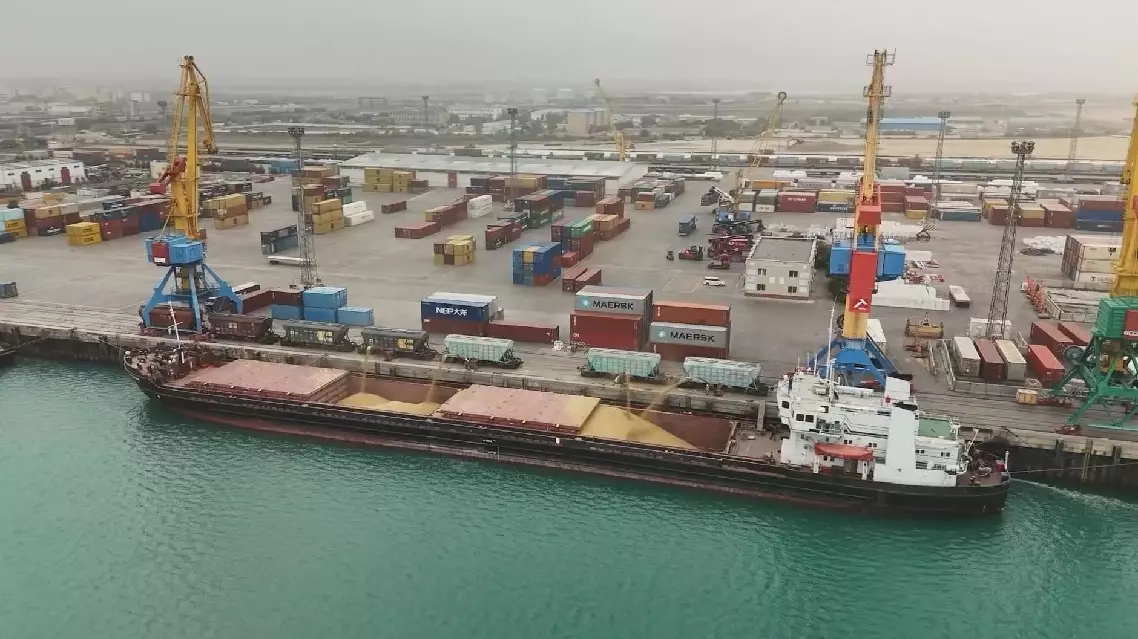
New container hub at Kazakh port facilitates Trans-Caspian transportation