Officials and scholars from Central Asia countries highlighted the achievements in their countries' cooperation with China ahead of the second China-Central Asia Summit, set to be hosted in Astana, Kazakhstan.
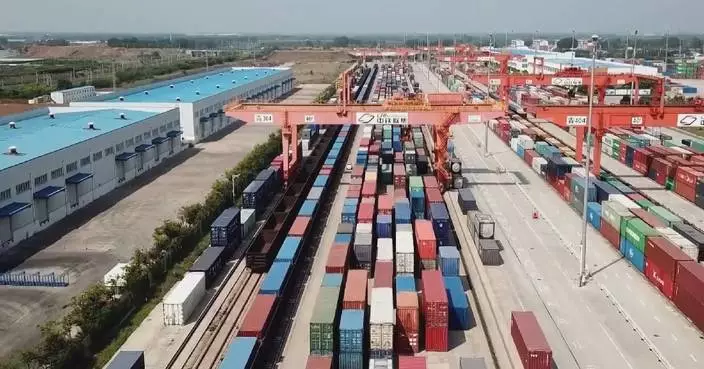
Yerzhan Kistafin, Kazakhstan's ambassador to Pakistan, pointed to the Belt and Road Initiative (BRI) -- first announced by Chinese President Xi Jinping in Astana in 2013 -- has transformed Kazakhstan into a vital land bridge between Asia and Europe.
"In 2013 President of China Xi Jinping for the first time announced the idea to launch the One Belt One Road initiative in Astana during his visit to Kazakhstan. This project is a global infrastructure strategy with participation of more than 150 countries. As of today Kazakhstan plays an important role in this term, and three years back we finalized construction of the railroad connecting China with the European countries. And, for example, the delivery time today is two weeks in comparison to 40, 50 days by sea. Kazakhstan is the largest landlocked country in the world, and the main purpose of our government today is transforming Kazakhstan from a landlocked to a land-linked country. And this is why we pay very special attention to developing collaboration with China in terms of the One Built One Road initiative," said Kistafin
Javlon Vakhabov, former ambassador of Uzbekistan to the United States, emphasized the importance of growing the partnerships between developing countries in bolstering global economic resilience amid shared challenges.
"The Global South opens up new opportunities for sustainable economic growth and to expand the international partnerships, and it also supports the diversification of trade and investment flows, reduces reliance on traditional routes, and strengthens regional economic resilience," Vakhabov said.
Highlighting agricultural cooperation, Odilkhoja Parpiev, director of the Institute of Materials Science at the Academy of Sciences of Uzbekistan, described successful collaborations with Chinese research institutions.
"Actually, we are working with a lot of universities and institutions from China, from Beijing, Shanghai, Qingdao, Urumqi. But I would like to talk today to give some examples of the joint work with the Shanghai Academy of Agriculture, because it is very important for us also, the greenhouse technology. The results are wonderful. I would like to say some results. For example, the irrigation water consumption that was reduced by 30 percent, crops yield increase by up to forty percent," said Parpiev.

Central Asian experts highlight importance of China cooperation outcomes amid global uncertainty