Central Asia's largest sports complex, built by a Chinese company in Uzbekistan, is ready to host the 2025 Asian Youth Games. As the first major project completed under China-Uzbekistan cooperation, it took just two years to build using advanced green technology.
In Tashkent, the capital of Uzbekistan, state-of-the-art sports facilities are taking shape as part of the Uzbekistan Olympic City, built by China CAMC Engineering, which is set to host the 4th Asian Youth Games and the 5th Asian Youth Para Games in 2025.
"The project, contracted on December 31, 2022, spans over 100 hectares and includes five large sports venues, one sports office building, and 15 outdoor facilities. The design phase was completed in just four months. From 2023 to 2025, the entire construction was finished in only two years—an exceptionally fast pace, even by Chinese standards. At peak times, the Chinese team comprised over 2,000 workers. The project highlights China’s rapid, efficient, and high-quality construction capabilities," said Guo Zijie, general manager of 4th Engineering Division of China CAMC Engineering.
Many local people recognize that this project integrates China's advanced concepts and technologies in combination with the local conditions.
"The entire project was designed to Chinese standards while carefully considering local conditions and usage habits, such as the height of switches and backboards. The approach makes the project a successful blend of Chinese design and local requirements. As a state-of-the-art, multifunctional sports venue cluster, it incorporates numerous advanced technologies and equipment. Structurally, the venue features a roof photovoltaic system with a total capacity of 7 megawatts, ensuring full solar panel coverage. For landscaping, the design takes the local climate into account, incorporating a water system that is both visually appealing and functional for rainwater storage and regulation, enhancing the overall landscape effect," said Zhang Yu, chief designer of the project.
Locals feel that the project has brought tangible improvements to their daily lives.
Nazarov Dilshojon Rasul, a staff member at the Uzbekistan Olympic Sports City project, said that thanks to the project, the region's infrastructure has greatly improved, with new roads and buildings being built, making transportation more convenient. The anticipated rise in tourism and the hosting of major events will also generate increased employment opportunities for them.
This project also shows that infrastructure projects under the Belt and Road Initiative provide new opportunities for better cooperation and development between China and Central Asian countries.
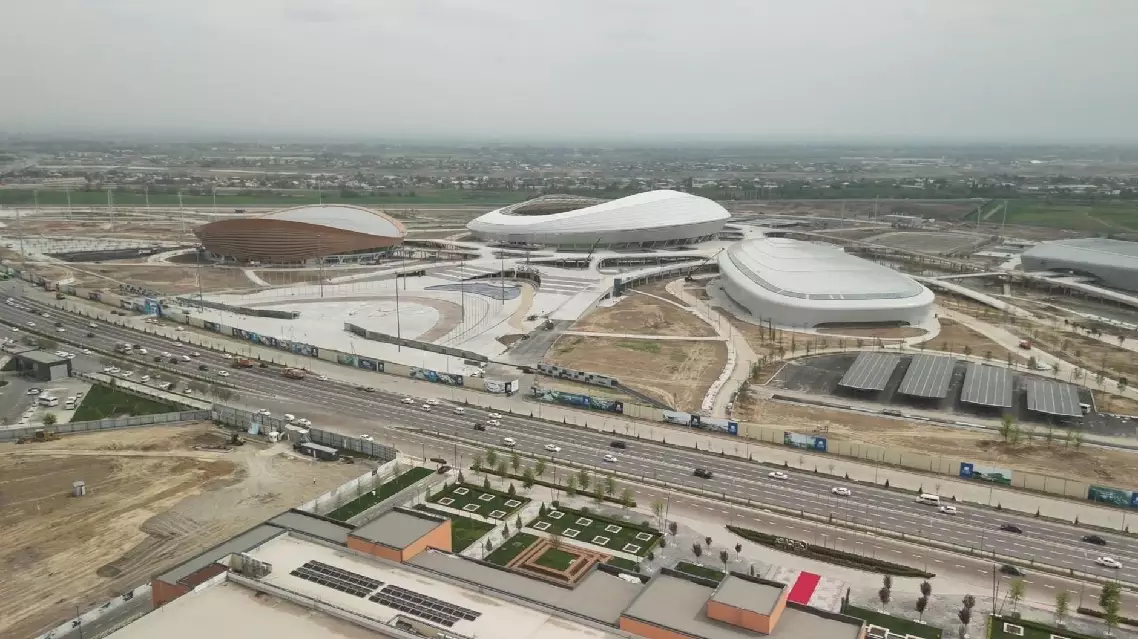
New Olympic City in in Uzbekistan showcases China’s construction prowess