Skip to Content Facebook Feature Image

Yunnan’s fresh-cut flowers find fertile ground in Central Asia

China

China

China

Yunnan’s fresh-cut flowers find fertile ground in Central Asia

2025-06-17 20:03 Last Updated At:21:57

Fresh-cut flowers from southwest China's Yunnan Province are making their way nearly 4,000 kilometers northwest to Kazakhstan, thanks to enhanced infrastructure which has led to flourishing trade in a variety of goods and products among the nations.

The Belt and Road Initiative (BRI) has strengthened economic and cultural exchanges between China and Central Asian countries.

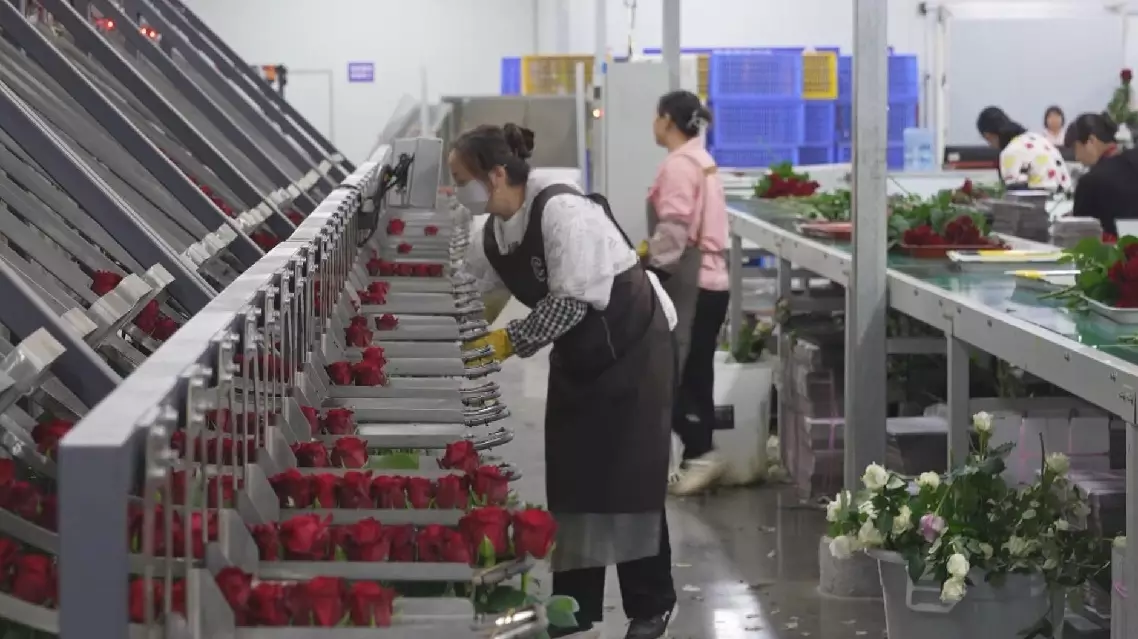
In Kunming, Yunnan's provincial capital, workers at a flower-packing facility are still working even at 22:00, carefully packaging rose stems destined for the Kazakh market.

"We usually work from 20:00 until 6:00 or 7:00 the next morning," said Kong Weimang, an employee at Yunnan Huashengjin Network Technology.

Known as China's "Kingdom of Flowers," Yunnan is a floral powerhouse, with flower fields, especially roses, stretching widely across the landscape. Its blossoms are now reaching far beyond domestic borders, with Central Asia one of the most vibrant markets.

"We started exporting to the Kazakh market in March this year. Back then, we sent about eight or nine truckloads that month. But volumes kept rising in April, and by May, we had the average of one truckload a day," said Shen Chunling, general manager of Yunnan Huashengjin Network Technology.

According to Kunming Customs, in the first five months of this year, Yunnan exported fresh-cut flowers worth nearly 60 million yuan (about 8.3 million U.S. dollars) to Central Asian countries, marking a nearly tenfold increase year on year.

The boom is not limited to flowers. Traders from Central Asia are also relocating to Yunnan to tap into the growing market.

"Yunnan produces a huge variety of flowers. They’re very competitive in our markets, including Russia, Kazakhstan, Kyrgyzstan, Uzbekistan, (other markets in) Central Asia and Belarus. We are even developing supply lines to Azerbaijan," said Turapov Rafat, a flower businessman from Kazakhstan.

Thanks to BRI infrastructure upgrades and enhanced cold-chain logistics, Yunnan's blooms now reach Kazakh cities like Almaty and Astana in just five days, arriving fresh for sale.The surge in demand is also transforming local farming.

Zhou Yulian, a veteran flower grower in this business for 25 years, now partners with the local government to manage six modern greenhouses. These facilities are expected to yield around 7 million stems annually -- most destined for clients in Kazakhstan.

"The foreign buyers require what's called order-based planting -- whatever variety they need, I grow. They also commit to buying everything and even set the price. I’m thrilled and relieved as I can focus entirely on growing without having to worry about sales," she said.

With ongoing improvements in quality and logistics, growers and exporters are optimistic that Yunnan's fresh-cut flowers will continue to bloom on the international stage -- especially in Central Asia.
Yunnan’s fresh-cut flowers find fertile ground in Central Asia


Yunnan’s fresh-cut flowers find fertile ground in Central Asia

Japanese Prime Minister Sanae Takaichi's political stunts both at home and abroad cannot whitewash Japan's World War II (WWII) aggression, but instead expose the schemes of the country's far-right forces to incite bloc confrontation and promote remilitarization, says a China Media Group commentary published on Sunday.

An edited English version of the commentary is as follows:

In recent days, Takaichi has faced fierce criticism both domestically and internationally.

Her political stunt of kneeling in front of the Tomb of the Unknown Australian Soldier to lay flowers at the Australian War Memorial in Canberra during her visit to Australia further exposed her multiple political calculations to the international community.

Choosing to kneel in front of a tomb in Australia, Takaichi was not regretting for Japan's aggression and atrocities during World War II.

This act not only reveals the distorted world outlook of Japanese politicians, but also exposes their attempts to mislead public opinion, whitewash the crimes of WWII aggression, instigate bloc confrontation, and push for military buildup.

From "fawning diplomacy" during her U.S. visit in March to the recent kneeling show during her visit to Australia in May, Takaichi has been trying to cultivate a friendly image towards the West.

Geopolitically speaking, Japan's far-right forces are trying to expand their military and breach from the restraints of the pacifist constitution by exaggerating external threats. To this end, they are making every effort to exploit geopolitical conflicts and draw neighboring countries, especially Western countries, into bloc confrontation.

Since the end of WWII, Japanese leaders have never apologized to the people of victim countries such as China, the Republic of Korea, and the Democratic People's Republic of Korea. Many Japanese politicians have even tried every means to justify the war crimes.

In particular, Takaichi has questioned the 1995 Murayama Statement, denied the Nanjing Massacre, visited the notorious Yasukuni Shrine annually for many consecutive years, and revived military rank titles during WWII, such as "taisa."

On the issue of Japan's history of aggression, Takaichi's insidious move cannot deceive the world.

Takaichi's political stunts both at home and abroad are a provocation against WWII victim countries in Asia and other regions.

This cannot conceal Japan's remilitarization attempt or the reality that " neo-militarism" is spreading and becoming a threat.

All countries that have suffered from Japanese militarist aggression should remain highly vigilant and united, and work together to safeguard the outcomes of WWII victory, so that historical tragedies never repeat themselves.

Takaichi's political stunts cannot whitewash Japan's history of aggression, remilitarization attempt: commentary

Takaichi's political stunts cannot whitewash Japan's history of aggression, remilitarization attempt: commentary

Recommended Articles