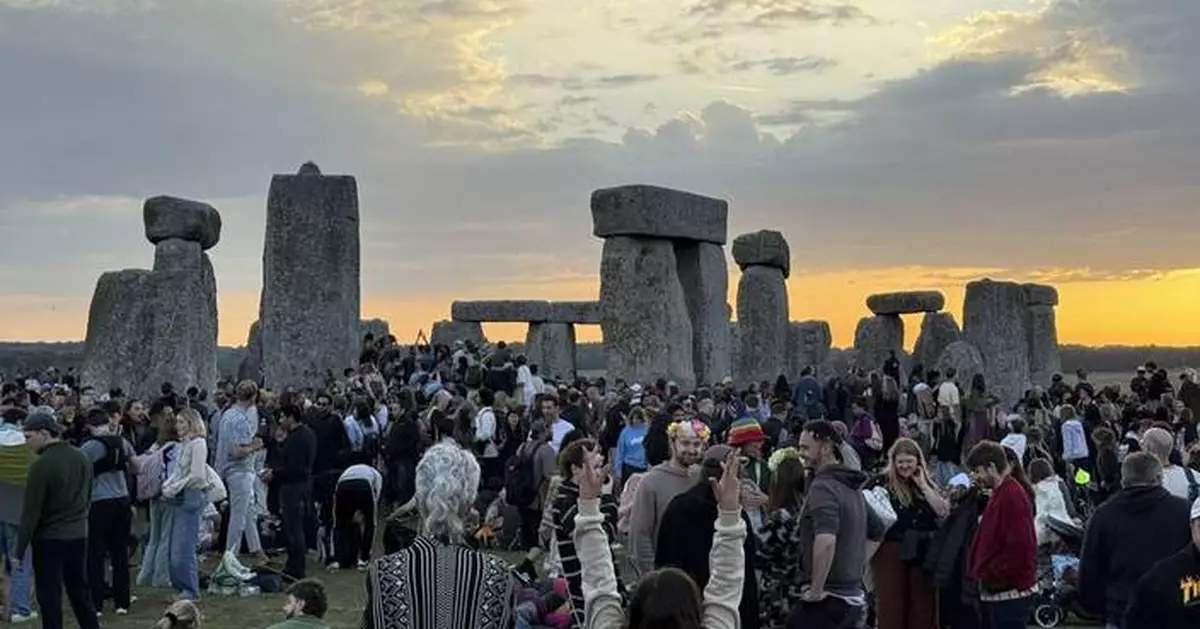
LONDON (AP) — As the sun rose Saturday on the longest day of the year in the Northern Hemisphere, a crowd erupted in cheers at Stonehenge where the ancient monument in southern England has clocked the summer solstice over thousands of years.
The orange ball crested the northeast horizon behind the Heel Stone, the entrance to the stone circle, and shone its beam of light into the center of one of the world’s most famous prehistoric monuments. The solstice is one of the few occasions each year when visitors are allowed to walk among the stones, which are otherwise fenced off.
The crowd gathered before dawn at the World Heritage Site to mark the start of summer in the Northern Hemisphere, beating the heat during the U.K.'s first amber heat-health alert issued since September 2023. Temperatures later topped 33 degrees Celsius (91.4 degrees Fahrenheit) in Surrey, 80 miles (128 kilometers) east of Stonehenge, the hottest temperature recorded in the U.K. so far this year.
About 25,000 sun devotees and other revelers, including druids, pagans, hippies, locals and tourists, showed up, according to English Heritage which operates the site. More than 400,000 others around the world watched a livestream.
“This morning was a joyous and peaceful occasion with the most beautiful sunrise," said Richard Dewdney, head of operations at Stonehenge. “It is fantastic to see Stonehenge continuing to enchant and connect people.”
Stonehenge was built in stages 5,000 years ago on the flat lands of Salisbury Plain approximately 75 miles (120 kilometers) southwest of London. The unique stone circle was erected in the late Neolithic period about 2,500 B.C.
Some of the so-called bluestones are known to have come from the Preseli Hills in southwest Wales, nearly 150 miles (240 kilometers) away, and the altar stone was recently discovered to have come from northern Scotland, some 460 miles (740 kilometers) away.
The site’s meaning has been vigorously debated. Theories range from it being a coronation place for Danish kings, a druid temple, a cult center for healing, or an astronomical computer for predicting eclipses and solar events.
The most generally accepted interpretation is that it was a temple aligned with movements of the sun — lining up perfectly with the summer and winter solstices.
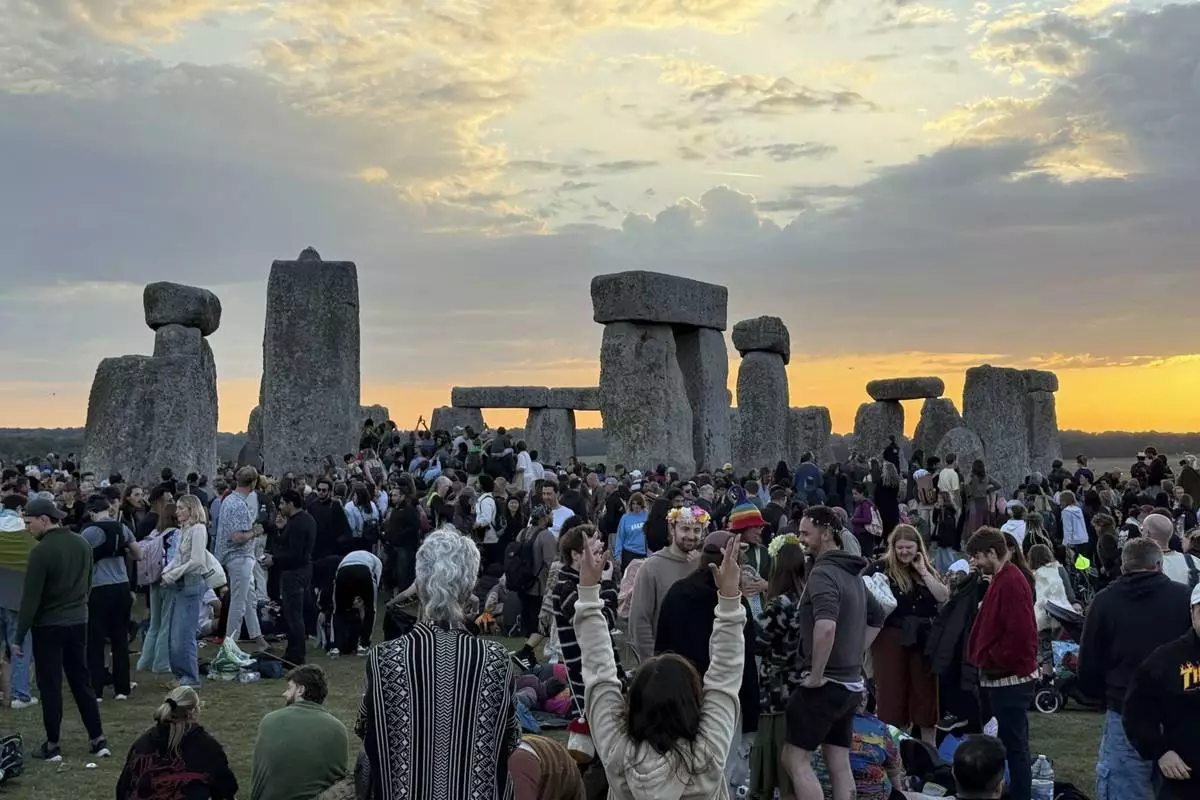
People gather at Stonehenge, England, during sunrise on the summer solstice, the longest day of the year, Saturday, June 21, 2025. (Zhanna Manukyan/PA via AP)
LJUBLJANA, Slovenia (AP) — Slovenia’s parliament on Friday appointed right-wing populist politician Janez Jansa as the new prime minister, in a shift for the small European Union country that was previously run by a liberal government.
Lawmakers backed Jansa in a 51-36 vote in the 90-member assembly. The new prime minister will need to come back to Parliament within the next 15 days for another vote to confirm his future Cabinet.
Jansa's appointment concludes a postelection stalemate in Slovenia after a parliamentary ballot two months ago ended practically in a tie. Former liberal Prime Minister Robert Golob's Freedom Movement won by a thin margin but he was unable to muster a parliamentary majority.
Jansa and his populist Slovenian Democratic Party signed a coalition agreement this week with several right-wing groups. The new government also has the backing of a nonestablishment Truth party that first emerged as an anti-vaccination movement during the COVID-19 pandemic.
The new term in office will be the fourth for the veteran Slovenian politician. Jansa, 67, is an admirer of U.S. President Donald Trump and was a close ally of former populist Hungarian Prime Minister Viktor Orbán, who was defeated in a landslide election last month.
Jansa in a speech listed the economy, fight against corruption and red tape, and decentralization as key goals of the future government. He has promised to lower taxes for the rich and support private education and healthcare.
Critical of the previous government's alleged “inefficiency," Jansa said the new government will turn Slovenia into “a country of opportunity, prosperity and justice, where each responsible citizen will feel safe and accepted."
Like Orban, Jansa was staunchly anti-immigrant during the huge migration wave to Europe in 2015. Also like Orban, Jansa has faced accusations of clamping down on democratic institutions and press freedoms during a previous term in 2020-2022. This led to protests at the time, and scrutiny from the European Union.
Golob in his speech described Jansa as “the greatest threat to Slovenia’s sovereignty and democracy."
Alleging that Jansa had threatened to arrest him, Golob said Jansa's "idea of democracy is that anyone who dares speak a word against you deserves only the worst.”
Jansa, a supporter of Israel, also has been a stern critic of the Golob government's 2024 recognition of a Palestinian state.
The vote on March 22 was marred by allegations of foreign influence and corruption. The around 2 million people in the Alpine nation are deeply divided between liberals and conservatives.

Janez Jansa, center, addresses the Slovenian Parliament during a session in Ljubljana, Slovenia, Friday, May 22, 2026, before appointing him as prime minister, ending a political deadlock after tight elections in March. (AP Photo/Igor Kupljenik)

Janez Jansa arrives for a session of the Slovenian Parliament in Ljubljana, Slovenia, Friday, May 22, 2026, before appointing him as prime minister, ending a political deadlock after tight elections in March. (AP Photo/Igor Kupljenik)

Janez Jansa addresses the Slovenian Parliament during a session in Ljubljana, Slovenia, Friday, May 22, 2026, before appointing him as prime minister, ending a political deadlock after tight elections in March. (AP Photo/Igor Kupljenik)