Several close U.S. allies urged a return to the negotiating table following American strikes on Iran that fueled fears of a wider conflict, while noting the threat posed by Tehran’s nuclear program. Some countries and groups in the region, including those that support Iran, condemned the move while also urging de-escalation.
U.S. President Donald Trump described the damage as “monumental” after the U.S. hit three Iranian nuclear sites, though the U.S. assessment was unfinished.
Iranian Foreign Minister Abbas Araghchi said the U.S. had “crossed a very big red line,” the time for diplomacy was over and Iran had the right to defend itself.
Here is a look at the global reaction:
U.N. Secretary-General António Guterres said he was “gravely alarmed” by the use of force by the United States.
“There is a growing risk that this conflict could rapidly get out of control — with catastrophic consequences for civilians, the region, and the world,” he said in a statement on the social media platform X. “I call on Member States to de-escalate.”
“There is no military solution. The only path forward is diplomacy.”
British Prime Minister Keir Starmer warned of escalation beyond the Middle East as he called for all sides to negotiate a diplomatic end to the crisis, saying stability was the priority in the volatile region.
The U.K., along with the European Union, France and Germany, tried unsuccessfully to broker a diplomatic solution in Geneva last week with Iran.
Starmer said Iran’s nuclear program posed a grave threat to global security.
“Iran can never be allowed to develop a nuclear weapon and the U.S. has taken action to alleviate that threat,” Starmer said.
Dmitry Medvedev, who serves as deputy head of President Vladimir Putin’s Security Council, said several countries were prepared to supply Tehran with nuclear weapons.
He didn't specify which countries, but said the U.S. attack caused minimal damage and would not stop Tehran from pursuing nuclear weapons.
Russia’s Foreign Ministry said it “strongly condemned” the airstrikes and called them a “a gross violation of international law, the U.N. Charter, and U.N. Security Council resolutions.”
The Iraqi government condemned the U.S. strikes, saying the military escalation created a grave threat to peace and security in the Middle East. It said it poses serious risks to regional stability and called for diplomatic efforts to de-escalate the crisis.
“The continuation of such attacks risks dangerous escalation with consequences that extend beyond the borders of any single state, threatening the security of the entire region and the world,” government spokesman Bassem al-Awadi said in the statement.
President Abdel Fattah el-Sissi warned of “grave repercussions” for expanding the Middle East conflict and urged a return to negotiations.
Saudi Arabia, which previously condemned Israel’s strikes on Iran’s nuclear facilities and military leaders, expressed “deep concern” about the U.S. airstrikes, but stopped short of condemning them.
“The Kingdom underscores the need to exert all possible efforts to exercise restraint, de-escalate tensions, and avoid further escalation,” the Foreign Ministry said in a statement.
Qatar, which is home to the largest U.S. military base in the Middle East, said it “regrets” escalating tensions in the Israel-Iran war.
Its Foreign Ministry in a statement urged all parties to show restraint and “avoid escalation, which the peoples of the region, burdened by conflicts and their tragic humanitarian repercussions, cannot tolerate.”
Qatar has served as a key mediator in the Israel-Hamas war.
Both the Houthi rebels in Yemen and Hamas condemned the U.S. strikes.
The Houthi political bureau in a statement called on Muslim nations to join “the Jihad and resistance option as one front against the Zionist-American arrogance.”
Hamas and the Houthis are part of Iran’s so-called Axis of Resistance, a collection of pro-Iranian proxies stretching from Yemen to Lebanon that for years gave the Islamic Republic considerable power across the region.
Lebanese President Joseph Aoun said the U.S. bombing could lead to a regional conflict that no country could bear and called for negotiations.
“Lebanon, its leadership, parties, and people, are aware today, more than ever before, that it has paid a heavy price for the wars that erupted on its land and in the region,” Aoun said in a statement on X. “It is unwilling to pay more.”
Pakistan blasted the U.S. strikes as a “deeply disturbing” escalation just days after it nominated Trump for the Nobel Peace Prize for his diplomatic intervention with the India-Pakistan crisis.
“These attacks violate all norms of international law,” the government said in a statement. “Iran has the legitimate right to defend itself under the U.N. Charter.”
China condemned U.S. strikes on Iran, calling them a serious violation of international law that further inflamed tensions in the Middle East.
In a statement, the Chinese Foreign Ministry urged all parties — especially Israel — to implement a cease-fire and begin dialogue.
“China is willing to work with the international community to pool efforts together and uphold justice, and contribute to the work for restoring peace and stability in the Middle East,” the ministry said.
The European Union’s top diplomat said Iran must not be allowed to develop a nuclear weapon, but she urged those involved in the conflict to show restraint.
“I urge all sides to step back, return to the negotiating table and prevent further escalation,” EU foreign policy chief Kaja Kallas said in a post on social media.
Foreign Minister Antonio Tajani said Iran’s nuclear facilities “represented a danger for the entire area” but hoped the action could lead to de-escalation in the conflict and negotiations.
Deputy Prime Minister Simon Harris called the U.S. airstrikes “an extraordinarily dangerous escalation of a conflict that already best be described as a tinderbox.”
Ireland, which has been especially critical of Israel’s war in Gaza, echoed other European calls for negotiations that would prevent Iran from getting a nuclear weapon.
“We’re now entering a moment of particular danger,” Harris said. “The chances now of a spiral of escalation are more likely than ever before, and there is a real prospect now of the international community losing all control of this very, very volatile conflict.”
Foreign Minister Penny Wong said Australia's government endorsed the U.S. strikes.
“We support action to prevent Iran getting a nuclear weapon and that is what this is,” she said. Her remarks to Channel Nine news Monday were firmer than an official statement supplied Sunday by her government immediately after the strikes that stopped short of backing them.
“Ultimately we want to see de-escalation and diplomacy,” Wong said.
She would not say whether Australian satellite communications or signals intelligence were employed by the United States. Both countries are members of the Five Eyes intelligence sharing partnership. But Wong said the U.S. had been clear that “this was a unilateral strike.”
Left-wing Latin American governments expressed fierce opposition to the U.S. strikes.
Iran-allied Venezuela called the attacks “illegal, unjustifiable and extremely dangerous.” Colombian President Gustavo Petro said they were an insult to the Middle East. Chile’s President Gabriel Boric said they violated “rules we have established as humanity.” Mexico’s Foreign Ministry made “an urgent call for peace.”
In contrast, Argentina’s libertarian President Javier Milei, a loyal ally of Trump and Israeli Prime Minister Benjamin Netanyahu, praised the attacks on social media. “Terrorism, never again,” his spokesperson said.
Japanese Prime Minister Shigeru Ishiba told reporters it was crucial to calm the situation as soon as possible, adding that Iranian nuclear weapons development also must be prevented. He declined to comment on whether he supported the U.S. attacks on Iran.
Vietnam called on parties to continue negotiation efforts and respect humanitarian law and International Atomic Energy Agency regulations. “Vietnam is deeply concerned about the escalating and complex conflict in the Middle East, which poses a serious threat to the lives and safety of civilians, as well as to regional and global peace and stability,” Foreign Affairs Ministry spokeswoman Pham Thu Hang said in the statement.
Thailand called on all parties to immediately stop all acts of violence and seek a peaceful resolution. “Thailand expresses its grave concern over the escalating tensions between Israel and Iran, particularly in light of the recently intensified attacks and expansion of conflict by other parties, which pose a serious threat to regional peace and stability and risk further escalation, all of which is dangerous and affecting countless civilians," the Foreign Affairs Ministry said in a statement.
Pope Leo XIV made a strong appeal for peace during his Sunday Angelus prayer in St. Peter’s square, calling for international diplomacy to “silence the weapons.”
After an open reference to the “alarming” situation in Iran, the first American pontiff stressed that “today more than ever, humanity cries out and invokes peace and it is a cry that demands reason and must not be stifled.”
Pope Leo urged every member of the international community to take up their moral responsibility to “stop the tragedy of war before it becomes an irreparable abyss.”
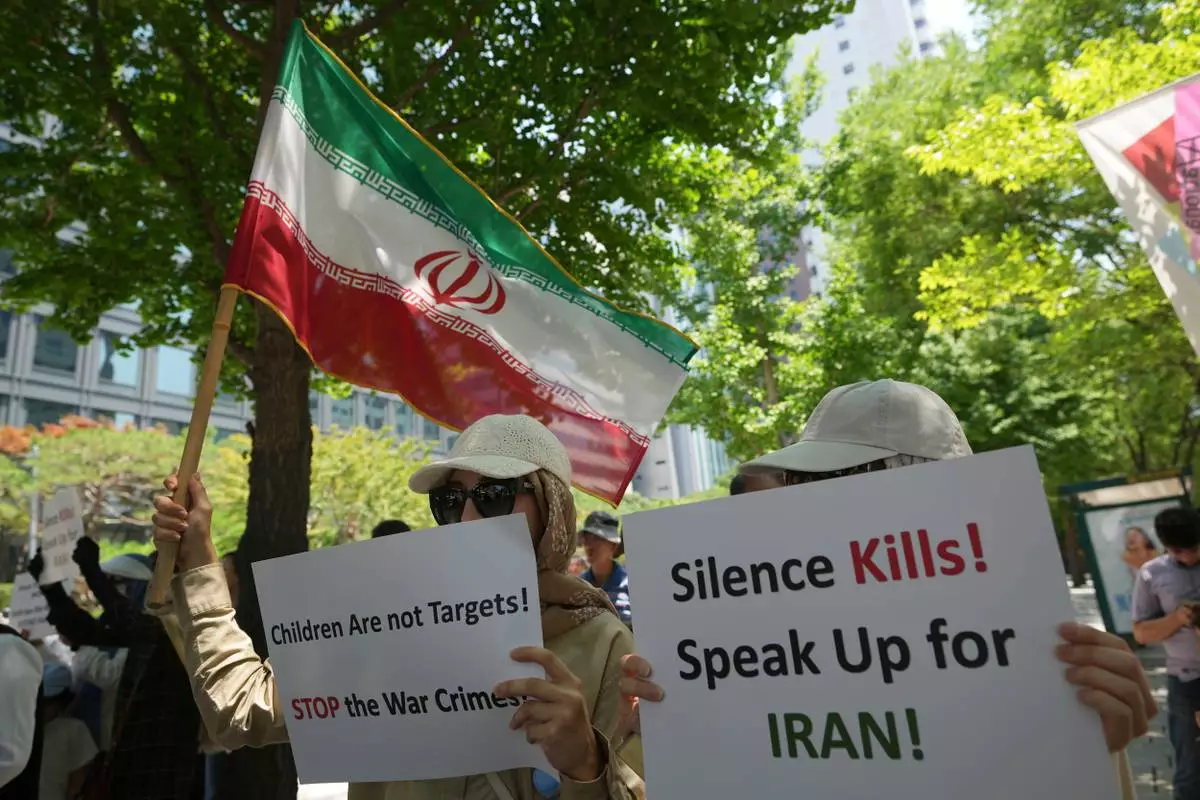
People hold an Iranian flag and signs during a rally demanding to stop the war between Israel and Iran, in Seoul, South Korea, Sunday, June 22, 2025. (AP Photo/Lee Jin-man)
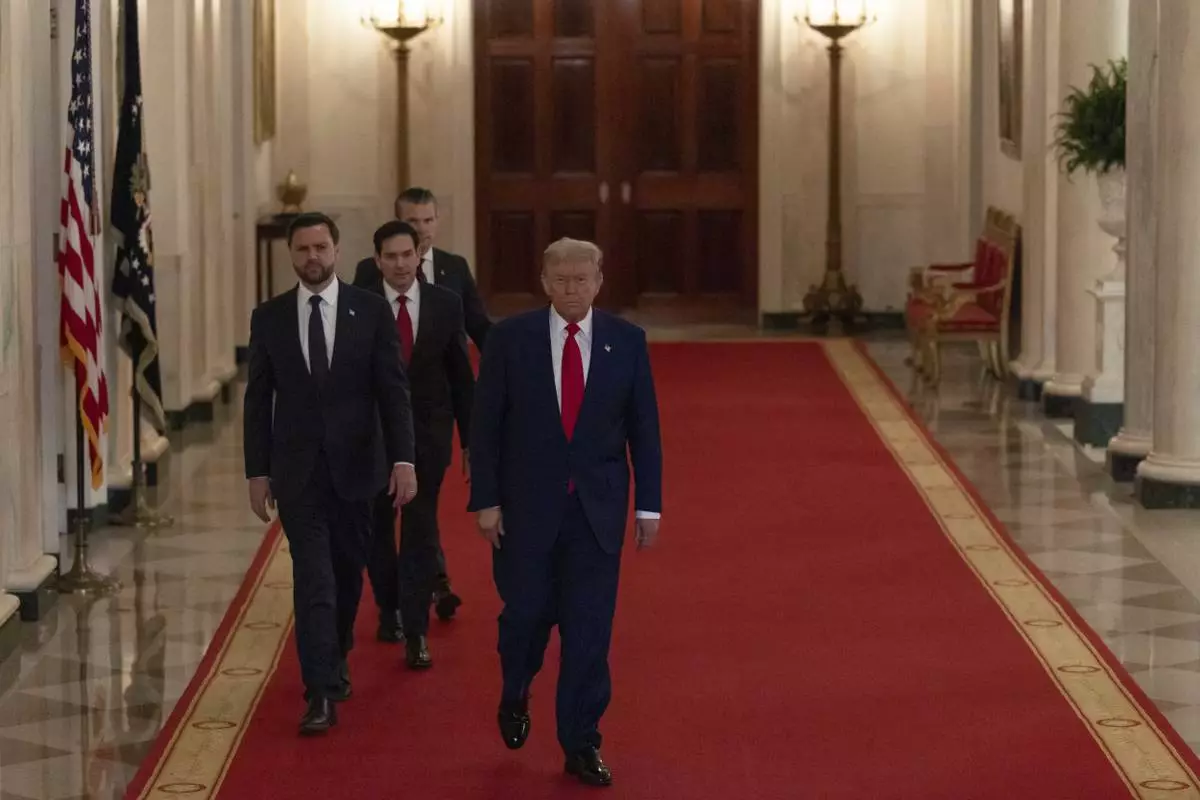
President Donald Trump arrives to speak from the East Room of the White House in Washington, Saturday, June 21, 2025, after the U.S. military struck three Iranian nuclear and military sites, directly joining Israel's effort to decapitate the country's nuclear program, with Vice President JD Vance, Secretary of State Marco Rubio and Defense Secretary Pete Hegseth. (Carlos Barria/Pool via AP)