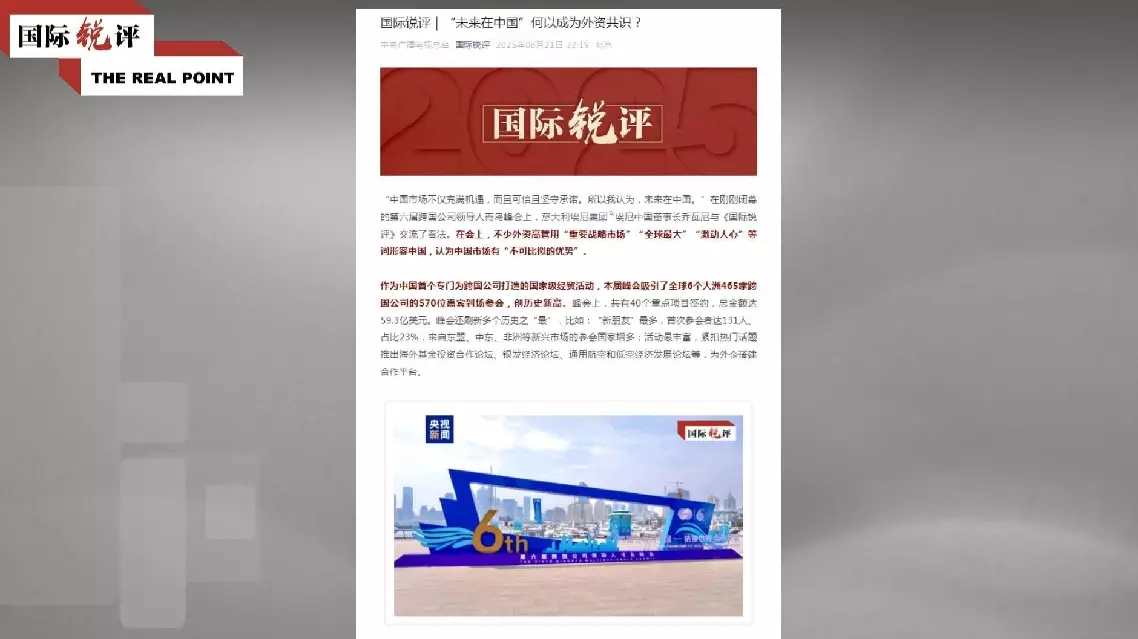
Many participants from foreign enterprises at the recently concluded 6th Qingdao Multinationals Summit expressed confidence in the Chinese market, highlighting the country's robust economic resilience, according to a commentary by China Media Group on Saturday.
The three-day summit, which concluded in Qingdao City, east China's Shandong Province on Friday, featured closed-door meetings focusing on policy interpretation, parallel forums aimed at discussing open cooperation, and the release of a research report on the presence of multinationals in China.
A translation of the commentary follows:
The Chinese market is not only full of opportunities, but also credible and committed, so the future is in China, said Gianni Di Giovanni, chairman of Eni China at the 6th Qingdao Multinationals Summit.
At the summit, senior executives from leading international companies described China as "a critical strategic market", "the world's largest", and "an exciting opportunity", emphasizing the country's "unparalleled advantages".
As the first state-level economic and trade event specifically held for multinational companies in China, the summit attracted 570 representatives from 465 multinational firms across six continents - setting a new attendance record.
At the summit, a total of 40 key projects were signed, with a combined value reaching 5.93 billion U.S. dollars.
The event drew the highest number of first-time attendees, with 131 first-time participants accounting for 23 percent of total attendance. It also saw increased participation from emerging markets including ASEAN, Middle Eastern, and African countries.
It also featured the most diverse agenda to date, addressing hot topics through specialized forums on overseas fund investment cooperation, the silver economy, as well as general aviation and low-altitude economic development - creating valuable collaboration platforms for foreign enterprises.
It is worth mentioning that the theme of this summit is "Multinationals and China: Connecting the World for Win-Win Cooperation", which highlights the strategic position of China in the global layout of multinational corporations.
Foreign enterprises have deeply integrated into Chinese economy, facilitating China's connectivity with the world. Now, they believe that being in China enables them to better connect with the world.
David Xu Daquan, president of Bosch China, said Bosch needs China, which boasts great innovation opportunities and speed.
His words also represent the consensus of many international companies in China.
"Research and development in China" plays a crucial role in the global landscape. Only by fully leveraging China's market potential, talent pool, and innovative resources can a multinational strengthen its global competitive advantage.
According to the summit's report, from 2013 to 2023, the full-time equivalent of research and development personnel in China's foreign-funded industrial enterprises above designated size increased by 33.2 percent, while research and development expenditure rose by 86.5 percent. Taking Beijing as an example, in 2024 alone, the city recognized more than 110 new foreign research and development centers. By January 2025, the number of foreign research and development centers in Beijing had reached 221, demonstrating exponential growth.
China also provides huge market potential for foreign firms that aim to seize new opportunities and make the "first move".
For example, in the energy industry, participating companies generally believe that China's green transformation in renewable energy, seawater desalination, hydrogen energy and other fields is developing rapidly.
In January this year, leading Saudi electricity producer ACWA Power announced that it had signed investment agreements with two Chinese enterprises totaling 312 million U.S. dollars.
In the first five months of this year, among the high-tech industries in China, the actually used foreign capital increased by 146 percent in the e-commerce service industry, 74.9 percent in the aerospace and equipment manufacturing industry, 59.2 percent in the chemical medicine manufacturing industry, and 20 percent in the medical equipment and instrument manufacturing industry.
Looking ahead, a stable and open policy environment is crucial for the sustained development of foreign investment. From fully opening up the manufacturing sector to advancing institutional openness in rules, regulations, governance and standards, China has been consistently optimizing its policies and approach to foreign investment, ensuring an equitable development environment for both foreign and domestic companies.
Last year, Denmark-based pump manufacturer Grundfos participated in formulating China's first compulsory national standard for energy efficiency of pump product systems. He Liu, senior manager of public affairs at Grundfos, said, "This has enabled our cooperation in China to develop in greener and more digital directions from the product field, thus further exploring the Chinese market."
Now, through a series of investment facilitation measures and precise services, China is creating a broader space for foreign companies to showcase their potential. For example, a global medical industry fund jointly established by British pharmaceutical giant AstraZeneca and Chinese enterprises has invested in and supported 27 local enterprises to help their products go global.
"China's continuous efforts to improve business environment have strengthened our confidence in sustainable development here, giving us greater assurance to seize opportunities amid competition," said Yang Lan, senior director of public affairs at Herbalife China, a U.S.-based global nutrition company.
It is this confidence that has enabled many foreign companies in China to accelerate their expansion in the Chinese market. Panasonic Appliances (China) Co., Ltd. has invested in and expanded 20 new projects based on existing operations; ACWA Power plans to substantially increase its Chinese assets to one-third of its global portfolio by 2030; McDonald's plans to open 1,000 new stores in China this year. These goals demonstrate both a profound understanding of the Chinese market and a firm commitment to future growth.
Against the current international backdrop of rising unilateralism and protectionism, these expansions reflect foreign capital's rational choices and strong confidence. Amid turbulent changes, the sustained inflow of foreign investment proves that connecting with China means better connecting with the world; investing in China is investing in the future.
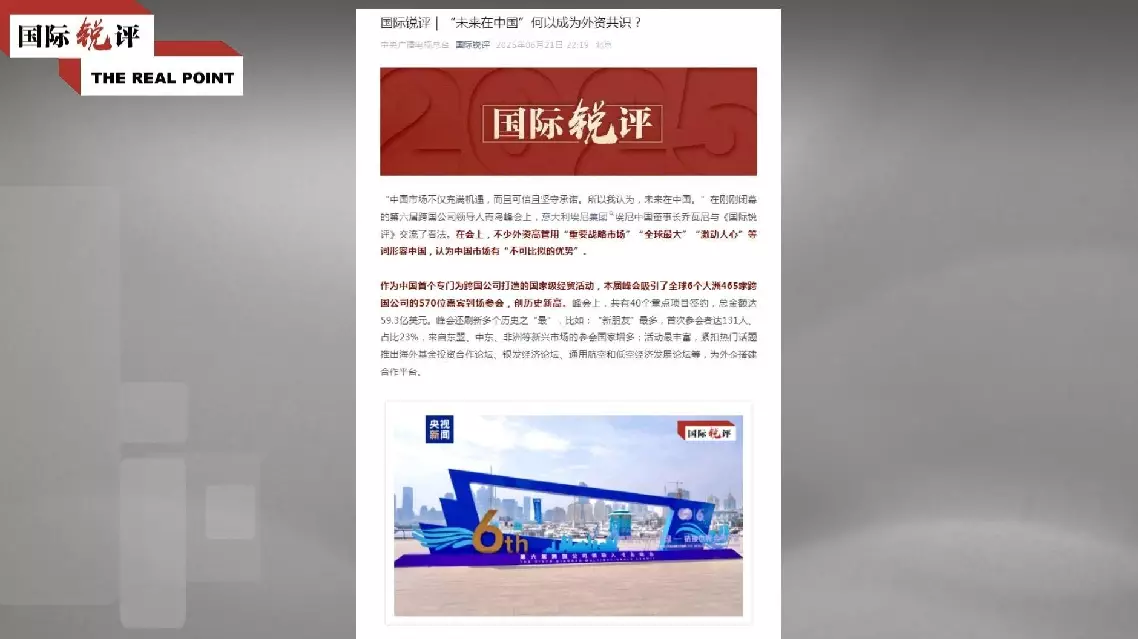
"Future is in China" a consensus of int'l companies: commentary
"Future is in China" a consensus of int'l companies: commentary