The key artifacts excavated from Niuheliang Archeological Site, the most important archaeological site of China's Hongshan culture located in Chaoyang City of northeast China's Liaoning Province, have proved the establishment of a systemic ritual system for offering sacrifice over 5,000 years ago.
The findings were released jointly by China Academy of Social Science (CASS) and Liaoning Provincial Cultural Relics Bureau on June 14.
Dating back to about 5,000 to 5,800 years and covering a protected area of nearly 60 square kilometers, Niuheliang Archeological Site is the largest site complex ever found in Hongshan Culture.
Hongshan culture is an important prehistoric archaeological culture dating back roughly 5,000 to 6,000 years. Its distribution covers three regions located in the west of Liaoning Province, the north of Hebei Province and the east of Inner Mongolia Autonomous Region.
Among these, Liaoning is the core area in terms of Hongshan culture distribution and the focal region for studying this culture.
The released findings included burned artifacts and ceremonial objects, evidence that proves the existence of rituals similar to those documented in later historic periods and used in offering sacrifice to heaven and ancestors.
"Liaoji and Guanli are documented ceremonies for offering sacrifice to heaven and ancestors. We found burned fruit cores and incomplete jades in the archeologist sites, which are highly likely to be linked to heaven worshiping. Besides, we also found a pair of potteries, which are also highly likely to be used in rituals to worship ancestors," said Guo Ming, executive head of the field archaeology project at the Niuheliang Archaeological Site.
Another major finding at the prehistoric archeological site was a delicately constructed altar also used in heaven worshiping.
The altar, which consists of three concentric stone circles, requires a construction process that maps out two squares to lay out the stones in exact positions.
"The three concentric stone circles should be built by mapping out two squares and this proves the existence of an ancient Chinese cosmology that assumes the sky is a dome that covers the square land. The altar was built in a period when this belief started to take shape in China," said Guo.
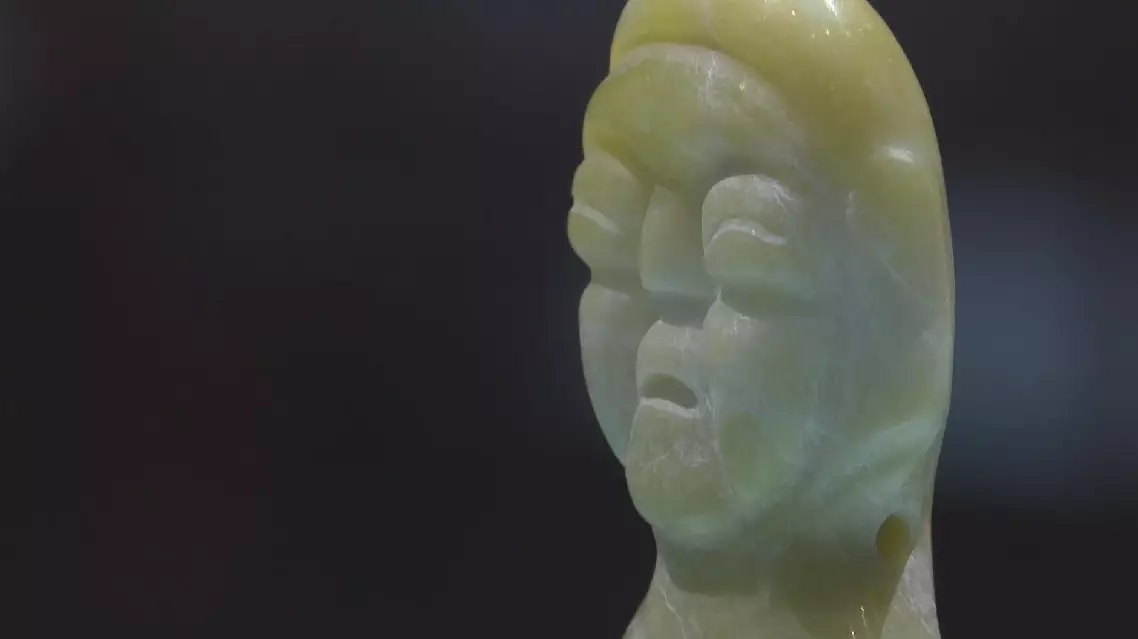
Latest findings prove China's prehistoric ritual system dates back over 5,000 years