Cities in east China's Jiangsu Province, including Suqian and Changzhou, have introduced preferential cultural and tourism policies, to meet the demands of football fans and tourists brought by the popular local grassroots football event.
The Jiangsu Provincial City Football League, dubbed the “Su Super League,” features 13 teams -- each representing a city in east China's Jiangsu Province. The event has stirred football fever across China, with online viewership soaring into the hundreds of millions.
With matches running from May through to November, the amateur championship has now entered its fourth round as the competition heats up through the summer.
The commerce, culture and tourism departments of Suqian City have recently worked with more than 100 local catering businesses, commercial complexes and scenic spots to live broadcast the football games on large screens in shopping malls and TVs in stores.
Football fans and tourists coming from afar are provided with 20 to 50 percent discounts on accommodation in the city.
"Tourists can enjoy a 20-percent discount at our hotel. We will fully reimburse the taxi fare from the high-speed rail station to the hotel," said Zhou Moxi, a hotel manager.
The football fans can also enjoy discounts at some specialty restaurants with their Suqian home game tickets.
"Diners here can enjoy a 12-percent discount on all dishes. In addition, we will gift each table of diners a famous Suqian dish named 'Farewell My Concubine.' We can also provide pick-up and drop-off services at the stadium," said Tang Chunxia, a restaurant manager
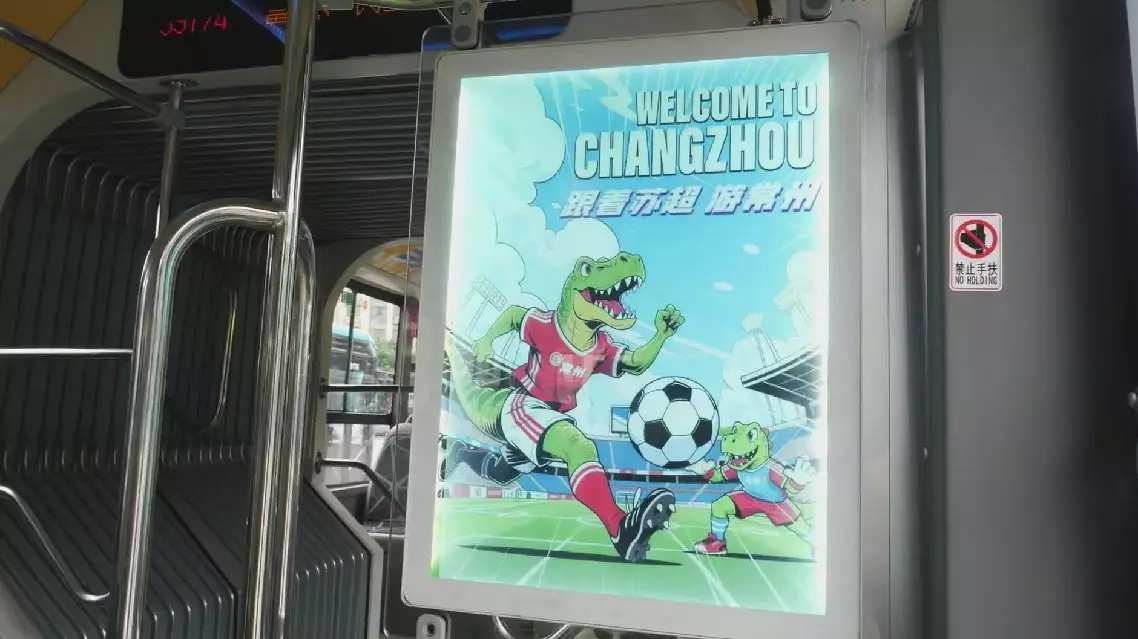
The China Dinosaur Land is a characteristic attraction in Changzhou City. The popularity of the Su Super League has brought life to the cultural and creative products combining elements of dinosaur and football, including specially-designed dolls and T-shirts.
The local transport department also launched themed buses and subway trains, on which travelers can find joy in the cute cartoon dinosaur and football patterns.
"There are pink, green and yellow patterns, it gives a feel of Changzhou style," said a passenger.
The football event has also sparked a growing demand for the construction of football fields and the renewal of equipment. From football shoes, jerseys, support towels, to artificial turf and stadium hardware facilities, relevant companies in Jiangsu are working overtime to expand production.
Grassroots football league boosts tourism in Jiangsu
A former television host from Taiwan, Zhai Xuan, has made a pivotal decision to leave mainstream broadcasting in order to create content that provides a better understanding of the Chinese mainland and cross-strait relations.
Zhai, a seasoned television host with over a decade of experience in Taiwan's media landscape, recently addressed an audience at an event in Beijing, where she revealed her complete transition into independent online media.
In her remarks, she articulated her aspiration to bridge what she perceives as a significant information gap between audiences on both sides of the Strait, highlighting her commitment to fostering a deeper understanding and connection through her new endeavors.
"I was really surprised by all the fake news. There were stories saying people on the mainland can't afford tea eggs or that they live in mud houses and in Taiwan, this was the main information many people received," said Zhai.
Zhai said she initially began producing online videos to challenge such perceptions while continuing her work as a television host.
In April 2025, she travelled to the mainland with her father to fulfill her late grandfather's wish to return to his hometown. The trip, which reunited family members separated since 1949, was recorded in a video series titled "Journey to Find Our Roots", drawing attention from viewers in both Taiwan and the mainland.
"Many people in Taiwan told me that after watching, they wanted to apply for a mainland travel permit immediately and go looking for their relatives. Some had long forgotten these things, but after seeing my story, they began thinking about their hometowns and family members they had never met and decided to search for their roots," Zhai shared her story at the event.
By mid-2025, Zhai said she began to feel increasing pressure amid rising political tensions and a tightening atmosphere around cross-Strait exchanges in Taiwan.
After more than 12 years in the industry, Zhai resigned from her position, believing it was the right thing to do.
"At that moment, I felt this was a major issue,not just for me, but for Chinese people on both sides of the Strait. If I backed down then, I wouldn’t be standing on the right side," said Zhai.
Since leaving television, Zhai has broadened her online programming to encompass a range of daily-life topics, including practical guidance on applying for a mainland travel permit and using commonly employed mobile applications, in addition to content that delves into historical memory and cultural connections across the Strait.
As the debate over cross-Strait relations continues in Taiwan, Zhai said she remains committed to her current path.

Former Taiwan TV host bridges cross-Strait divide via online media