Skip to Content Facebook Feature Image

Trump administration postpones classified briefings for lawmakers on Iran

News

Trump administration postpones classified briefings for lawmakers on Iran
News

News

Trump administration postpones classified briefings for lawmakers on Iran

2025-06-25 05:49 Last Updated At:05:51

WASHINGTON (AP) — The Trump administration on Tuesday postponed classified briefings for Senate and House members as lawmakers look for more answers about President Donald Trump's directed strikes on Iranian nuclear facilities over the weekend and his announcement on Monday that the two countries had reached a ceasefire agreement.

The Senate briefing has been rescheduled for Thursday so that Defense Secretary Pete Hegseth and Secretary of State Marco Rubio can attend, according to multiple people with knowledge of the scheduling change who would only discuss it on the condition of anonymity. House Speaker Mike Johnson, R-La., said on social media that the House briefing will now be held on Friday, “details to follow.”

Trump proclaimed on social media that Israel and Iran had agreed that there will be an “Official END” of their conflict. That tentative truce briefly faltered Tuesday when Israel accused Iran of launching missiles into its airspace, but Trump later declared it was “in effect!”

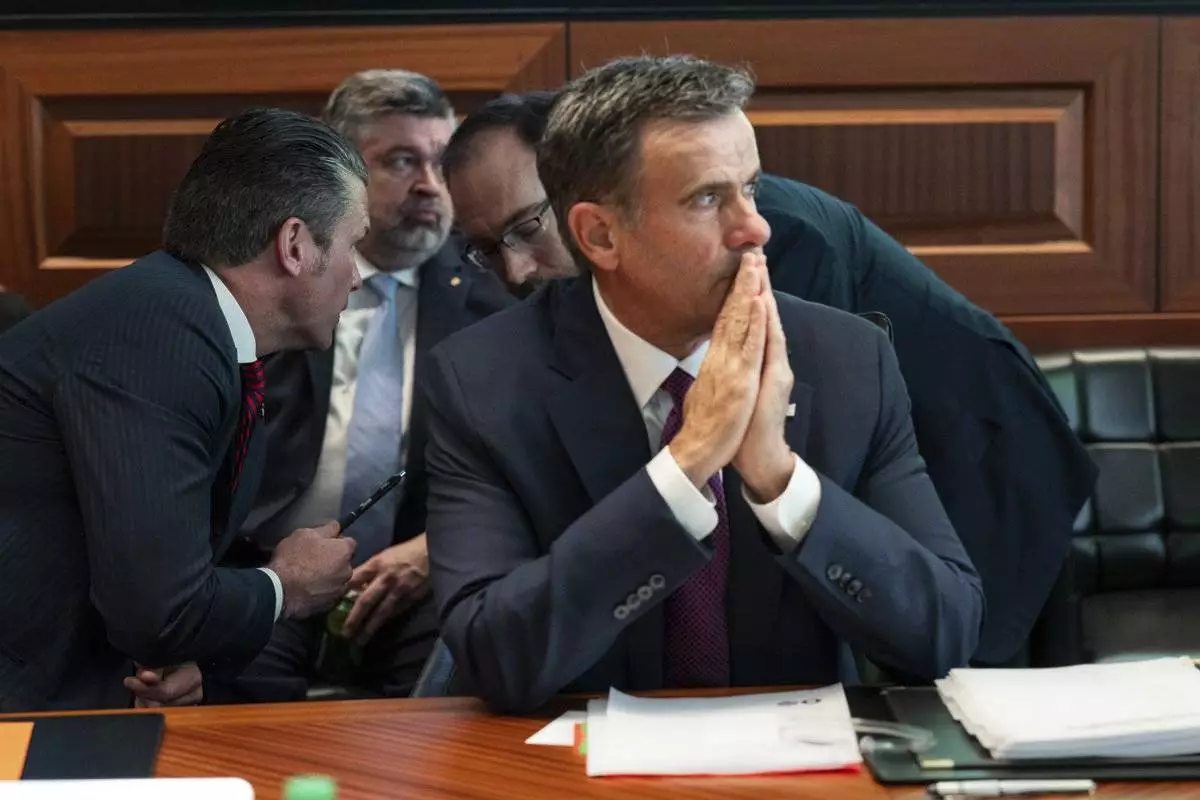
The separate briefings for the House and Senate were to be led by CIA Director John Ratcliffe and Director of National Intelligence Tulsi Gabbard, along with Gen. Dan Caine, chairman of the Joint Chiefs of Staff, and deputy secretaries of state Christopher Landau and Steve Feinberg.

Democrats in Congress, along with some Republicans, have many questions about Trump’s unilateral decision to launch military action, arguing he should have gone to Congress for approval — or at least provided more justification for the attacks. Congress has not received any new intelligence since Gabbard told lawmakers in March that the U.S. believed Iran was not building a new nuclear weapon, according to two people familiar with the intelligence. The people insisted on anonymity to share what Congress has been told.

Senate Democratic Leader Chuck Schumer said it is “outrageous” that the administration postponed the briefings.

“There is a legal obligation for the administration to inform Congress about precisely what is happening,” Schumer said. “What are they afraid of? Why won’t they engage Congress in the critical details?”

California Rep. Pete Aguilar, chair of the House Democratic caucus, said that lawmakers "need evidence, we need details and we need to know them now.”

House Majority Leader Steve Scalise, R-La., defended the administration's handling of the information, saying the briefings were postponed because “the situation is still developing" amid the recent ceasefire announcement.

Many lawmakers feel they have been left in the dark on what led to the strikes and amid escalating tensions between the White House and Congress over the role of the United States internationally — disagreements that don’t always fall along party lines.

Democrats have been generally suspicious of the Republican president’s strategy, and his motives abroad, but some believe the U.S. could have a role in supporting Israel against Iran. Others strongly believe the U.S. should stay out of it.

Some of Trump’s strongest Republican supporters agree with the Democrats who oppose intervention, echoing the president's years of arguments against “forever wars.” But most Republicans enthusiastically backed the strikes, saying Trump should have the power to act on his own.

Speaker Johnson said Tuesday that the strikes on Iran’s nuclear facilities were "clearly” within Trump’s powers and went as far as to question the constitutionality of the War Powers Act, which is intended to give Congress a say in military action.

“The bottom line is the commander in chief is the president, the military reports to the president, and the person empowered to act on the nation’s behalf is the president,” Johnson told reporters.

After Trump first announced a ceasefire between the two countries on Monday, Republicans immediately praised him. Sen. Bernie Moreno, R-Ohio, suggested in a post on X that Trump should be nominated for the Nobel Peace Prize. Sen. Katie Britt, R-Ala., posted: “Historic! The President of Peace!”

But Democrats said they wanted more information. After Iran’s retaliation on the U.S. base in Qatar earlier in the day on Monday, Schumer said he wanted an additional classified briefing “laying out the full threat picture, the intelligence behind Iran’s retaliation, and the details, scope, and timeline of any U.S. response.”

Senate Democrats are also forcing a vote as soon as this week on a resolution by Sen. Tim Kaine, D-Va., requiring congressional approval for specific military action in Iran.

“You have a debate like this so that the entire American public, whose sons and daughters are in the military and whose lives will be at risk in war, get to see the debate and reach their own conclusion together with the elected officials about whether the mission is worth it or not,” Kaine said.

While he did not seek approval, Trump sent congressional leaders a short letter Monday serving as his official notice of the strikes, two days after the bombs fell.

The letter said that the strike was taken “to advance vital United States national interests, and in collective self defense of our ally, Israel, by eliminating Iran's nuclear program.”

While previous presidents have deployed armed forces without permission from Congress, Democratic Leader Hakeem Jeffries said that those administrations explained “the imminent threat that justified their action.”

“We’ve asked that question,” Jeffries said. “We have no answers from the Trump administration.”

Associated Press writers Lisa Mascaro, Leah Askarinam, Matt Brown and Joey Cappelletti contributed to this report.
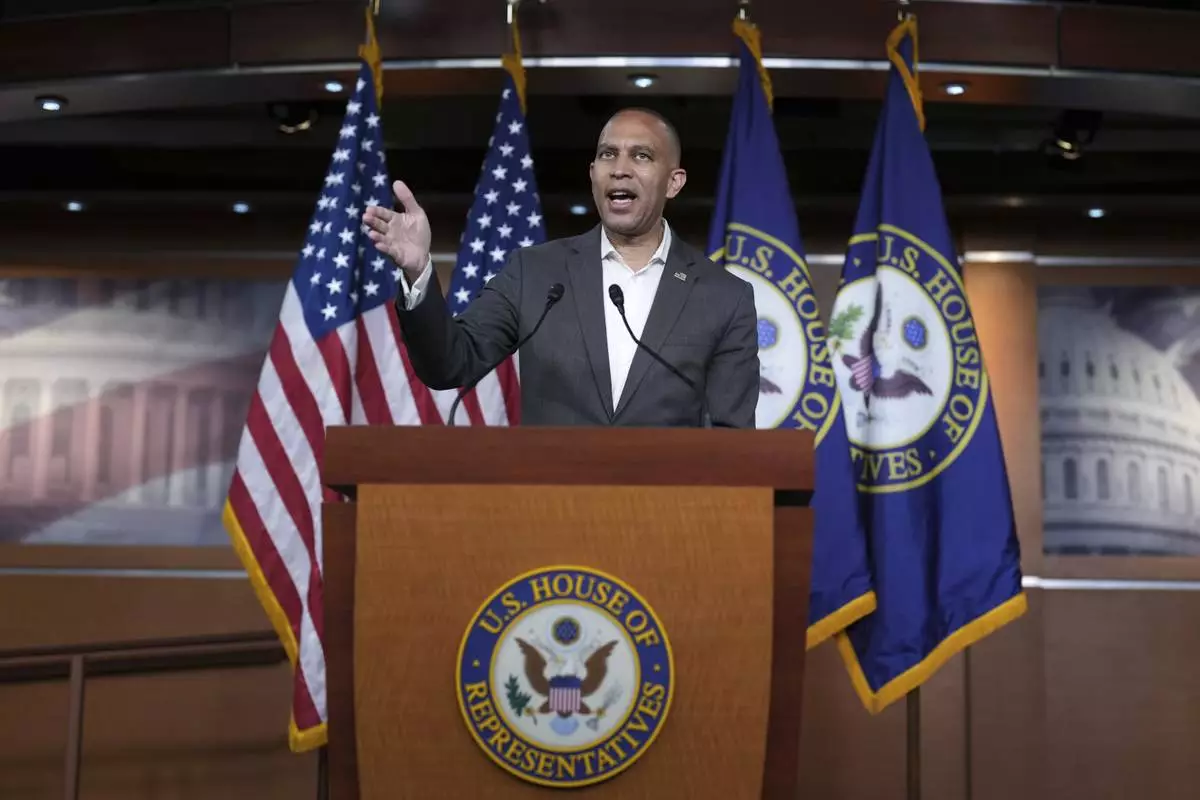
House Minority Leader Hakeem Jeffries, D-N.Y., speaks to reporters about the U.S. bombinb of three sites in Iran, at the Capitol in Washington, Monday, June 23, 2025. (AP Photo/J. Scott Applewhite)
House Minority Leader Hakeem Jeffries, D-N.Y., speaks to reporters about the U.S. bombinb of three sites in Iran, at the Capitol in Washington, Monday, June 23, 2025. (AP Photo/J. Scott Applewhite)

This image released by the White House and digitally altered to diffuse papers by the source for national security reasons, shows CIA Director John Ratcliffe, in foreground seated, as Defense Secretary Pete Hegseth, left, speaks with national security adviser Andy Baker with White House counsel David Warrington seated in background in the Situation Room, Saturday, June 21, 2025, at the White House in Washington. (The White House via AP)

This image released by the White House and digitally altered to diffuse papers by the source for national security reasons, shows CIA Director John Ratcliffe, in foreground seated, as Defense Secretary Pete Hegseth, left, speaks with national security adviser Andy Baker with White House counsel David Warrington seated in background in the Situation Room, Saturday, June 21, 2025, at the White House in Washington. (The White House via AP)

Joint Chiefs Chairman Gen. Dan Caine speaks during a news conference at the Pentagon in Washington, Sunday, June 22, 2025, after the U.S. military struck three sites in Iran, directly joining Israel's effort to destroy the country's nuclear program. (AP Photo/Alex Brandon)

Joint Chiefs Chairman Gen. Dan Caine speaks during a news conference at the Pentagon in Washington, Sunday, June 22, 2025, after the U.S. military struck three sites in Iran, directly joining Israel's effort to destroy the country's nuclear program. (AP Photo/Alex Brandon)

WASHINGTON (AP) — Becky Pepper-Jackson finished third in the discus throw in West Virginia last year though she was in just her first year of high school. Now a 15-year-old sophomore, Pepper-Jackson is aware that her upcoming season could be her last.

West Virginia has banned transgender girls like Pepper-Jackson from competing in girls and women's sports, and is among the more than two dozen states with similar laws. Though the West Virginia law has been blocked by lower courts, the outcome could be different at the conservative-dominated Supreme Court, which has allowed multiple restrictions on transgender people to be enforced in the past year.

The justices are hearing arguments Tuesday in two cases over whether the sports bans violate the Constitution or the landmark federal law known as Title IX that prohibits sex discrimination in education. The second case comes from Idaho, where college student Lindsay Hecox challenged that state's law.

Decisions are expected by early summer.

President Donald Trump's Republican administration has targeted transgender Americans from the first day of his second term, including ousting transgender people from the military and declaring that gender is immutable and determined at birth.

Pepper-Jackson has become the face of the nationwide battle over the participation of transgender girls in athletics that has played out at both the state and federal levels as Republicans have leveraged the issue as a fight for athletic fairness for women and girls.

“I think it’s something that needs to be done,” Pepper-Jackson said in an interview with The Associated Press that was conducted over Zoom. “It’s something I’m here to do because ... this is important to me. I know it’s important to other people. So, like, I’m here for it.”

She sat alongside her mother, Heather Jackson, on a sofa in their home just outside Bridgeport, a rural West Virginia community about 40 miles southwest of Morgantown, to talk about a legal fight that began when she was a middle schooler who finished near the back of the pack in cross-country races.

Pepper-Jackson has grown into a competitive discus and shot put thrower. In addition to the bronze medal in the discus, she finished eighth among shot putters.

She attributes her success to hard work, practicing at school and in her backyard, and lifting weights. Pepper-Jackson has been taking puberty-blocking medication and has publicly identified as a girl since she was in the third grade, though the Supreme Court's decision in June upholding state bans on gender-affirming medical treatment for minors has forced her to go out of state for care.

Her very improvement as an athlete has been cited as a reason she should not be allowed to compete against girls.

“There are immutable physical and biological characteristic differences between men and women that make men bigger, stronger, and faster than women. And if we allow biological males to play sports against biological females, those differences will erode the ability and the places for women in these sports which we have fought so hard for over the last 50 years,” West Virginia's attorney general, JB McCuskey, said in an AP interview. McCuskey said he is not aware of any other transgender athlete in the state who has competed or is trying to compete in girls or women’s sports.

Despite the small numbers of transgender athletes, the issue has taken on outsize importance. The NCAA and the U.S. Olympic and Paralympic Committees banned transgender women from women's sports after Trump signed an executive order aimed at barring their participation.

The public generally is supportive of the limits. An Associated Press-NORC Center for Public Affairs Research poll conducted in October 2025 found that about 6 in 10 U.S. adults “strongly” or “somewhat” favored requiring transgender children and teenagers to only compete on sports teams that match the sex they were assigned at birth, not the gender they identify with, while about 2 in 10 were “strongly” or “somewhat” opposed and about one-quarter did not have an opinion.

About 2.1 million adults, or 0.8%, and 724,000 people age 13 to 17, or 3.3%, identify as transgender in the U.S., according to the Williams Institute at the UCLA School of Law.

Those allied with the administration on the issue paint it in broader terms than just sports, pointing to state laws, Trump administration policies and court rulings against transgender people.

"I think there are cultural, political, legal headwinds all supporting this notion that it’s just a lie that a man can be a woman," said John Bursch, a lawyer with the conservative Christian law firm Alliance Defending Freedom that has led the legal campaign against transgender people. “And if we want a society that respects women and girls, then we need to come to terms with that truth. And the sooner that we do that, the better it will be for women everywhere, whether that be in high school sports teams, high school locker rooms and showers, abused women’s shelters, women’s prisons.”

But Heather Jackson offered different terms to describe the effort to keep her daughter off West Virginia's playing fields.

“Hatred. It’s nothing but hatred,” she said. "This community is the community du jour. We have a long history of isolating marginalized parts of the community.”

Pepper-Jackson has seen some of the uglier side of the debate on display, including when a competitor wore a T-shirt at the championship meet that said, “Men Don't Belong in Women's Sports.”

“I wish these people would educate themselves. Just so they would know that I’m just there to have a good time. That’s it. But it just, it hurts sometimes, like, it gets to me sometimes, but I try to brush it off,” she said.

One schoolmate, identified as A.C. in court papers, said Pepper-Jackson has herself used graphic language in sexually bullying her teammates.

Asked whether she said any of what is alleged, Pepper-Jackson said, “I did not. And the school ruled that there was no evidence to prove that it was true.”

The legal fight will turn on whether the Constitution's equal protection clause or the Title IX anti-discrimination law protects transgender people.

The court ruled in 2020 that workplace discrimination against transgender people is sex discrimination, but refused to extend the logic of that decision to the case over health care for transgender minors.

The court has been deluged by dueling legal briefs from Republican- and Democratic-led states, members of Congress, athletes, doctors, scientists and scholars.

The outcome also could influence separate legal efforts seeking to bar transgender athletes in states that have continued to allow them to compete.

If Pepper-Jackson is forced to stop competing, she said she will still be able to lift weights and continue playing trumpet in the school concert and jazz bands.

“It will hurt a lot, and I know it will, but that’s what I’ll have to do,” she said.

Heather Jackson, left, and Becky Pepper-Jackson pose for a photograph outside of the U.S. Supreme Court in Washington, Sunday, Jan. 11, 2026. (AP Photo/Jose Luis Magana)

Heather Jackson, left, and Becky Pepper-Jackson pose for a photograph outside of the U.S. Supreme Court in Washington, Sunday, Jan. 11, 2026. (AP Photo/Jose Luis Magana)

Heather Jackson, left, and Becky Pepper-Jackson pose for a photograph outside of the U.S. Supreme Court in Washington, Sunday, Jan. 11, 2026. (AP Photo/Jose Luis Magana)

Heather Jackson, left, and Becky Pepper-Jackson pose for a photograph outside of the U.S. Supreme Court in Washington, Sunday, Jan. 11, 2026. (AP Photo/Jose Luis Magana)

Becky Pepper-Jackson poses for a photograph outside of the U.S. Supreme Court in Washington, Sunday, Jan. 11, 2026. (AP Photo/Jose Luis Magana)

Becky Pepper-Jackson poses for a photograph outside of the U.S. Supreme Court in Washington, Sunday, Jan. 11, 2026. (AP Photo/Jose Luis Magana)

The Supreme Court stands is Washington, Friday, Jan. 9, 2026. (AP Photo/J. Scott Applewhite)

The Supreme Court stands is Washington, Friday, Jan. 9, 2026. (AP Photo/J. Scott Applewhite)

FILE - Protestors hold signs during a rally at the state capitol in Charleston, W.Va., on March 9, 2023. (AP Photo/Chris Jackson, file)

FILE - Protestors hold signs during a rally at the state capitol in Charleston, W.Va., on March 9, 2023. (AP Photo/Chris Jackson, file)

Recommended Articles