The city of Shenzhen in south China's Guangdong Province is fast becoming the world's most dynamic hub for humanoid robotics.
Home to over 74,000 robotics firms and more than 140,000 AI professionals, Shenzhen is not only powering the city's robotics boom through its thriving innovation ecosystem but also transforming the way robots are developed from sensor-packed feet to ultra-sensitive skin.
One of the front-runners is UBtech, a leading robotics innovator headquartered in the city. Back in 2022, its humanoid robots were only capable of walking, writing calligraphy, and practicing tai chi. Today, they are deployed in dozens of smart factories, including those run by Geely, BYD, and Foxconn, handling repetitive tasks once done by humans.
This year, UBtech plans to roll out 1,000 humanoid robots across factory floors.
"Over the past 15 months, our industrial humanoid robots have progressed through three generations, with each iteration faster than the previous," said Michael Tam, chief brand officer of UBtech.
This rapid development cycle, known locally as "Shenzhen Speed," is driven by deep research and development capacity and an unparalleled supply chain.
In Nanshan District alone, dubbed Shenzhen's "Robot Valley," over 30 robotics companies operate along a 10-kilometer stretch of Liuxian Avenue.
"We can quickly find efficient solutions across the entire supply chain, all within one hour," Tam said.
Hardware innovation plays an equally critical role. At Sycsense Technology, robots are being equipped with precision sensors and LiDAR systems that enable them to handle fragile tasks, like picking strawberries without damage.
"Here, you can finalize a design by morning and get a sample by evening. This is 'Shenzhen Speed,'" said Sycsense CEO Xiong Gengchao.
The speed mentioned by Xiong is underpinned by Shenzhen's dense and mature electronics ecosystem. RoboSense, a major supplier of LiDAR technology, is located just 20 minutes away from hundreds of robotics firms it serves.
"Shenzhen's electronics ecosystem delivers twin advantages: suppliers next door slash production time by 50 percent, while daily collaboration with nearby innovators accelerates our R and D," said Xie Tiandi, marketing director of RoboSense.
The city's concentrated supply chains and R and D power have led to a surge in innovation. In 2024 alone, robotics patent filings and grants rose more than 35 percent from the previous year. The sector reached 201.2 billion yuan (about 28 billion U.S. dollars), up 12.6 percent year on year.
Shenzhen's robotics rise is the result of over a decade of investment from government funding to talent cultivation, all of which aimed at building a globally competitive, full-stack innovation ecosystem.
Today, Shenzhen produces one-third of the world's LiDAR systems. And thanks to the seamless pipeline from lab to factory, the city is sending the country's humanoid robots onto the global stage at a pace no one can match.

Shenzhen home to 74,000 robotics firms
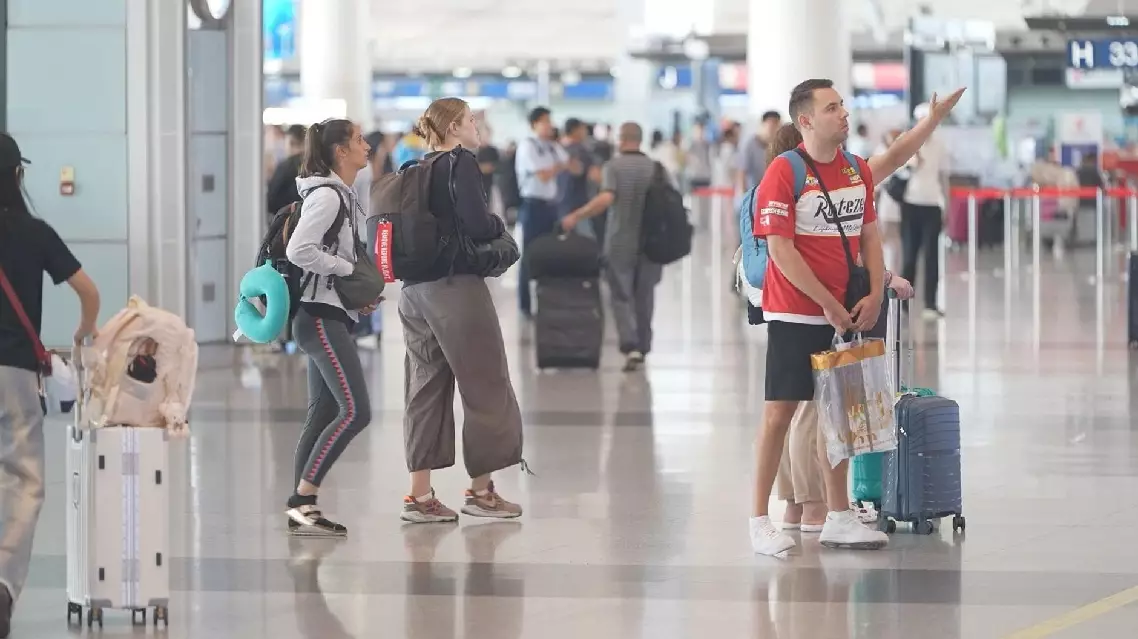
Inbound travel to China has kept growing since the start of this year, as the country's adoption of travel facilitation measures, including expanded visa-free access, has made border entry easier for international visitors.
Foreign nationals made nearly 61.29 million border crossings in the January-August period, up 19.5 percent from a year earlier, according to the latest official data released Thursday. Visa-free entries accounted for 23.72 million of the total, or 77.6 percent, up 26.8 percent from a year earlier.
In Beijing, various ports in Beijing have seen an average of 15,000 border entries by foreigners each day since the start of September, up 20 percent from August's daily average. Notably, the figure topped 17,000 on Sept 7, setting a new single-day record for the year.
During the three-day Mid-Autumn Festival which starts on Friday and the week-long National Day holiday season starting on Oct 1, the number of border entries and exits through Beijing's airports is projected to reach 727,000. The Beijing Capital International Airport is expected to handle 547,000 entries and exits, or 54,700 per day on the average, while the Beijing Daxing International Airport is expected to handle 180,000, or 18,000 per day on the average.
To ensure smooth customs clearance, the Beijing General Border Inspection Station will open additional inspection lanes during peak periods to reduce travelers' waiting time. It will also maintain permanent multilingual advisory and guidance stations staffed by on-site officers, thereby improving passenger clearance efficiency.
East China's Shandong Province, one of the Chinese provinces closest to South Korea, is expected to see more than 190,000 border entries and exits by travelers, averaging over 8,000 per day, according to the Shandong General Border Inspection Station. Notably, the Weihai Shidao Port is expected to receive more than 3,000 tourist arrivals from South Korea, a marked increase in inbound group travel compared with previous years.
"I'm very interested in Chinese traditions, so I've chosen to visit Rongcheng in Weihai during the Mid-Autumn Festival to experience the holiday here firsthand," said Kim Kyung-nam, a tourist from South Korea.
In response to the overlapping passenger flows and the concentrated arrival of large tour groups during the Mid-Autumn Festival holiday, the Shidao Border Inspection Station has worked out a specific duty plan including strategic deployment of personnel and the opening of all inspection lanes to minimize clearance times and maximize operational efficiency.
"We have set up border inspection and cultural tourism facilitation service posts, where on-duty officers will provide bilingual service for consultation and process entry formalities for tour groups, balancing efficient customs clearance with a human touch," said Li Nannan, head of a frontier inspection team at the Shidao Border Inspection Station.
East China's Jiangsu Province, with its rich cultural heritage and diverse cultural and tourism resources, attracts tourists from around the world. The Jiangsu General Border Inspection Station predicts that the ports across the province will process 110,000 border entries and exits and handle over 750 inbound and outbound flights and vessel voyages during the two holiday seasons. For outbound travel, Singapore, Thailand and other countries have emerged as popular destinations for mainland residents departing from Jiangsu's ports.
Tourist cities in south China's Guangxi Zhuang Autonomous Region are top choices for Vietnamese tourists. Thanks to its advantageous geographic location, efficient customs clearance services, and abundant border tourism resources, cross-border tourism between Guangxi and Vietnam is steadily gaining popularity.
According to the Guangxi General Border Inspection Station, the total number of border entries and exits through the four key ports -- Nanning, Guilin, Youyiguan, and Dongxing -- is expected to exceed 355,800 during this year's Mid-Autumn Festival and National Day holiday season.
The Mid-Autumn Festival, a traditional Chinese holiday, is celebrated on the 15th day of the eighth month of the Chinese lunar calendar. This year, the festival falls on Friday, and the public holiday lasts three days through Sunday.
China's National Day holiday lasts from Oct 1 to 7 this year.
Inbound travel to China continues to surge as visitors seek diverse experiences