Chinese Foreign Minister Wang Yi, also a member of the Political Bureau of the Communist Party of China (CPC) Central Committee and director of the Office of the Central Commission for Foreign Affairs, met with Graham Allison, a professor at Harvard University, in Beijing on Wednesday.
Wang said that the principles of mutual respect, peaceful coexistence and win-win cooperation proposed by Chinese President Xi Jinping provide essential guidance for China in handling affairs with the United States. He expressed the hope that the U.S. side will work with China to address the fundamental issue of mutual perceptions, set the tone for the China-U.S. relationship, and to find the right way to coexist under the guidance of the three principles.
"We hope that people of insight across U.S. society would play an active role in fostering an objective and positive perception of China and promoting proper interaction between the two countries," Wang added.
Allison said that the concept of harmony without uniformity shares common ground with the U.S. value of respecting diversity, and both sides should find a strategic positioning for coexistence to avoid falling into Thucydides Trap.
The United States and China should establish a new principled framework for the future development of bilateral relations, with mutual respect as the first principle, Allison said, expressing his willingness to continue contributing to advancing communication and exchanges between the two sides and promoting the stable development of bilateral relations.
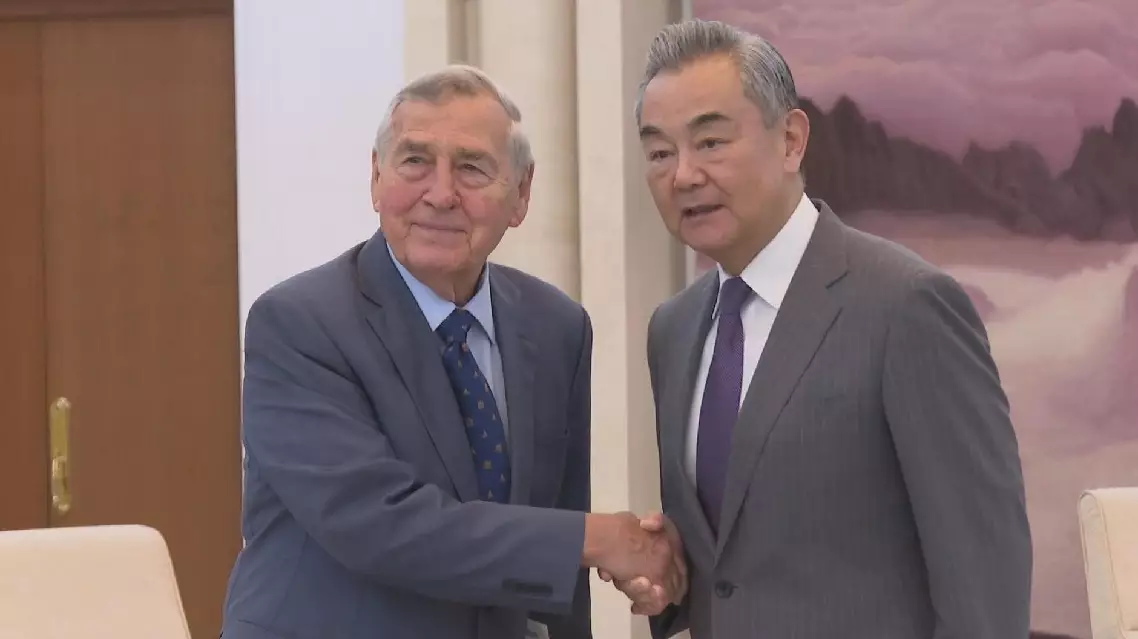
Chinese Foreign Minister meets Harvard professor Graham Allison
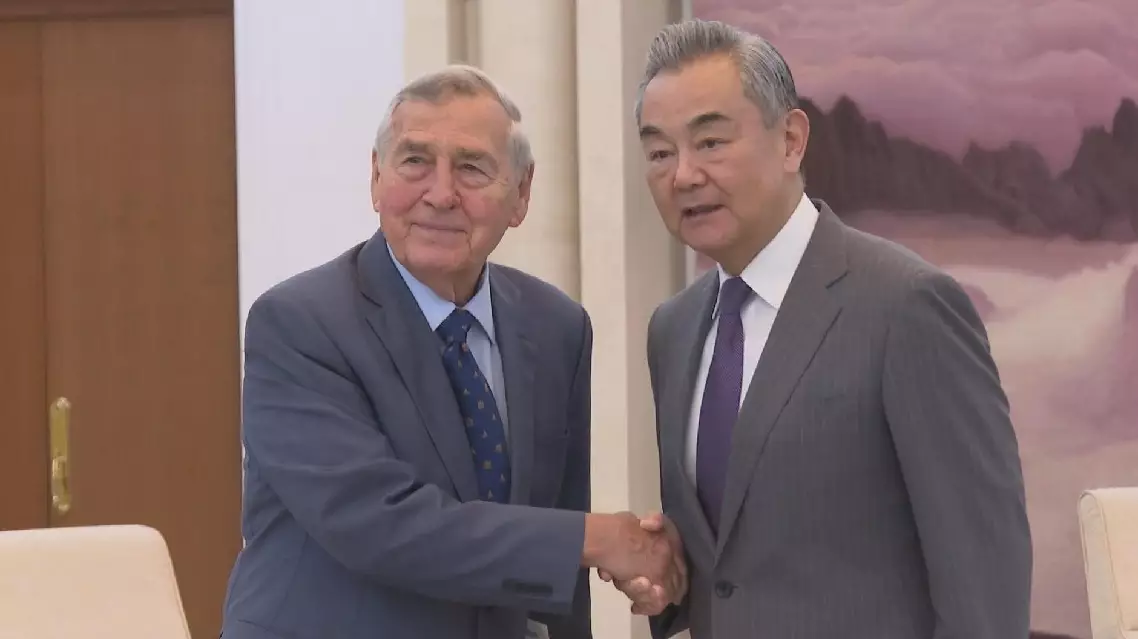
Chinese Foreign Minister meets Harvard professor Graham Allison
Iranian Parliament Speaker Mohammad Baqer Qalibaf warned on Sunday that Tehran would view the United States and Israel's military bases and facilities in the Middle East as "legitimate targets" should Washington take military action against Iran.
At a parliamentary session convened to review an emergency proposal on assembly regulations, Qalibaf emphasized that, at this highly sensitive juncture, Iran must accurately and thoroughly identify the schemes of its adversaries.
Qalibaf said that Iran is currently confronting Israel and the United States simultaneously on four fronts: economic, cognitive, military, and counterterrorism. Of them, the economic warfare and the cognitive and psychological warfare began many years ago and have persisted to this day, growing increasingly complex and intense in recent years.
The remarks came as U.S. President Donald Trump is reportedly "seriously considering authorizing a strike" against Iran, taking advantage of its nationwide unrest.
Protests have erupted in several Iranian cities since late December over the sharp fall of the rial and long-standing economic hardship. Iranian authorities have acknowledged the demonstrations and voiced willingness to address economic grievances, while warning against violence and vandalism.
Amid the ongoing protests, deadly clashes have been reported lately between police and what the government described as "rioters." However, no official death toll has been released.
Also on Sunday, Iran's semi-official Tasnim news agency reported that Iranian President Masoud Pezeshkian will address the country's economic situation and political environment in a televised interview later that day.

Iran swears to counterattack if attacked