INDIANAPOLIS (AP) — The NCAA is considering a proposal that would allow athletes and staff members to bet on professional sports and shift enforcement efforts to college sports betting and “behaviors that directly impact game integrity.”
The Division I Council introduced the proposal that will be considered this fall and be implemented if Divisions II and III officials also approve.
The NCAA would still bar betting on college sports and sharing information about college events with bettors. Advertising and sponsorships associated with betting are also not allowed at NCAA championship events.
The shift comes as the organization grapples with the growth of legalized gambling across the United States. NCAA President Charlie Baker and other college sports leaders have raised concerns about gamblers attacking athletes on social media for their play and there have been scattered allegations, including some earlier this year, against programs involving betting.
The NCAA said Wednesday that “several sports betting-related violations by staff members at NCAA schools” have been resolved in recent years and noted its enforcement staff is working on issuing notices of allegations in several ongoing gambling cases.
Still, the NCAA has acknowledged the challenges in barring adult athletes at hundreds of schools from gambling on pro sports. Two years ago, it made reinstatement policies more lenient and the NCAA has a multi-year partnership with Genius Sports, which distributes official NCAA data to licensed sportsbooks, an arrangement that bars negative prop bets.
“NCAA rules prohibiting sports betting at all levels were written and adopted at a time when sports gambling was largely illegal nationwide,” said Josh Whitman, athletics director at Illinois and council chairman. “As betting on sports has become more widely accepted across the country, Division I members have determined that further discussion of these sports betting rules is warranted, particularly as it relates to the potential distinctions between betting on professional vs. collegiate sports.”
Current NCAA rules do not allow athletes or institutional staff to engage in sports betting for any sports that have NCAA championships; bets by an athlete on their own team or own sport risks a lifetime ban from college athletics.
“The enforcement staff’s sports betting-related caseload has significantly increased in recent years, and our staff — including our new sports betting integrity unit — has been effective in detecting and pursuing violations,” said Jon Duncan, NCAA vice president of enforcement.
Dr. Deena Casiero, the NCAA's chief medical officer, said allowing pro sports betting may be more effective and realistic than an “abstinence-only” approach, clearing the way for education and better understanding of the risks.
“By meeting student-athletes where they are, schools may be more effective at preventing, identifying and supporting student-athletes with problematic gambling behaviors," Casiero said.
In other NCAA moves, the Division I Board of Directors this week formally adopted roster limits for NCAA sports as part of the $2.8 billion House settlement that also allows revenue-sharing and schools to award as many scholarships as they wish within the roster caps.
Also this week, the Division I Council:
— Endorsed a recommended cap of 32 regular-season games in both men’s and women’s basketball beginning with the 2026-27 season. Critics include early-season tournament organizers who say the change could result in fewer marquee matchups.
— Introduced a proposal to add women’s flag football to the emerging sports for women program. Flag football has grown rapidly in popularity and will make its Olympic debut at the 2028 Games in Los Angeles.
— Adopted scheduling flexibility changes allowing Football Championship Subdivision programs to compete in 12 regular-season games every year, starting in 2026.
— Voted to introduce proposals that, if also supported by Divisions II and III, would establish NCAA championships for women’s stunt and women’s acrobatics and tumbling as early as spring 2027. The sports have grown in popularity.
— Voted to separate the scoring at the fencing championships to recognize winning teams in both men’s and women’s fencing. Currently, women’s-only teams are statistically unable to win the national championship under the existing scoring format. The change also needs backing by Divisions II and III.
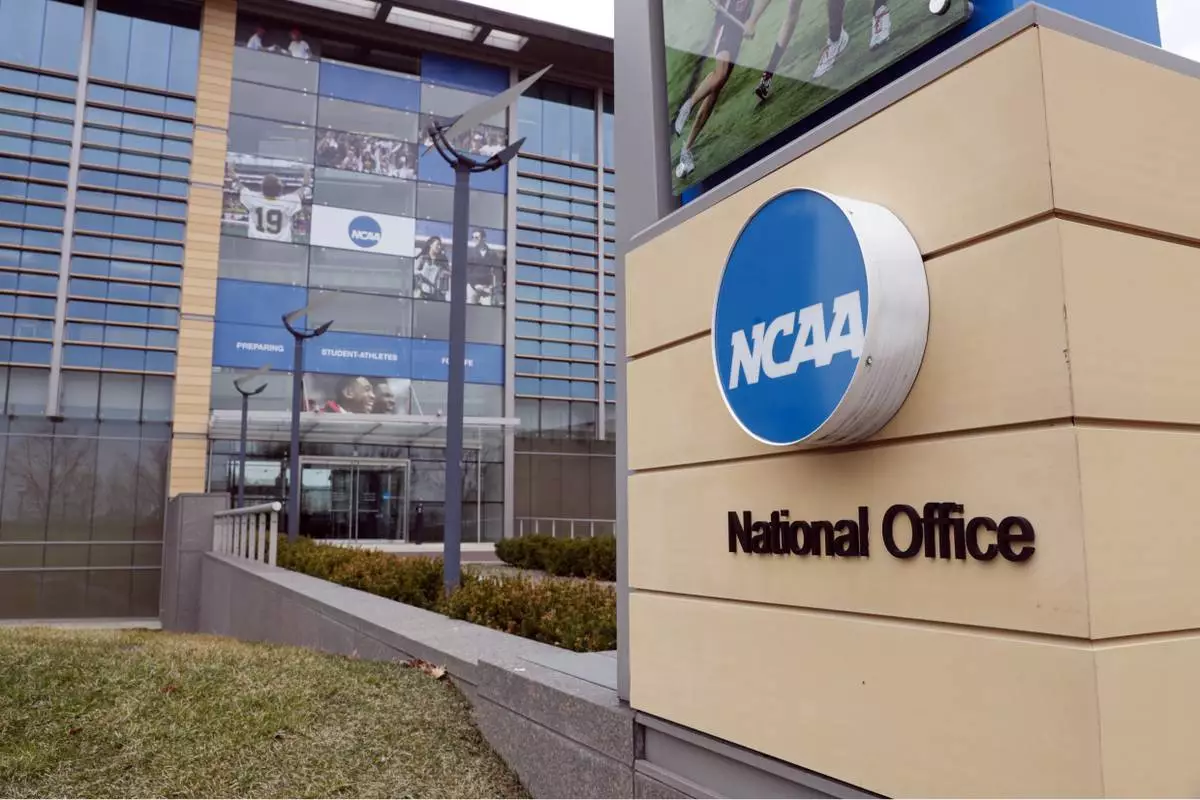
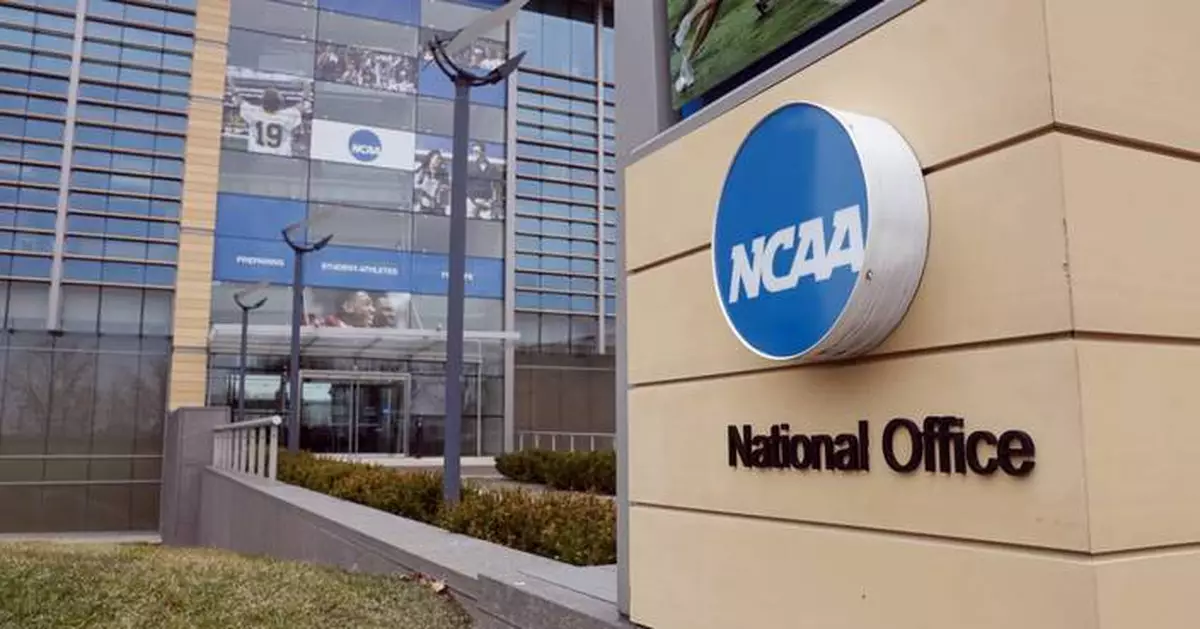
FILE - The national office of the NCAA in Indianapolis is shown on March 12, 2020. (AP Photo/Michael Conroy, File)
SAN FRANCISCO (AP) — Wildlife crews are no longer actively searching for two juvenile gray wolves who were part of a pack that killed dozens of cows and calves last summer in Northern California’s Sierra Valley, an official said Tuesday.
The two wolves were members of the Beyem Seyo pack that in 2025 killed or injured at least 92 calves and cows in a seven-month period, according to a report released last week by two researchers with the University of California, Davis.
Wolves in the state are protected under California law and the federal Endangered Species Act. Under former President Joe Biden, officials said they planned a first-ever national recovery plan for wolves, but President Donald Trump’s administration ended that initiative in November.
In October, the California Department of Fish and Wildlife announced it had euthanized four gray wolves — three adults and a juvenile — from the Beyem Seyo pack after “an unprecedented level of livestock attacks across the Sierra Valley” by a single wolf pack since the canids returned to the state. It also said it planned to capture and relocate the remaining two wolves to wildlife facilities to prevent their behavior from spreading to other wolves in California.
Gray wolves primarily prey on wild animals like deer and elk, not livestock, but the pack became used to killing cows and calves, the department said.
“These wolves had become habituated to preying on cattle, a feeding pattern that persisted and was being taught to their offspring which would leave to form their own packs and could teach them the same cattle-preying behavior,” the department said at the time.
But following weeks of searching for the remaining two wolves, officials have “reduced efforts to capture” them, Katie Talbot, CDFW Deputy Director of Public Affairs, said in a statement.
“Despite best efforts from CDFW’s expert wolf biologists and law enforcement officers, we have not been able to find or get close enough to these young wolves to safely capture them,” Talbot said.
“We remain hopeful our continued remote monitoring will allow for sightings that will lead to safe capture of these juveniles," she added.
Talbot said that CDFW crews will be working this week on capturing wolves and collaring them throughout the state, including in the Sierra Valley.
Wildlife officials tried for months to prevent the pack from attacking farm animals by using drones, nonlethal bean bags, installing flags or rope to deter them and having officers in the field 24 hours a day, seven days a week, but their efforts failed.
“The efforts that the (CDFW) made were tremendous and heroic but it was too late.” said Amaroq Weiss, senior wolf advocate for the Center for Biological Diversity.
She said that cattle ranchers in the area should have been taking proactive prevention measures for years, including increased human presence around the cattle, keeping the livestock bunched up instead of letting them loose on large grazing pastures, and calving at the same time of year that deer and elk are birthing so wolves have a source of wild prey.
“Ranchers in California have been on notice that wolves were coming since late December 2011, when we got our first wolf. They have been on notice they would establish packs since 2015,” when the first pack was confirmed in Siskiyou County, Weiss said.
Gray wolves were eradicated in California early in the last century because of their perceived threat to livestock, with the last known native wolf killed in 1924 in Lassen County. Since their reintroduction in Idaho and at Yellowstone National Park in the mid-1990s, they’ve proliferated throughout the West. The recovering population has meant increasing conflict with ranchers.
“It was a horrible summer here for everybody and the emotional strain was probably worse than the financial strain for most people. They did the right thing. We couldn’t go on living the way we were living,” said Rick Roberti, a cattle rancher in Plumas County and president of the California Cattlemen’s Association, who lost several animals.
Economist Tina Saitone and researcher Tracy Schohr said in UC Davis’ quarterly agricultural economics update released Friday that the Beyem Seyo pack killed more livestock than the entire wolf population of Montana killed in 2024 and the killings of farm animals by the wolves in Wyoming in 2023.
In Montana, the state’s 1,100 wolves killed 54 domestic animals in 2024, and Wyoming’s 352 wolves killed 49 livestock in 2023, the scientists said.
In California, about 70 gray wolves were responsible for 175 livestock kills between January and October of last year, with the Beyem Seyo pack responsible for half of the killings, according to CDFW data.
Roberti said the attacks on livestock in Plumas and Sierra counties left many ranchers angry. He said he would like to see certain areas in the state declared “special zones” where people are allowed to hunt wolves that attack livestock.
“We’re pretty much in unison about thinking that it would help if we started taking out the ones that are just killing cattle and are too habituated to man or they’re not afraid of us,” he said.
The predators are a long way from recovery, Weiss said, adding that killing them is not a long-term solution.
“The scientific literature is pretty conclusory that killing wolves to resolve conflicts with livestock is not a solution. It can actually be counterproductive. It can result in there being more conflicts with livestock," she said.
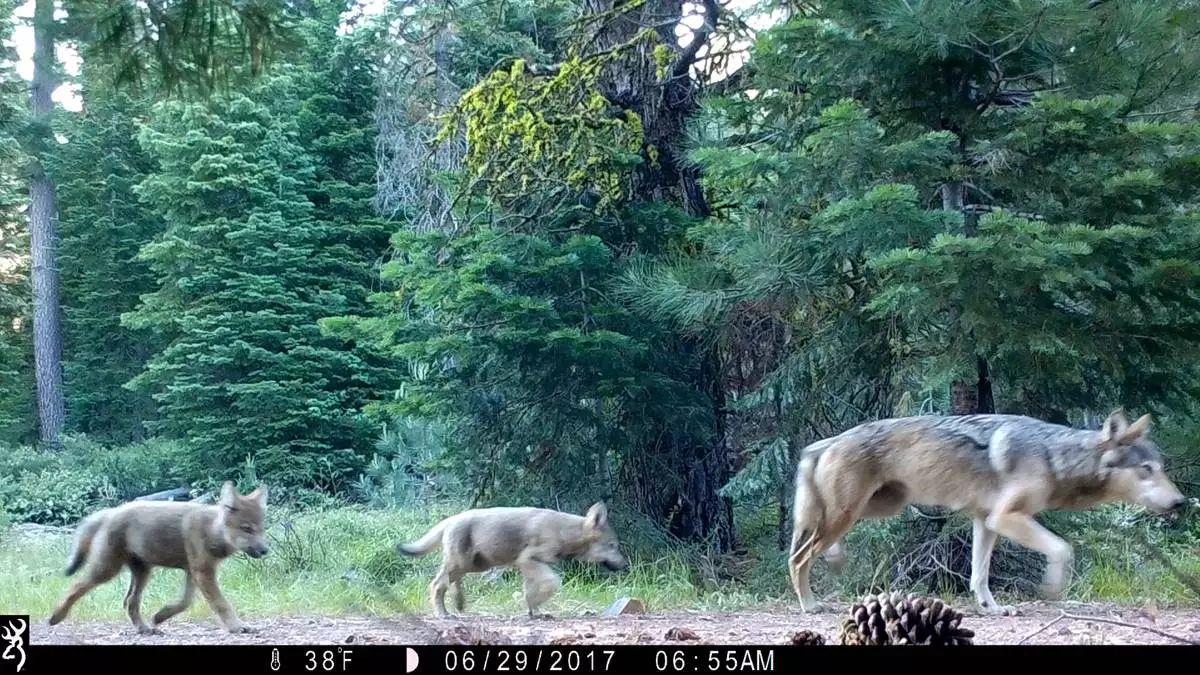
FILE - This remote camera image provided by the U.S. Forest Service shows a female gray wolf and two of the three pups born in 2017 in the wilds of Lassen National Forest in northern California on June 29, 2017. (U.S. Forest Service via AP, File)