WASHINGTON (AP) — The U.S. Supreme Court's decision Friday limiting federal judges from issuing nationwide injunctions threatens to upend numerous lawsuits that have led to orders blocking Trump administration policies.
Between the start of the new administration and mid-May, judges issued roughly 40 nationwide injunctions against the White House on topics including federal funding, elections rules and diversity and equity considerations. Attorneys involved in some of those cases are vowing to keep fighting, noting the high court left open other legal paths that could have broad nationwide effect.
Here's a look at some of the decisions that could be impacted:
Multiple federal judges have issued nationwide injunctions blocking President Donald Trump's order denying citizenship to U.S.-born children of people who are in the country illegally or temporarily. The high court's decision Friday came in a lawsuit over that order, but the justices left unclear whether the restrictions on birthright citizenship could soon take effect in parts of the country.
Opponents went back to court within hours of the opinion, using a legal path the court left open to file class-action lawsuits that could have nationwide effect.
On June 13, U.S. District Judge Denise J. Casper in Massachusetts blocked Trump’s attempt to overhaul elections in the U.S. An executive order the Republican president issued in March sought to compel officials to require documentary proof of citizenship for everyone registering to vote for federal elections, accept only mailed ballots received by Election Day and condition federal election grant funding on states adhering to the new ballot deadline.
California was one of the plaintiffs in that suit. The office of the state's attorney general, Rob Bonta, said in an email it was assessing the effect of Friday's Supreme Court decision on all of the state's litigation.
A federal judge in California in April blocked the administration from cutting off funding for legal representation for unaccompanied migrant children. The administration has appealed.
U.S. District Judge Araceli Martinez-Olguin in San Francisco said there was “no practical way” to limit the scope of the injunction by party or by geography.
“Indeed, as discussed with the Government’s declarants at the preliminary injunction hearing, there exists only one contract for the provision of the subject funding, and it applies to direct legal services nationwide,” Martinez-Olguin wrote.
Plaintiffs’ attorney Adina Appelbaum, program director for the Amica Center for Immigrant Rights, said she didn't think the Supreme Court’s decision would significantly affect her case.
But she blasted it, saying the high court had “turned its back on its role to protect the people,” including immigrants.
A federal judge in February largely blocked sweeping executive orders that sought to end government support for programs promoting diversity, equity and inclusion.
U.S. District Judge Adam Abelson in Baltimore granted a preliminary injunction preventing the administration from terminating or changing federal contracts it considers equity-related.
An appeals court later put the decision on hold. Attorneys for the group Democracy Forward represented plaintiffs in the case.
The group's president and CEO, Skye Perryman, said she was disappointed by the Supreme Court’s ruling, calling it another barrier to seeking relief in court. But she also said it was limited and could keep at least some decisions blocking the Trump administration in place.
A federal judge in February stopped the administration from withholding federal funds from health care facilities that provide gender-affirming care to patients under the age of 19.
Explaining his reasoning for a nationwide injunction, U.S. District Judge Brendan Abell Hurson in Maryland said a “piecemeal approach is not appropriate in this case.”
“Significant confusion would result from preventing agencies from conditioning funding on certain medical institutions, while allowing conditional funding to persist as to other medical institutions,” he wrote.
An appeal in the case was on hold as the Supreme Court considered similar issues about minors and transgender health care. The high court last week upheld a Tennessee law banning key health care treatments for transgender youth.
Omar Gonzalez-Pagan, senior counsel for the Lambda Legal Defense and Education Fund Inc., was one of the attorneys who secured Hurson's ruling. He said the plaintiffs’ lawyers were still evaluating the possible impact of the Supreme Court’s decision, but he believed the high court recognized that “systematic, universal relief is sometimes appropriate.”
In May, a judge in Rhode Island blocked an executive order that sought to dismantle federal agencies supporting libraries, museums, minority businesses and parties in labor disputes.
The administration has appealed.
Rhode Island was a plaintiff in the lawsuit. The state's attorney general, Peter F. Neronha, said in a statement Friday he would "continue to pull every available legal lever to ensure that Americans, all Americans, are protected from the progressively dangerous whims of this President.”
Thanawala reported from Atlanta. Associated Press writers Alanna Durkin Richer, Lindsay Whitehurst, Christina Cassidy in Atlanta and Rebecca Boone in Boise, Idaho contributed to this report.

This artist sketch depicts Justice Elena Kagan, from left, Justice Brett Kavanaugh and Justice Ketanji Brown Jackson as the Justices announce opinions at the Supreme Court in Washington, Friday, June 27, 2025. (Dana Verkouteren via AP)
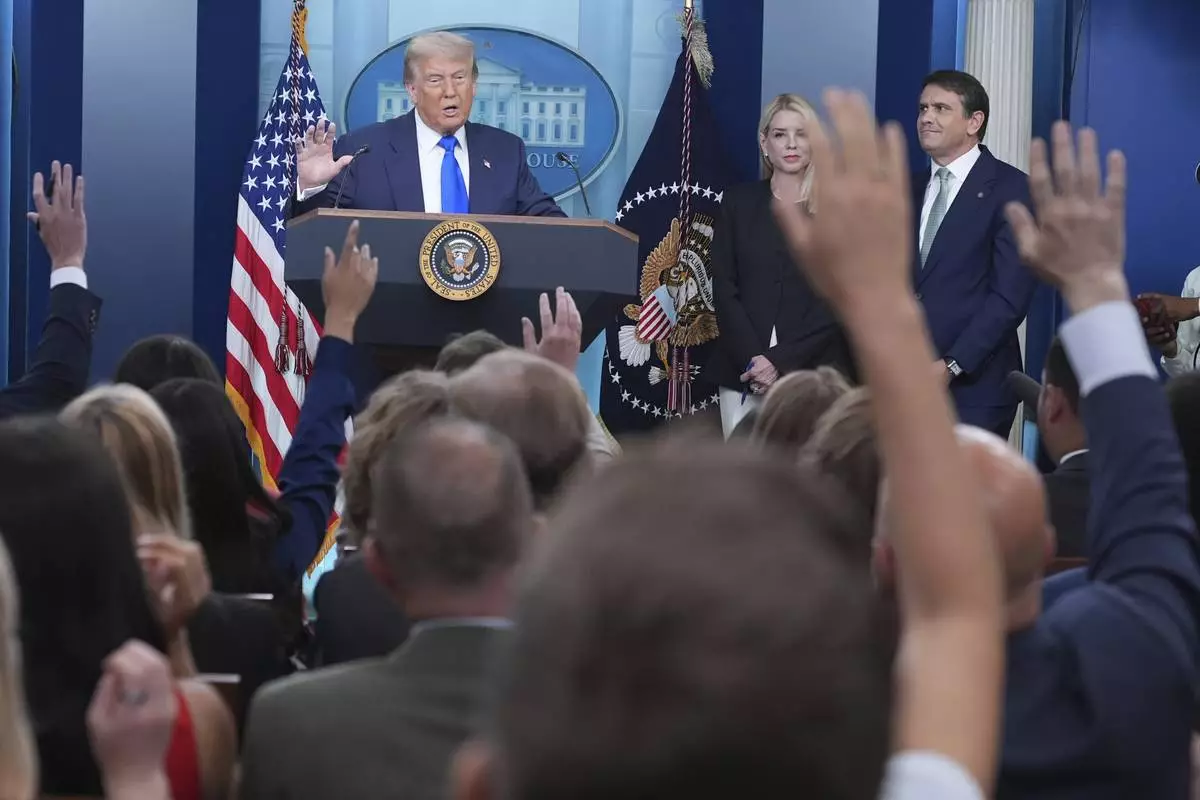
President Donald Trump, from left, speaks to the media as Attorney General Pam Bondi and Deputy Attorney General Todd Blance listen, Friday, June 27, 2025, in the briefing room of the White House in Washington. (AP Photo/Jacquelyn Martin)