Taiwan leader Lai Ching-te's recent speeches amount to nothing more than distorting historical facts and challenging the authority of international law, a China Media Group (CMG) commentary said on Friday, slamming Lai's so-called "10 Lectures on Unity" campaign launched in recent days.
An edited English-language version of the commentary is as follows:
Recently, Lai Ching-te, the leader of China's Taiwan region, launched what he called the "10 lectures on unity" on the island.
In the inaugural speech, Lai willfully distorted the history of Taiwan, blatantly denied the fact that Taiwan has been an inalienable part of China since ancient times, deliberately avoided reference to a series of significant international legal documents regarding Taiwan's status after World War II, and openly challenged United Nations General Assembly (UNGA) Resolution 2758 and the authority of international law.
Such actions by Lai amount to antagonizing over 1.4 billion Chinese people and standing against the international order and fairness and justice. His attempt is doomed to fail. In his remarks, Lai vigorously peddled the fallacy of the "two states" theory under the guise that the two sides are not subordinate to one another across the Taiwan Strait, in a bid to brainwash the island's residents with the erroneous Taiwan secession narrative and mislead international public opinion.
Some Taiwan-based media outlets and scholars have incisively pointed out that Lai Ching-te's speech was riddled with historical and logical flaws, amounting to a stealthy attempt to promote Taiwan secession.
Far from promoting genuine unity, Lai's so-called "unity" seeks only to unite those advocating Taiwan secession, further deepening divisions within the island's society and serving as political maneuvering to fuel his so-called "mass recall" campaign and pursue personal gain.
It is well known that people across the Taiwan Strait share the same ancestry, culture, and history. People on both sides are part of the Chinese nation and are descendants of the legendary Emperors Yan and Huang. Since the Democratic Progressive Party (DPP) came to power, it has relentlessly pursued "de-Sinicization" on historical and cultural fronts.
In his latest speech, Lai promoted notions of Taiwan's "uniqueness" in culture, language, and even ecology, while intentionally ignoring the irrefutable historical facts, including that the Chinese people were the earliest developers and builders of Taiwan, and that the central government of China has exercised administrative jurisdiction over Taiwan since ancient times.
The historical record is clear: the island's bond with the Chinese mainland are deeply rooted and amply evidenced. Most of the island's population, including its ethnic minorities, are descendants of migrants from the Chinese mainland over successive periods.
Numerous historical records and documents have chronicled the development of Taiwan by the Chinese people, with the earliest accounts tracing back to the Three Kingdoms period (220-280). Starting from the Song and Yuan dynasties (960-1368), the central governments of China all set up administrative bodies to exercise jurisdiction over Taiwan.
In 1624, Dutch colonialists invaded and occupied the southern part of Taiwan. In 1662, Zheng Chenggong, a general of the Ming Dynasty (1368-1644), led an expedition and expelled the Dutch colonizers from Taiwan.
The subsequent Qing Dynasty (1644-1911) also set up administrative bodies in Taiwan. In 1684, a Taiwan prefecture administration was set up under the jurisdiction of Fujian Province. In 1885, Taiwan's status was upgraded to a province of China.
Yet, Lai has deliberately ignored these historical facts, which serves no other purpose than to fabricate a distorted narrative of Taiwan's history so as to justify his attempted Taiwan secession maneuvering.
In a further attempt to trumpet Taiwan's so-called "sovereign nation" status, Lai has resorted to manipulating concepts such as people, territory, governance, and sovereignty for sophistry. But does the DPP administration truly possess the sovereignty recognized by the international community and international law?
This year marks the 80th anniversary of the victory of the World Anti-Fascist War, and it also marks the 80th anniversary of Taiwan's recovery from Japanese occupation. These historical milestones offer the international community an important opportunity to clearly recognize the historical and legal context of the Taiwan question.
The Cairo Declaration of 1943 and the Potsdam Proclamation of 1945 explicitly stipulated that Japan must return all territories it had stolen from China, including Taiwan. Japan subsequently announced its unconditional surrender and acceptance of the terms of the Potsdam Proclamation.
These documents, which carry binding force under international law, form an integral part of the post-war international order and clearly demonstrate that Taiwan is an inalienable part of China.
Following the founding of the Central People's Government of the People's Republic of China in 1949, it replaced the former government of the Republic of China as the sole legal government representing the entirety of China. Accordingly, the Chinese central government has since exercised its full sovereignty over Taiwan.
In complete disregard of these established facts, Lai claimed in his speeches that UNGA Resolution 2758 "only addressed the issue of representation within the United Nations and did not involve Taiwan." Such statements are a deliberate attempt to mislead public opinion and distort historical truth.
Chen Guiqing, a researcher at the Taiwan Institute of the Chinese Academy of Social Sciences, told The Real Point that Resolution 2758, adopted by the UNGA in 1971, is in full accord with the principles enshrined in the Cairo Declaration, the Potsdam Proclamation, and other international legal instruments, with its core foundation being the one-China principle.
Other scholars also pointed out that Resolution 2758 clearly states the expulsion of "the representatives of Chiang Kai-shek from the seat which they unlawfully occupied at the United Nations and in all the organizations related to it." Given the historical context at that time, "the representatives of Chiang Kai-shek" referred to the authorities in Taiwan. Therefore, Resolution 2758 resolved - both politically and legally, as well as procedurally - the issue of China's representation at the United Nations, including that of Taiwan.
Lai's calculated distortion of UNGA Resolution 2758 is not only a blatant violation of international law, but also a dangerous attempt to challenge the post-World War II international order. Such actions are bound to meet firm opposition from the international community.
As for Lai's claim that "the international community does not recognize China's sovereignty claim over Taiwan," it is nothing but self-deception and an attempt to mislead the public.
At present, based on the one-China principle, 183 countries around the world have established diplomatic relations with China. In recent years, Taiwan has successively lost 10 so-called "diplomatic allies." Not long ago, the DPP authorities were once again, for the ninth consecutive year, refused entry to the World Health Assembly.
These facts fully demonstrate that the one-China principle is a prevailing consensus of the international community and a basic norm governing international relations. It represents the aspiration of the people and the prevailing trend of the times. Those "diplomatic allies" that the DPP authorities have bought over with money, and certain Western countries that support Taiwan for political purposes, are merely a small minority and do not represent the mainstream of the international community.
It is thus evident that, whether from the perspective of history, jurisprudence, or present reality, Taiwan has never been a country and will never become one in the future.
Attempts to seek Taiwan's secession through provocation are doomed to fail, and acts of splitting the country will be severely punished.
No matter how much scheming the Lai authorities engage in, they cannot change the legal fact that Taiwan is part of China, cannot shake the fundamental pattern of the international community's adherence to the one-China principle, and cannot stop the inevitable historical trend of China's reunification.
Reunification is the shared aspiration of all Chinese people and the unstoppable tide of history.
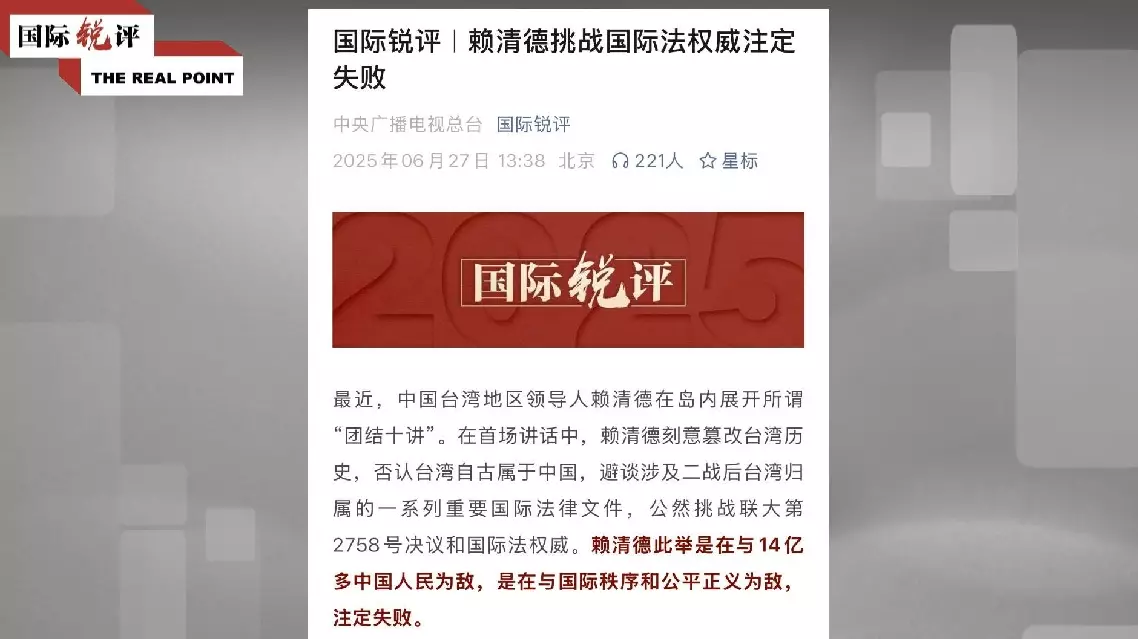
Lai Ching-te's challenge to international law is doomed to fail: commentary