The crew of China's Shenzhou-20 mission shared details of how they detected and responded to a suspected window crack struck by space debris on their return capsule, which has inspired many with the courages and composure of the astronauts in coping with space emergency.
China launched the Shenzhou-20 manned spacecraft on April 24 2025, carrying the crew of three astronauts -- Chen Dong, Chen Zhongrui and Wang Jie -- to China's space station in orbit.
Following the damage caused by a suspected space debris impact on the spacecraft, the crew’s return, originally scheduled for Nov 5, was postponed, with the astronauts later using an alternative spacecraft to get back to the Earth safely.
After spending a total of 204 days in orbit, the trio set a new record for the longest in-orbit stay among Chinese astronaut crews.
In an interview with China Media Group, the astronauts elaborated on how they discovered the crack on the viewport one day before their planned return.
Chen Dong, commander of the crew, said he noticed the damage while conducting final checks on the return capsule.
"I was the one who went for the checks. I was through the capsule with the naked eye, when I spotted something like a triangular on the viewport. My first thought was whether a small leaf had somehow stuck to the outside of the window. But then I quickly realized that couldn't happen because we were in space. How could there possibly be a fallen leaf there?" said Chen Dong.
After Chen pointed it out, the other two crew members, Chen Zhongrui and Wang Jie, also observed the anomaly.
Wang, who served as the flight engineer on the Shenzhou-20 mission, had previously worked as an aerospace technician involved in the construction of China's space station before becoming an astronaut.
He said that although the trio was not immediately certain what they caught, he did not feel nervous.
"I wasn't really nervous, actually. The outermost layer of the viewport is a protective layer, and inside it there are two pressure-bearing layers, and we are safe as long as the cabin pressure doesn't change. I also know well about our ground team that no matter what happens, they will go through analysis and experiments to determine whether we can return safely and whether the crack affects our safety before making a final conclusion. So I wasn't too worried," Wang said.
To determine exactly what was on the viewport, the crew used every piece of equipment available inside the space station to photograph and document the abnormal area, including a work pad, a work phone and a magnifying glass, before finally confirming the crack using a 40-times microscope.
"It was a pen-shaped microscope. One end is the lens, connecting to a tablet -- the device we use to inspect the extravehicular suits, especially to check whether there is any damage in the sealed areas," said Chen Dong.
Despite sustaining damage, the debris-hit capsule withstood temperatures of thousands of degrees Celsius during the re-entry process and successfully touched down on the Earth on Jan 19.
Initial on-site inspections by the ground crew at the landing site confirmed that the return capsule's overall appearance was normal and that the items returned inside were in good condition.
The Shenzhou-20 spacecraft spent a total of 270 days in orbit, validating its long-term docking capability, with engineers saying the follow-up work will also provide an important basis for China's space program to continually refine operating procedures.
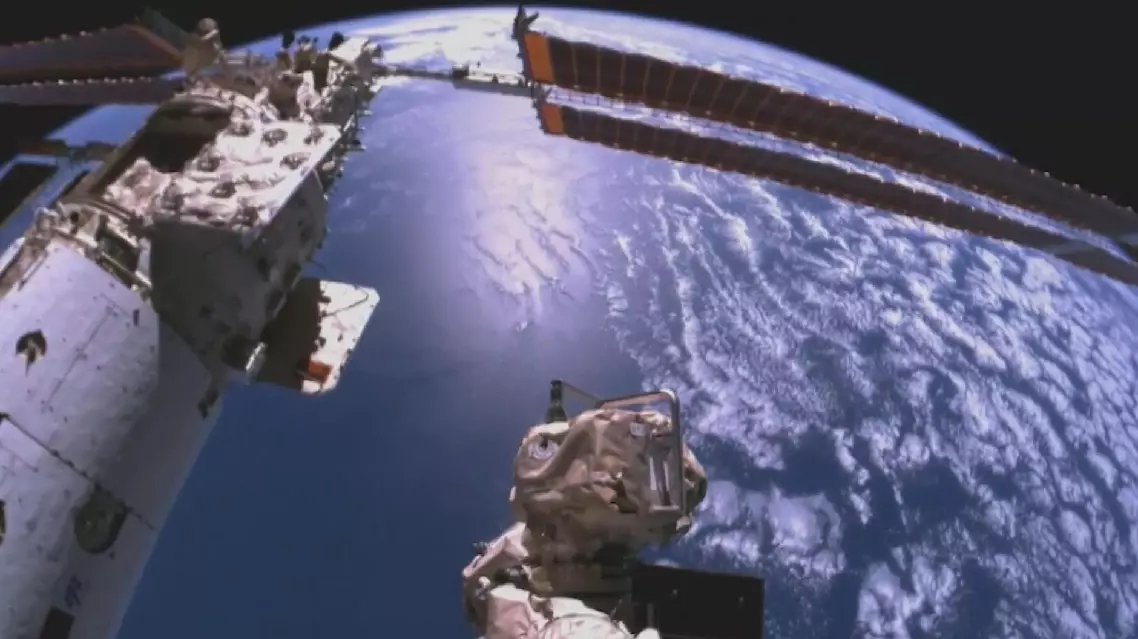
Shenzhou-20 crew detail discovery of cracks on return capsule viewport