Across China, cities are rolling out colorful evening activities and light shows in celebration of the Spring Festival.
From centuries-old city walls glowing with lanterns to drone formations painting the night sky, millions are celebrating the arrival of the Chinese New Year, which is the Year of the Horse, with light, fire and festivity.
In Ningbo of east China's Zhejiang Province, the Cicheng ancient town has transformed its kilometer-long city walls into a lantern corridor. By day, visitors browse a folk market of rice cakes and sugar paintings; by night, over 40 illuminated lantern installations cast historic architecture in colorful light.
In Guiyang of southwest China's Guizhou Province, an urban park has become an open-air theater and cultural fair which hosts daily performances, including lantern parades in traditional attire, with visitors welcome to join.
In Changchun of northeast China's Jilin Province, Chinese New Year celebrations at a ice and snow park are drawing many residents and tourists, while in the Xishuangbanna Dai Autonomous Prefecture of southwest China's Yunnan Province, tourists can enjoy the grand fireworks shows by the Lancang River at a night market next to popular tourist attractions.
In Jingzhou of central China's Hubei Province, 1,000 drones swarm above ancient city walls at night during the holiday season, sketching moving images in the dark, while the ancient city tourist zone hosts large-scale history reenactment shows and concerts to treat the holiday makers.
The Spring Festival falls on Tuesday this year, with the official holiday season lasting nine days from February 15 to 23.
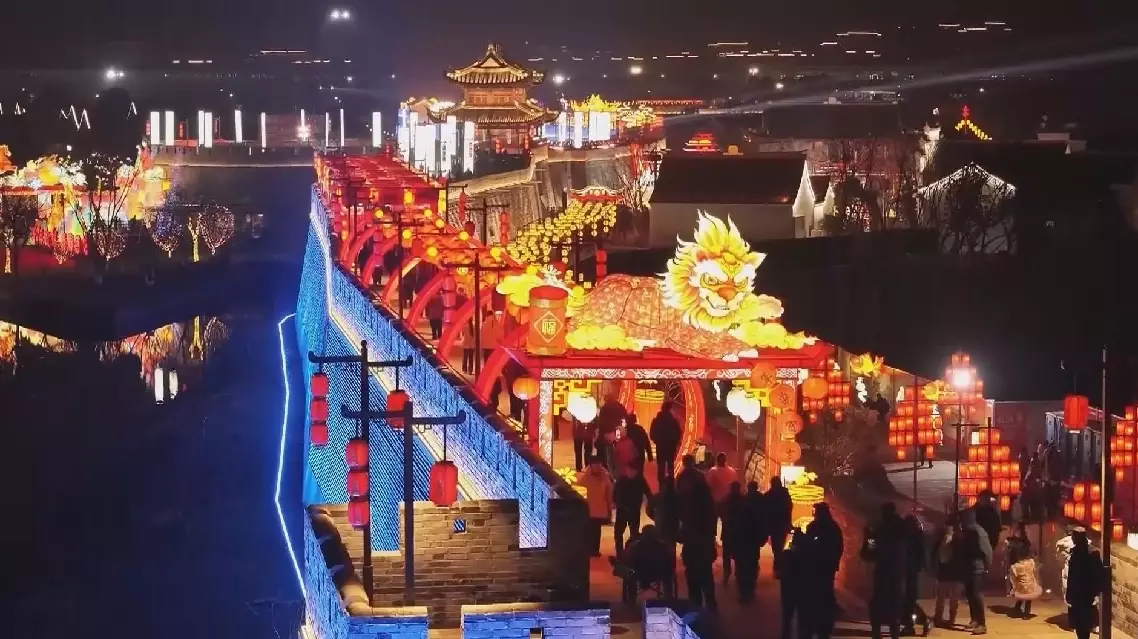
Chinese cities light up during Spring Festival
An artisan from the Bai ethnic minority group in southwest China's Yunnan province is working to preserve the centuries-old Jiama woodblock printing tradition during the ongoing Chinese New Year holiday season, sustaining a ritual craft long associated with prayers for protection and prosperity.
In his workshop in the Dali Bai Autonomous Prefecture, Zhang Renhua selects pear wood, carves intricate patterns into printing blocks and presses inked paper by hand to produce Jiama prints -- religious images traditionally used in blessing ceremonies and ancestral rites.
Jiama, sometimes known as "paper horse", blends Bai mythology with traditional Chinese woodblock printing. Introduced to Dali from central China centuries ago, the craft gradually became embedded in local customs.
"Jiama was brought here from central China in the early days. It settled and has been passed down ever since," Zhang said in the video.
Recognized as a state-level inheritor of intangible cultural heritage, Zhang oversees every stage of production, from carving to final printing.
Traditionally burned during rituals, Jiama prints depict protective deities and folk symbols, expressing hopes for favorable weather, safety and good fortune in the year ahead.
"Our Bai script has disappeared and survives only through oral tradition," Zhang said. "But Jiama will not be forgotten here in Dali. It is inseparable from the people and from Bai life."
Originally featuring armored horse-riding figures -- from which its name is derived -- Jiama evolved over time to include a broader range of folk deities as printing techniques developed.
Today, the prints remain part of Chinese New Year customs in parts of Yunnan, reflecting a tradition that has endured for generations.
Ethnic minority Bai artisan preserves Jiama woodblock tradition in southwest China's Yunnan