Australian film producers are looking to deepen ties with China as the world's film industry faces uncertainty following U.S. President Donald Trump's proposed tariffs on all non-Hollywood productions.
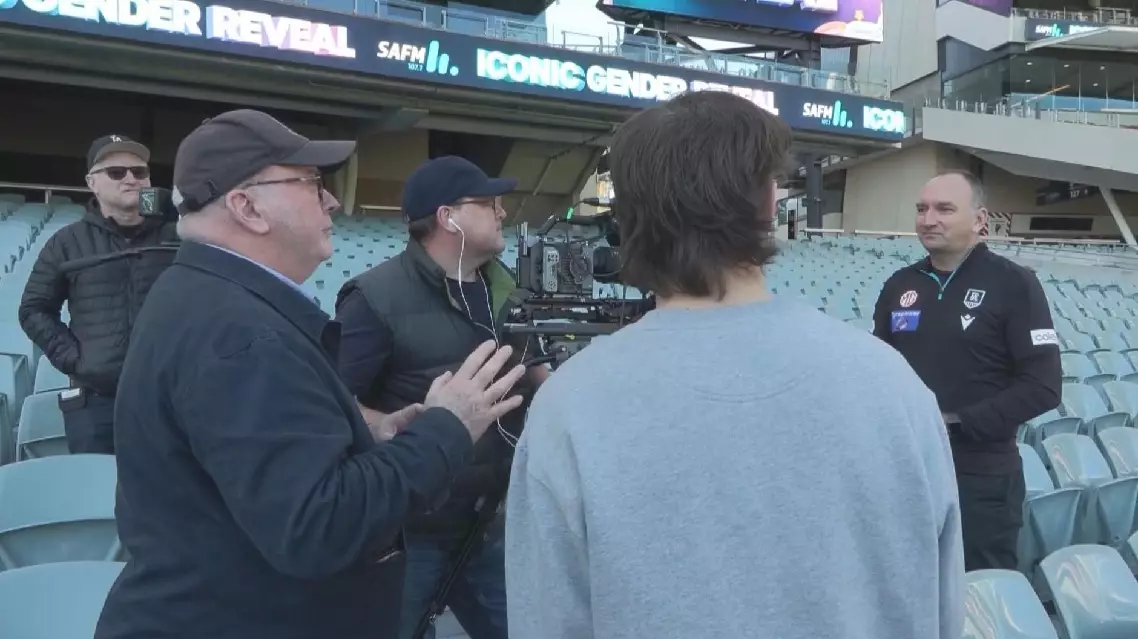
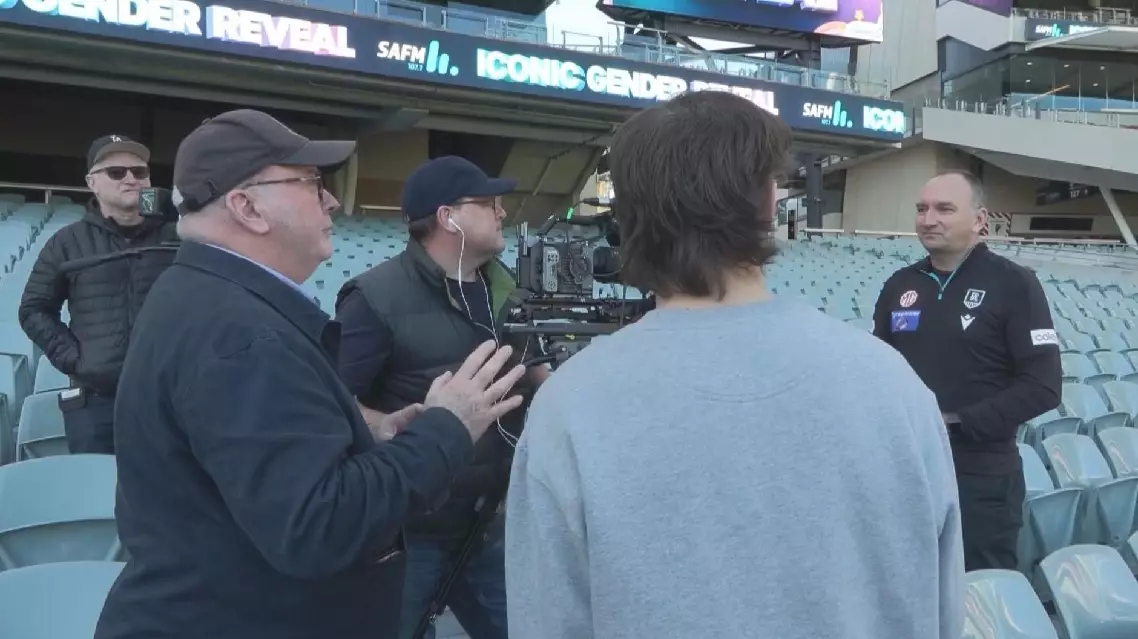
In Adelaide Oval, a film crew prepares for a shoot while the Port Adelaide Australian Football team practices for an upcoming match. The team has cultivated links to China since 2014, eventually bringing the uniquely Australian game to Shanghai in 2019. Film producer Paul Ryan, who participated in that effort, has also actively cultivated ties with China over the years, which he says began with a personal fascination.
"I just became really kind of captivated by the Chinese industry and Chinese people and being in China. I was a real sort of novelty to start with," said Paul Ryan, producer and founder of 57 Films.
Ryan built on that fascination, forging connections and working on joint productions. That includes "If Time Flows Back", starring Chinese actor Jin Dong, and "Speed", the first-ever Chinese drama shot in Adelaide.
"That presented a great experience for us because we had a number of people that worked on that project and the Chinese component represented 200 cast and crew that came here for well over 6 weeks or so," Ryan said.
Australia's film industry has established a global reputation, renowned for its exceptional locations, skilled crews, and state-of-the-art facilities. It has actively sought international productions, offering incentives for overseas crews.
"A lot of kind of partnerships were struck where companies were like, alright we want to keep making films here on the Gold Coast so they committed to long-term production slates, not just kind of one off productions," said Mark Ryan, professor in Film and Television with the Queensland University of Technology.
Earlier this year, Trump proposed imposing 100 percent tariffs on productions made outside of the United States.
"I think it would be tremendously negative for the Australian screen industry and I think we would see many many great filmmakers exit the industry," said Peter Hegedus, associate professor at Griffith Film School under Griffith University.
"There's no way that we've got the economies of scale in Australia to make things that would ultimately get to a budget level that is just for an Australian audience. It needs to have international audiences, and I've always been hopeful that [it] would be China. It didn't have to be European, western, American [audiences]," said Paul Ryan.
Australian filmmakers turn to Chinese market to counter US tariffs
Australian filmmakers turn to Chinese market to counter US tariffs
More than 770 high-tech companies have packed into 33 themed buildings at China's Xiong'an New Area, turning floor proximity into business partnerships in a government-engineered experiment to build innovation clusters outside the capital Beijing.
On April 1, 2017, China announced plans to establish the Xiong'an New Area, located about 100 kilometers southwest of Beijing. The aim was to build a green city on an area of 1,770 square kilometers, featuring innovation and providing a national model of high-quality development.
Over the past nine years, facilities such as the Zhongguancun Science Park have begun high-quality operations in Xiong'an. In the Zhongguancun Science Park's low-altitude economy building, Zhu Xu, co-founder of a Beijing drone company, dropped in on a company located one floor below his to explore collaboration opportunities.
As the building houses numerous upstream and downstream enterprises in the low-altitude economy industry, with potential partners just a floor or two away, Zhu frequently receives invitations to matchmaking events where participants analyze the market and discuss technologies together.
"(The Zhongguancun Science Park) organizes matchmaking events on a regular basis. At one such session, we learned about a company on the 7th floor that share some technical similarities with us. We spoke with them promptly, and now we are gradually carrying out research and development and cooperation together," said Zhu.
Zhu's company moved to Xiong'an in Oct 2025. Shortly after relocating, Zhu began joint research and development with the company on the 7th floor. Together, they have upgraded drones to support remote intelligent ground operation, quickly developing a mature autonomous drone operation system.
"We open up real-world application scenarios to enterprises. Through various activities, companies link up naturally, and collaborations within the building have happened effortlessly," said Li Yue, deputy head of the Industry, Information Technology and Data Bureau of the Xiong'an New Area.
Zhu is among many people who pursue a career and a life in the Xiong'an New Area, which has been transformed from a stretch of raw land to a mapped plan, and then to a city -- a modern new town springing up in a matter of nine years.
In the process of relieving Beijing of functions non-essential to its role as China's capital, renowned universities and research institutes, major state-owned companies as well as start-ups are relocated to this vibrant area.
So far, more than 4,000 Beijing-origin companies have been relocated to Xiong'an, and more than 400 centrally administrated state-owned enterprises have set branches in the city.
Construction is rapidly ongoing on the campus buildings of four universities in the Xiong'an New Area -- Beijing Jiaotong University, Beijing University of Science and Technology, Beijing Forestry University and China University of Geosciences.
In less than a decade, Xiong'an has adhered to high standards of planning and design, adopting a "moving in after infrastructure is in place" approach, ensuring that networks of water, electricity, gas, roads and bridges are established first.
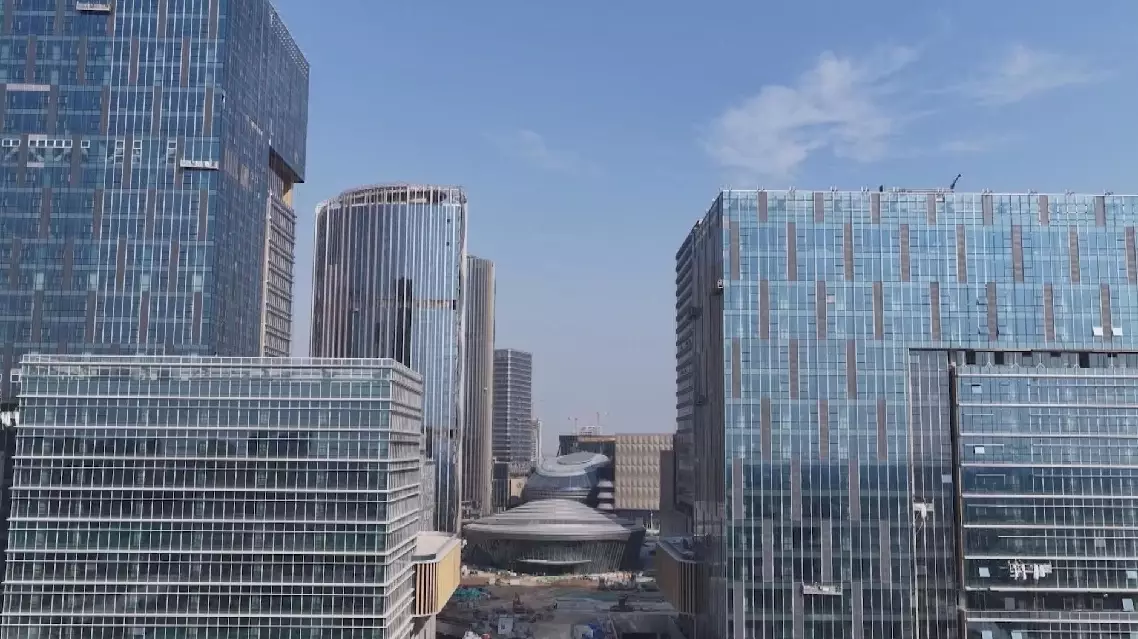
Dubbed the "city of the future", Xiong'an is undergoing rapid changes. The developed area spans around 215 square kilometers with total investment exceeding one trillion yuan (about 145 billion U.S. dollars) and over 5,300 buildings shaping the urban skyline, housing 1.41 million residents and 669 high-tech enterprises.
Meanwhile, Xiong'an is becoming greener and more biodiverse. Since 2017, a total of 32,200 hectares of new afforested land has emerged in Xiong'an, bringing the total green area to nearly 50,000 hectares. The forest coverage rate has risen from 11 percent to 35.1 percent, according to official data.
China's Xiong'an New Area clusters tech firms in themed towers, spurring vertical supply chains