Researchers at the Changchun Institute of Applied Chemistry, Chinese Academy of Sciences, have successfully developed a novel radical self-assembled molecular material for next-generation solar cells.
This innovation overcomes both the inadequate performance and the difficulty of uniformly fabricating large-area hole-transport layers in perovskite solar cells. Its performance has been certified by the U.S. National Renewable Energy Laboratory.
These findings were published in the journal Science on Thursday under the title "Stable and Uniform Self-Assembled Organic Diradical Molecules for Perovskite Photovoltaics."
"With the high performance and low cost of this material, it is expected that the production cost will be greatly reduced in the production line. After industrialization, customers will get products with higher cost performance," said Qin Chuanjiang, researcher from the Changchun Institute of Applied Chemistry under the Chinese Academy of Sciences.
Qin is among the researchers who spent three years independently creating a "double-radical self-assembled molecule" and integrating it into perovskite devices.
According to tests, the new material more than doubles carrier-transport rates under simulated operating conditions.
Devices built with it also show virtually no performance degradation after continuous operation for thousands of hours.
Over the past decade, perovskite compounds have become the material of choice for many companies developing next-generation solar cells.
Qin says the team's next step is to push for industrial-scale applications of the new material and to continue advancing the technology.
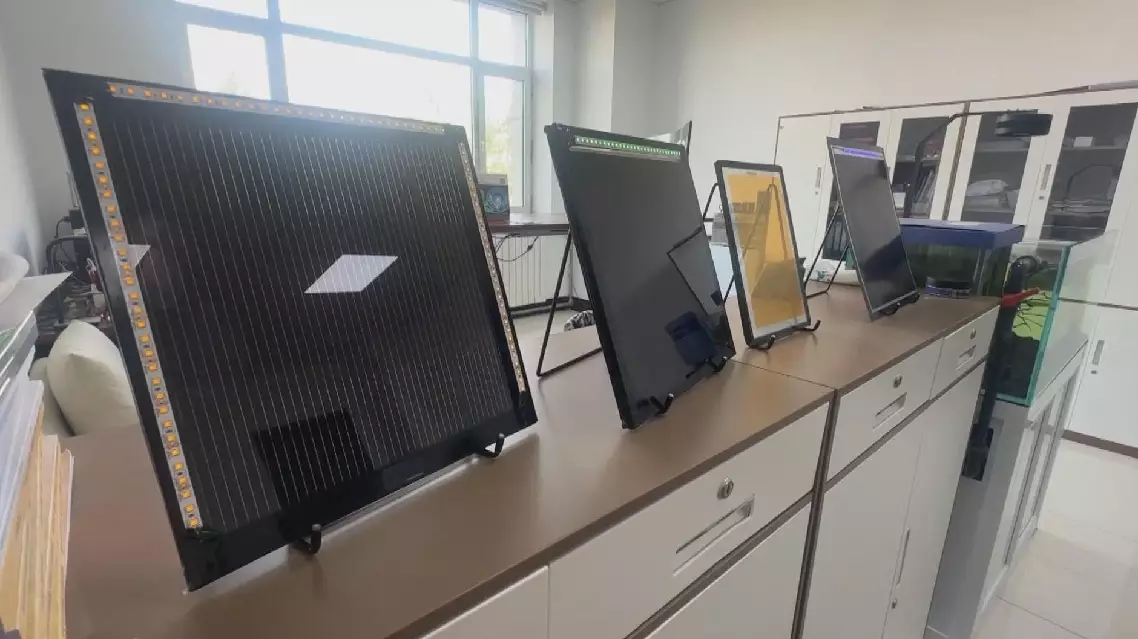
Chinese scientists develop new material for next-generation solar cells
The Shenzhou-21 crew aboard China's orbiting Tiangong space station completed their mission's third series of extravehicular activities (EVAs) on Friday, according to the China Manned Space Agency (CMSA).
The astronaut trio -- Zhang Lu, Wu Fei and Zhang Hongzhang -- worked for roughly five and a half hours and completed their EVAs at 01:36 (Beijing Time), assisted by the space station's robotic arm and a team on Earth.
The trio completed the installation of a space debris protection device for the space station, and extravehicular equipment and facility inspections, among other tasks. Zhang Lu, the commander of the Shenzhou-21 mission, and Wu Fei conducted the spacewalk and returned to the Wentian lab module safely, according to the CMSA.
Zhang Lu has so far carried out seven EVAs, making him one of the Chinese astronauts with the most spacewalks to date.
Since completing their second series of EVAs on March 16, the Shenzhou-21 astronauts have steadily advanced experiments in areas such as space life sciences, human research, and microgravity physical science. They have carries out in-orbit environmental monitoring, equipment inspection and maintenance, and supply management. The crew has also completed a full-system pressure emergency drill, emergency life-support training, and preparations for extravehicular activities.
The three astronauts have been in orbit for more than five months and remain in good working and living condition.
To further validate technologies related to long-term human habitation in orbit and to maximize the comprehensive benefits of using the Shenzhou-22 spacecraft as an emergency launch vehicle to resupply the space station, it has been decided, after careful evaluation and assessment, that the crew's stay in orbit will be extended by approximately one month.
During the upcoming phase of their space journey, the crew will continue to conduct scientific experiments and technical tests, and will also celebrate the Space Day of China, which is marked annually on April 24, and the International Workers' Day on May 1 while in orbit.
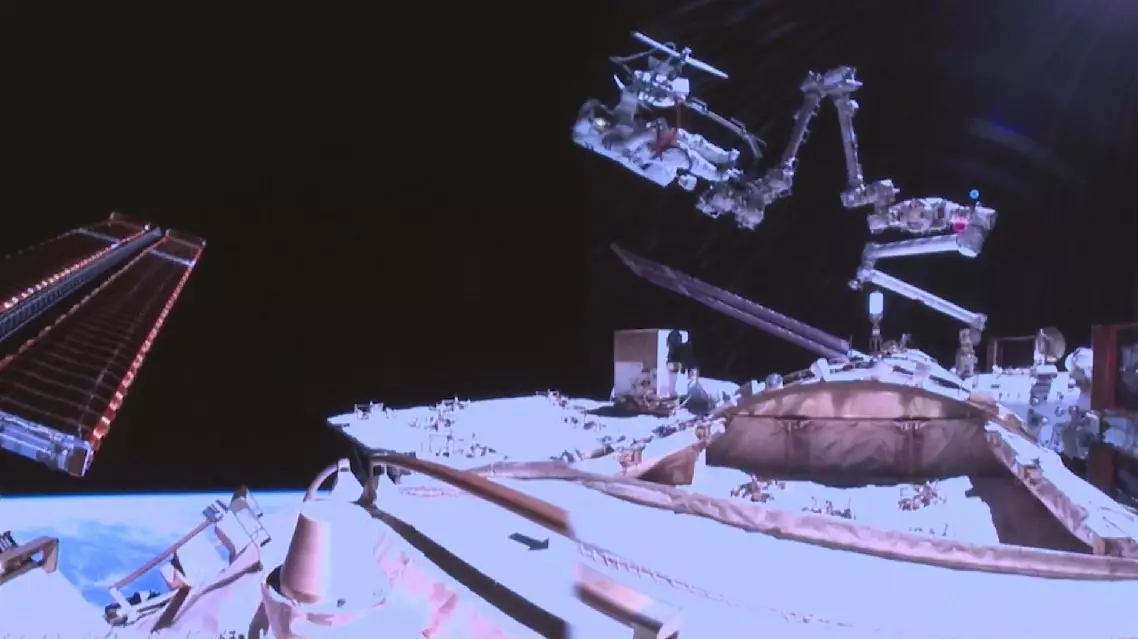
Shenzhou-21 astronauts complete 3rd series of extravehicular activities