China has officially completed its first teaching and practice base for the "simulated moon underground space" program by the Jingbo Lake in Mudanjiang City of northeast China's Heilongjiang Province on Wednesday.
The latest scientific research indicates that there are considerable lava pipe systems distributed beneath the surfaces of the Moon and Mars. These underground spaces form a sharp contrast with the extremely harsh lunar surface environment. They not only provide a natural barrier for cosmic rays but also have significant strategic value due to the special attributes of their underground spaces.
For further research, Peking University, in collaboration with seven other universities in China, has established the country's first "simulated moon underground space" teaching and practice base in a volcanic lava cave of the Jingbo Lake, to conduct a series of forward-looking and innovative research closely related to deep space exploration.
"The underground volcanic lava pipes by the Jingbo Lake are the most similar environment on Earth to the underground space of the moon. I hope our forward-looking research can serve China's lunar exploration program," said Li Jiaqi, a researcher of Peking University.
Inside the lava cave, two robots are conducting autonomous exploration and multi-functional operations for the "simulated moon underground space".
"Compared with traditional lunar roving vehicles and exploration robots, it has stronger environmental adaptability and flexibility. When exploring the underground space of the moon for the future, it can possess more precise perception, decision-making and operation capabilities," said Li Xianglong, a doctoral student of Harbin Institute of Technology.
Outside the cave, on the open ground, college students were seen working in collaboration to set up seismometers.
"The data we collected from deploying seismometer this time will serve as a reference for our future deployment of seismometers on the moon," said Kang Yi, an undergraduate student of the School of Earth and Space Sciences of Peking University.

China completes first teaching practice base for simulated moon underground space
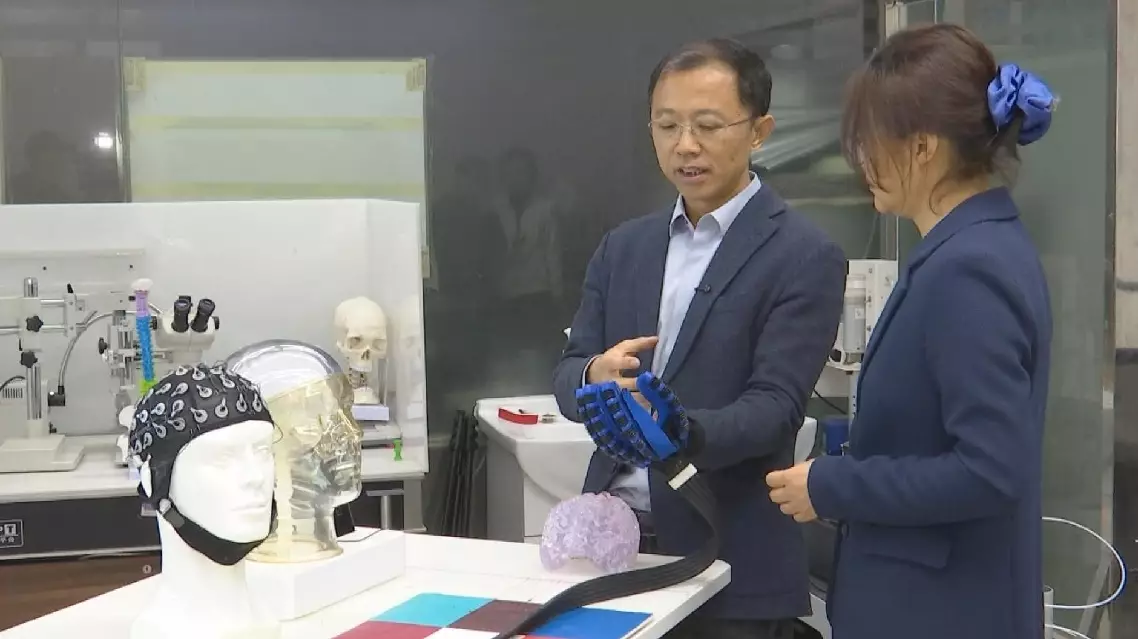
China's approval and issuance of its third medical device standard for brain-computer interfaces (BCIs) marks a significant advancement from isolated breakthroughs to a systematic approach in this emerging field, contributing a Chinese solution to global BCI standardization.
Approved on Monday and set to take effect on September 1, 2027, this standard is the world's first product guideline for BCIs utilizing AI algorithms to process brainwave data. It will establish unified requirements for the collection, processing, labeling, storage, and access of brainwave data.
China first released its standard for BCI medical devices on September 16, 2025, establishing a systematic terminology framework for equipment based on BCI technology. This standard took effect on January 1, 2026. A second standard was introduced on September 28, 2025, focusing on test method for sensing and response performance of implantable nerve stimulators.
"The third BCI medical device standard released today enhances the conceptual framework established by the terminology standard and offers a data quality foundation for performance test and registration review of specific brain-computer interface products," said Li Shu, Deputy Director of the Institute for Medical Devices Control of the National Institutes for Food and Drug Control, and a drafter of the standard.
The National Medical Products Administration is actively initiating and formulating a range of related standards, including 10 national standards and three industry standards. These efforts aim to create a comprehensive standards system covering terminology and definitions, paradigm design, data specifications, neural electrical signal acquisition and decoding, key performance testing, and reliability verification.
"The National Medical Products Administration has included implantable brain-computer interface medical devices in the Catalogue of High-End Medical Devices for Priority Examination and Approval, guiding enterprises in registration applications. At the same time, some products have been placed in the innovation and "global new" green approval channels, with full-process guidance to accelerate product launch," said Yuan Peng, Deputy Director of the Medical Device Registration Department at the National Medical Products Administration.
With robust policy support and technological advancements, China's BCI market is entering a rapid growth phase. Data predicts that China's BCI market will exceed 6 billion yuan (about 840 million U.S. dollars) by 2028 with a compound annual growth rate of 17.7 percent from 2024 to 2028. The global BCI medical application market will reach 40 billion U.S. dollars by 2030 and 145 billion U.S. dollars by 2040.
China advances global BCI framework with new standard for BCIs