Researchers at China's only nature reserve for blue-tailed bee-eaters in Xiamen, a coastal city in east China's Fujian Province, are taking targeted protective measures by using GPS tracking to monitor the birds' activities.
Admired by many as one of the most beautiful birds in the world for its fancy feathers, the species is under Class II state protection in China.
The GPS tracker specially designed for blue-tailed bee-eaters is tiny, weighing only about one gram. At the Wuyuan Bay Nature Reserve for Blue-tailed Bee-eaters, researchers attached the trackers around the birds' waists. Birds with the trackers on, akin to carrying a small backpack, can move around freely without any hindrance.
"Our main goal is to study how these birds utilize the areas around Xiamen, identifying their roosting sites, primary foraging sites, and food resources. Subsequently, we will make targeted policies to protect these key areas," said Wu Fuxing, associate research fellow at the Third Institute of Oceanography under China's Ministry of Natural Resources.
After analyzing the monitoring data that was transmitted back, researchers discovered that out of the 15 blue-tailed bee-eaters equipped with GPS trackers, nine of them exhibited a regular pattern of traveling back and forth between Xiamen and Kinmen, a small island located just off the mainland.
According to researchers, Kinmen hosts a significant population of around 3,000 blue-tailed bee-eaters, representing a large "clan". The tracking has confirmed frequent interactions between these two "families" of Xiamen and Kinmen.
Furthermore, researchers have identified additional foraging sites for blue-tailed bee-eaters in Xiamen beyond known habitats, such as the Wuyuan Bay Wetland. Tracking data reveals their activity in multiple reservoirs and green spaces near airports.
"There may be many places that we have not yet thought about. Beyond the nature reserve, there could be some other potential habitats in the surrounding areas, possibly even some potential breeding places," Wu said.
In addition to attaching trackers to the blue-tailed bee-eaters, researchers also collected samples of their feathers and droppings, which will undergo DNA testing and analysis in the laboratory.
"Determining the gender of the birds can be achieved through DNA extraction. DNA can also be extracted from droppings. Additionally, stable isotope analysis can be used to identify feeding habits, that is, what they mainly eat," Wu said.
Researchers will continue tracking and monitoring the activities of the blue-tailed bee-eaters. This data will reconstruct the birds' migration routes, offering scientific information for targeted protection efforts.
"Regarding the differentiated management strategies ahead, such as after identifying the places the birds will pass through along their migration routes and the locations that serve as crucial resting spots, protecting these critical resting spots is essential for ensuring the species' smooth life circles," Wu said.
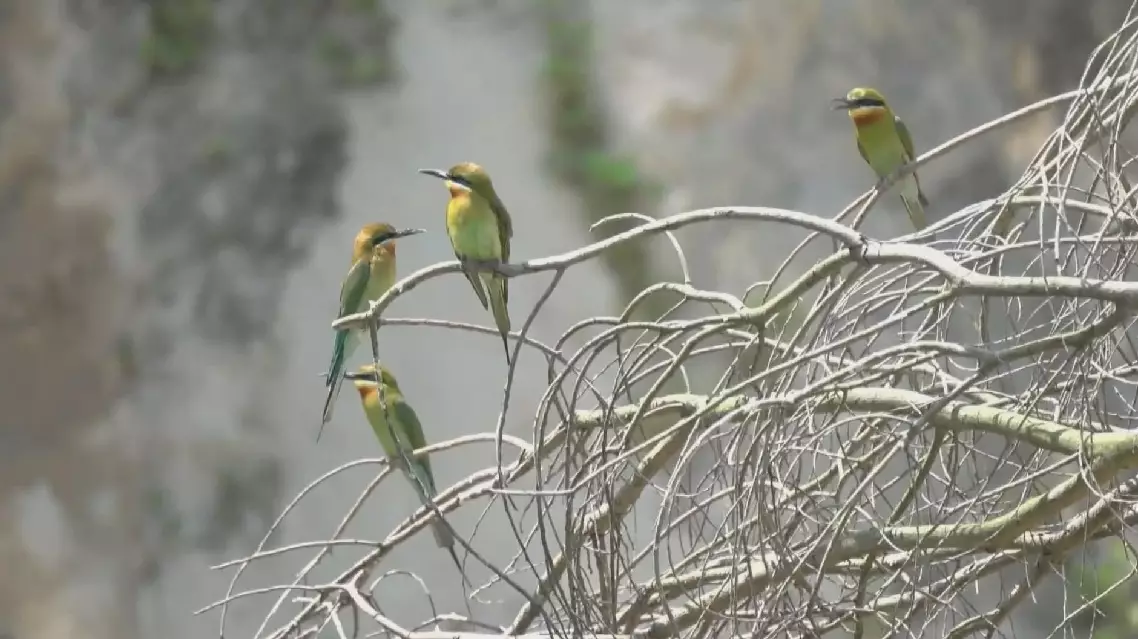
Chinese scientists conduct scientific tracking on rare birds for targeted protection