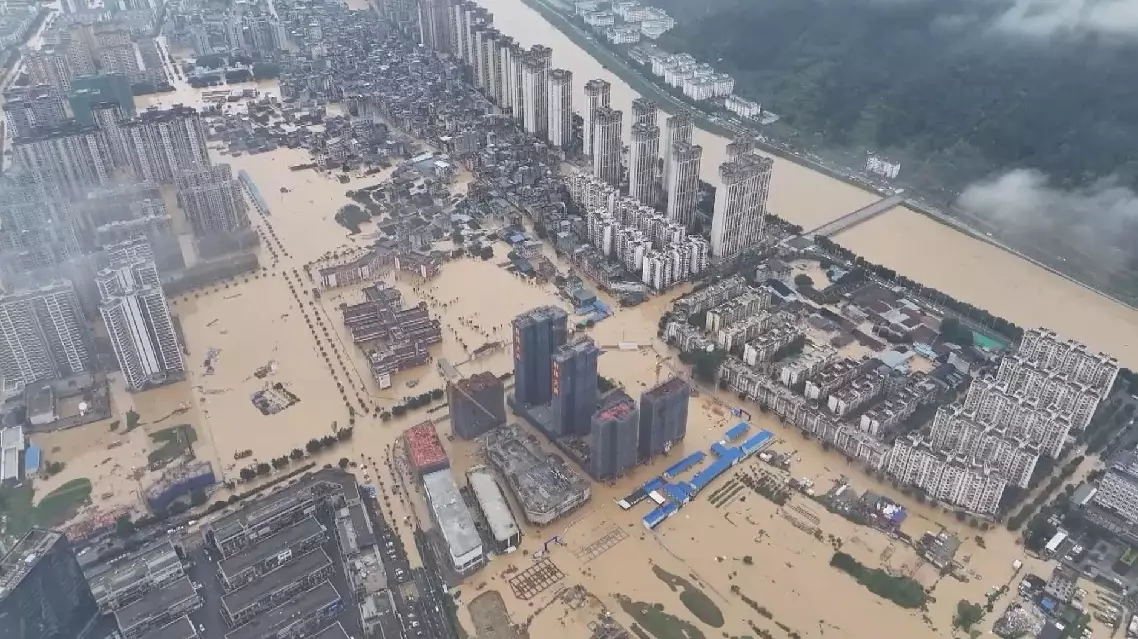
In response to the severe flooding in southwest China's Guizhou Province, the country has upgraded its national disaster relief emergency response to level-III and expanded emergency funding and aid deployments.
The National Committee for Disaster Prevention, Mitigation and Relief made the announcement on Saturday, deploying a task force to assess damages, coordinate emergency measures, and support relief work for affected residents.
As part of the national emergency response, the central government has dispatched 15,000 relief items to Guizhou, including folding beds, summer quilts, and household emergency kits, which are designed to help local authorities manage the emergency relocation of displaced residents.
China's top economic planner the National Development and Reform Commission (NDRC) has allocated an additional 100 million yuan (about 13.96 million U.S. dollars) in central budget funds to support emergency response and recovery work in flood-hit areas in Guizhou.
This follows an initial 100 million yuan that was allocated on Wednesday, raising total funds to 200 million yuan, the NDRC said on Saturday.
The funds will support the post-disaster emergency recovery of transportation, water conservancy, healthcare, education, and other infrastructure and public service facilities in Guizhou, particularly in counties that have been severely affected, including Rongjiang, Congjiang and Sandu, to help restore normal life and production as soon as possible.
The torrential rain devastated communities across Guizhou, killing six people and displacing tens of thousands. By Saturday, more than 41,500 residents had been evacuated from Rongjiang County alone, relocated to safer areas as rescue teams worked around the clock.
"The militia forces from the neighboring county have joined us, and we will return to the flood zone. We need to inspect low-lying residential areas for those who stayed behind and evacuate them. We will also identify other locations with potential hazards and assist with reinforcement efforts," said Tian Geng, local official of Rongjiang.
According to the Rongjiang Flood Control and Drought Relief Command Headquarters, the latest round of heavy rain has officially subsided. On Sunday at 10:00, the county downgraded its level-I flood emergency response, transitioning to routine flood prevention.
In another affected area, Danzhai County, almost entire communities faced infrastructure disruption caused by submerged roads and buildings.
"Half of the rooms have been totally flooded. You can see right here. Our homestay is a two-story traditional wooden building. The whole first floor was completely flooded at the highest water level," said Han Xiaoguang, a homestay owner.
"We have two main methods for relocating residents. First, we use centralized shelters. Villages with suitable conditions designate community centers in higher terrain as shelters. Second, some residents choose to stay with relatives in safe areas. For those staying with their families, we provide beds and bedding as needed. Our village cadres and task force teams are delivering supplies directly to people's homes," said Bao Chengfu, head of Nangao Township, Danzhai County.
Floodwaters swept through towns and villages, including historic Xiasi Ancient Town in Kaili City. Emergency personnel and over 1,000 troops, aided by heavy equipment like excavators and bulldozers, have mobilized massive cleanup and rescue efforts.
"At around 07:00 to 08:00, leaders from the Xiasi township government and the fire brigade were here helping us evacuate. They also assisted with cleaning up the rooms, as one person cannot handle the mess alone," said a shop owner surnamed Huang in Kaili.
As the nation mobilizes a large-scale response, rescue and recovery efforts in Guizhou continue in a race against time to restore normal life and prevent secondary disasters.
The National Meteorological Center issued a yellow alert at 06:00 on Sunday -- the third level in China's four-tier weather warning system -- over areas in eastern and southern China, where more heavy rainfall, thunderstorms, and strong winds are expected within the next 24 hours. Provincial-level regions such as Hubei, Zhejiang, and Chongqing are among those at risk.
China activates level-III emergency response for floods in Guizhou
China activates level-III emergency response for floods in Guizhou