The customs and other competent government authorities in different parts of China have rolled out policies and optimized services to provide greater support for enterprises to better benefit from arrangements within the framework of the Regional Comprehensive Economic Partnership (RCEP).
China's trade in goods with other RCEP member countries reached 5.5 trillion yuan (about 770 billion U.S. dollars) from January to May this year, growing 3.9 percent year on year, and surpassing the overall growth of China's foreign trade by 1.4 percentage points, according to the latest official data.
The Suzhou Customs in east China's Jiangsu Province has set up a special RCEP enterprise service post, which analyzes the import and export situation of the relevant enterprises, and sorts out the list of key preferential products, to customize the most favorable certification plan for enterprises.
"We analyze product characteristics and the status quo of exporting countries for enterprises on a one-to-one basis, and optimized the procedure handling process. Next, we will continue to guide enterprises to make full use of various favorable policies and tariff preferential treatments," said Zhang Biying, deputy chief of the general business section under Suzhou Customs Xiangcheng Office.
As part of the efforts to optimize services of its RCEP Enterprise Service Center, east China's Shandong has launched an AI-based query platform, integrating artificial intelligence technology into functions such as tax rate query, tariff comparison, and origin traceability to help enterprises make full use of preferential policies of the RCEP.
"By using the data platform, we can accurately identify the enterprises that have not made full use of the beneficiary policies, and then use AI assistants to match information from multiple databases. Then we will notify those enterprises in a timely manner through text messages and other means to ensure that they can enjoy all the preferential policies of the RCEP," said Xu Nan, leading official of the Qingdao Dagang Customs.
The Guangxi Zhuang Autonomous Region in south China has issued a guideline for corporate intellectual property compliance with the RCEP framework, and built a cloud platform of China-ASEAN/RCEP standards to provide relevant services for enterprises.
The Shenzhen Customs, in south China's Guangdong Province, has innovatively launched a mutual recognition and cooperation empowerment project together with the Singapore Customs to provide application guidance to enterprises. So far, a total of 106 approved exporters have gone through the trainings.
"Regions across China have actively promoted the upgrading of RCEP-related services, such as strengthening the digital and intelligent application of the RCEP platform, and enlarge the scope of services to cover standards, rules, intellectual property rights, laws, etc, instead of merely policies on traditional tariff concessions. These innovative approaches have effectively reduced customs clearance time and trade costs of enterprises, improved their ability to explore international markets and to cope with external risks and challenges, and facilitated to stabilize foreign trade," said Yuan Bo, director of the Asian Institute of the Chinese Academy of International Trade and Economic Cooperation under the Ministry of Commerce.
Effective to the signatories as of January 1, 2022, the RCEP -- the world's largest free-trade deal -- comprises 10 ASEAN member states, namely Brunei, Cambodia, Indonesia, Laos, Malaysia, Myanmar, Philippines, Singapore, Thailand, Vietnam, together with their five free-trade partners which are China, Japan, South Korea, Australia and New Zealand.
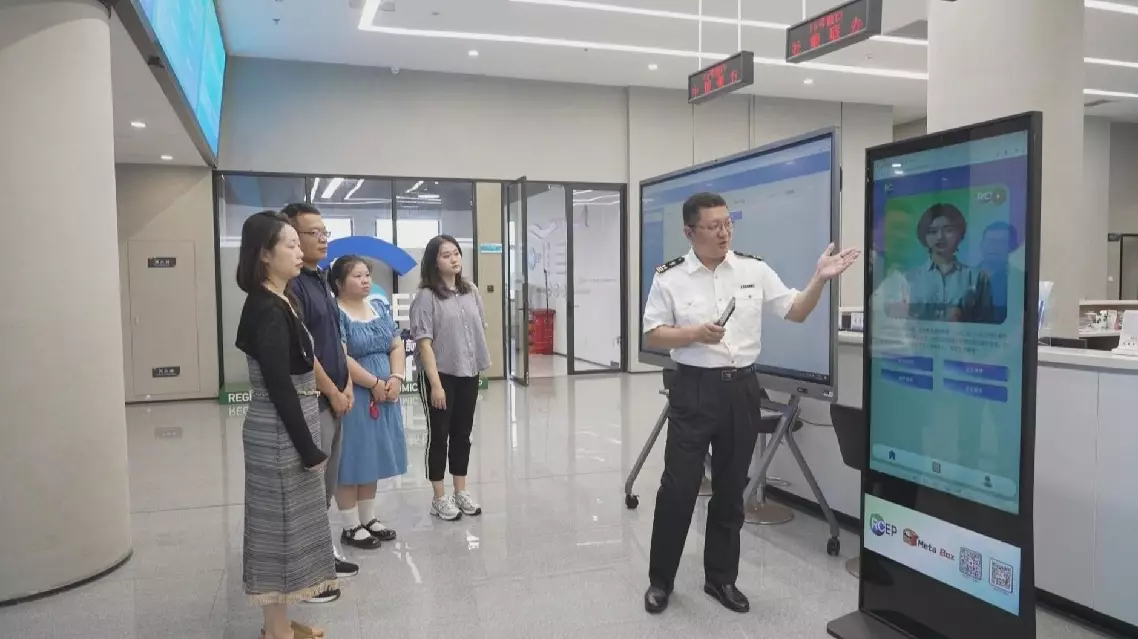
Measures rolled out to offer support for firms to better benefit from RCEP