Wetlands across China, from Henan to Qinghai and Xinjiang in the west, are teeming with life during this season as tens of thousands of migratory birds arrive to breed, transforming into vibrant havens of biodiversity.
In the misty dawn at Huaiyuan Wetland in central China's Henan Province, tens of thousands of migratory birds, such as egrets, cattle egrets, and night herons, were seen soaring through the air, perching lightly on branches or building their nests.
Currently, in the breeding season, most chicks have hatched in the nests scattered across the wetland, while some are perching with their heads out or learning to fly.
This year, the local forestry department established a protective zone extending over 500 meters around the breeding area to protect nesting birds from human disturbance.
Qinghai Lake, China's largest inland lake, located on the northeastern Qinghai-Tibet Plateau, is another haven for migratory birds. It welcomes over 600,000 migratory birds every year.
Ongoing protection and restoration efforts have led to a significant increase in the lake's surface area, reaching 4,650.08 square kilometers by the end of 2024, a gain of 28.1 square kilometers compared to 2023, which provides more habitat for these birds.
The Xinjiang Uygur Autonomous Region, Daxi Lake, situated deep within the Taklamakan Desert, has transformed into a haven for migratory birds due to sustained efforts in environmental protection and restoration.
This summer, the area has attracted a variety of rare birds and wildlife, including egrets wading gracefully and black-winged stilts foraging and frolicking in the waters.

Wetlands in China thriving as migratory birds flock for breeding
Smart technologies have reshaped China's ecological and environmental monitoring system, Huang Runqiu, minister of Ecology and Environment, said Thursday in Beijing on the sidelines of the fourth session of the 14th National People's Congress(NPC).
"Regarding ecological and environmental monitoring, we have been promoting the digitalization, informatization, and intelligentization of the entire monitoring process in recent years, reshaping the ecological and environmental monitoring system. For instance, in water environment monitoring and sampling, we have used intelligent drones which can quickly locate sampling points, collect samples accurately, return rapidly, and they are safe and reliable, improving work efficiency by over 70 percent. They are particularly advantageous for sampling during flood seasons and in remote areas," Huang told the press.
"In terms of environmental sample analysis, we have developed 'lights-out laboratories' in recent years. As the name suggests, these labs operate without lights and are unattended. Through robotic arms, robots, and intelligent management systems, they achieve full-process automation and intelligence from sample handover, testing, and analysis to report generation. This has significantly enhanced work efficiency, increasing it by more than eightfold compared to traditional labs. More importantly, it reduces human interference, human error, and even data falsification," he said.
Thanks to the improved ecological and environmental supervision capabilities, the number of environmental violation cases nationwide has decreased from 130,000 five years ago to 43,000 last year, representing a decline of 68 percent, Huang said.
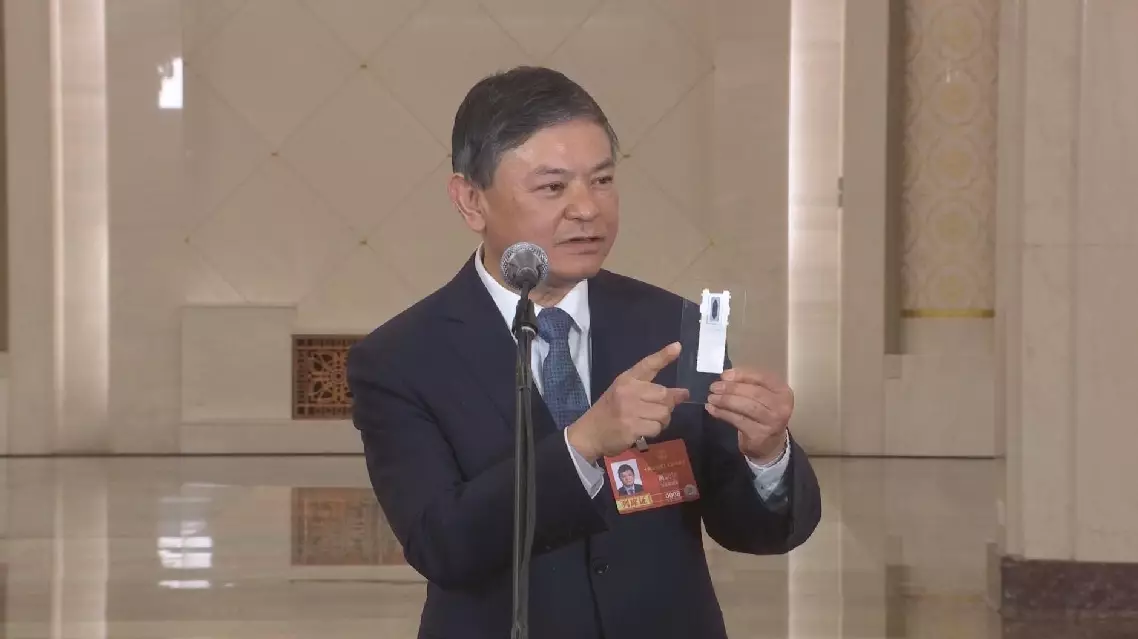
The minister said China has already applied environmental DNA technology in the biodiversity monitoring work.
"In the field of biodiversity monitoring, monitoring aquatic organisms remains a weak point. However, significant progress has been made in recent years as we have developed environmental DNA technology. Although this chip is very small in size, it contains DNA detection information for aquatic organisms, including the finless porpoise and the Chinese sucker, from 19 state-controlled sections in the Jiangsu segment of the Yangtze River. The results showed that over the past five years, more than 20 species of aquatic organisms have increased in this river section, fully demonstrating the tangible effectiveness of the ten-year fishing ban in the Yangtze River," Huang said while showing a chip to reporters.
The 14th NPC, China's national legislature, concluded its fourth session on Thursday.
Smart technologies reshape China's ecological, environmental monitoring system: minister