The purchasing managers' index (PMI) for China's non-manufacturing sector came in at 50.5 in June, up 0.2 percentage points from the previous month, showed official data released Monday.
A reading above 50 indicates expansion, while below 50 reflects contraction.
Click to Gallery
China's non-manufacturing PMI stands at 50.5 in June
China's non-manufacturing PMI stands at 50.5 in June
China's non-manufacturing PMI stands at 50.5 in June
China's non-manufacturing PMI stands at 50.5 in June
The sub-index for the construction sector came in at 52.8 in June, up 1.8 percentage points from the previous month, according to the National Bureau of Statistics (NBS).
The service sector continued to expand, with its sub-index standing at 50.1 in June, the data showed. "By industry, the business activity indexes for sectors such as telecommunications, radio and television broadcasting, satellite transmission services, monetary and financial services, capital market services, and insurance all remained above 60 percent, indicating a high level of prosperity. These sectors also saw rapid growth in overall business volume," said Huo Lihui, director of the business climate survey division of the NBS Service Survey Center.
Meanwhile, the construction sector showed a more pronounced recovery. In June, the construction sector's business activity sub-index rose to 52.8 percent, an increase of 1.8 percentage points compared to the previous month.
Within the construction sector, civil engineering stood out. Its business activity sub-index reached 56.7 percent, remaining above 55 percent for three consecutive months, signaling accelerated activity in infrastructure development.
"As the scope of special bond investment expands, investment-driven construction projects have rebounded significantly. Both housing and civil engineering construction are firmly in expansion territory, demonstrating investment's growing role in stabilizing economic growth," said He Hui, vice president of the China Federation of Logistics and Purchasing.
In contrast, business activity indexes for industries including retail, road transportation, air transportation, accommodation, catering, and real estate are below the boom-bust line.
The new orders index stood at 46.6 in June, an increase of 0.5 percentage points compared to the previous month, indicating a recovery in the market demand for the non-manufacturing sector, according to the NBS data.
Monday's data also showed that the PMI for China's manufacturing sector came in at 49.7 in June, up 0.2 percentage points from May.

China's non-manufacturing PMI stands at 50.5 in June

China's non-manufacturing PMI stands at 50.5 in June

China's non-manufacturing PMI stands at 50.5 in June

China's non-manufacturing PMI stands at 50.5 in June
From cutting-edge technology exhibitions to retail stores thousands of kilometers away from Europe and Southeast Asia, China-made robot vacuum cleaners are increasingly becoming a popular choice among consumers worldwide.
At electronics retailers in Berlin, Germany, Chinese brands such as Roborock and Dreame occupy prominent positions in dedicated robot vacuum sections, offering a wide range of products priced between 200 and 2,000 euros.
Many local consumers said that when purchasing smart home appliances including robot vacuum cleaners, they tend to give priority to Chinese-made products.
"It's a good price and good quality. It's also the innovation. I have a feeling that the European brands are not innovating enough," said one customer.
"I think they're always on top of the other technologies. They are getting them out faster. A lot of us are switching to the Chinese technology," another consumer said.
Germany is one of the most important overseas markets for China's floor-cleaning robots.
According to data from market research firm GfK, from January to November 2025, more than six out of 10 robot vacuum cleaners sold in Western Europe were Chinese brands.
Industry data also point to a strong global momentum.
According to the International Data Corporation (IDC), global shipments of smart robot vacuum cleaners reached 17.424 million units in the first three quarters of 2025, representing a year-on-year increase of 18.7 percent.
Chinese brands including Roborock, Ecovacs, Dreame, Xiaomi and Narwal ranked among the world's top five in terms of shipment volume, with a combined share of nearly 70 percent of the global market.
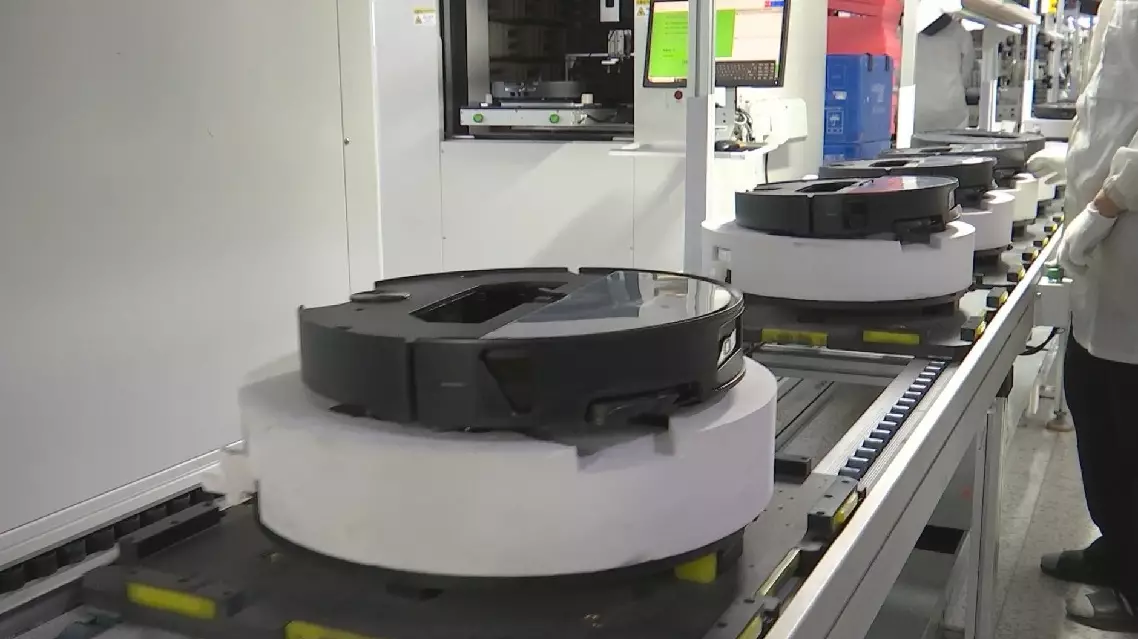
At a robot vacuum cleaner manufacturing plant in Huizhou, south China's Guangdong Province, workers were seen stepping up production of newly launched models that recently debuted at the Consumer Electronics Show in the United States, which concluded Friday in Las Vegas, Nevada.
The factory adjusted its production lines as early as December 2025 and stocked inventory in advance for overseas markets to ensure that new products could be delivered to global consumers at the earliest possible time.
"In 2025, Roborock's global shipments exceeded 7.2 million units. Since 2024, overseas revenue has accounted for more than 50 percent of our total revenue. Our products have now been sold to more than 170 countries and regions, serving more than 20 million households worldwide," said Quan Gang, president of Roborock.
At another robot vacuum cleaner manufacturing facility in Dongguan, Guangdong, rising overseas orders have prompted the company to upgrade its production lines with intelligent technologies to further boost capacity. The factory is currently operating at full load to meet a growing demand.
"For 2026, we have already obtained overseas orders worth at least 300 million to 400 million yuan (around 43 million to 57.3 million U.S. dollars). In addition, we've engaged in strategic cooperation with European home appliance group Cebos Group, and our total confirmed orders have exceeded 600 million yuan (around 86 million U.S. dollars)," said Zhang Junbin, founder and CEO of Narwal Robotics.
Chinese robot vacuum brands gain strong global traction