Thursday's Israeli airstrikes across Gaza killed at least 14 Palestinians, Gaza-based health authorities reported on Friday, while the Israel Defense Forces stated that the strikes resulted in the deaths of two senior Hamas members in the enclave.
The Israeli military said that the airstrikes followed a failed rocket launch from Gaza on Thursday toward an area of Gaza City where Israeli troops were operating.
Gaza health authorities reported that the 14 Palestinians killed included five children, and 17 others were wounded in Israeli attacks over the past day. Officials noted that some victims remain trapped under rubble or in areas inaccessible to rescue teams.
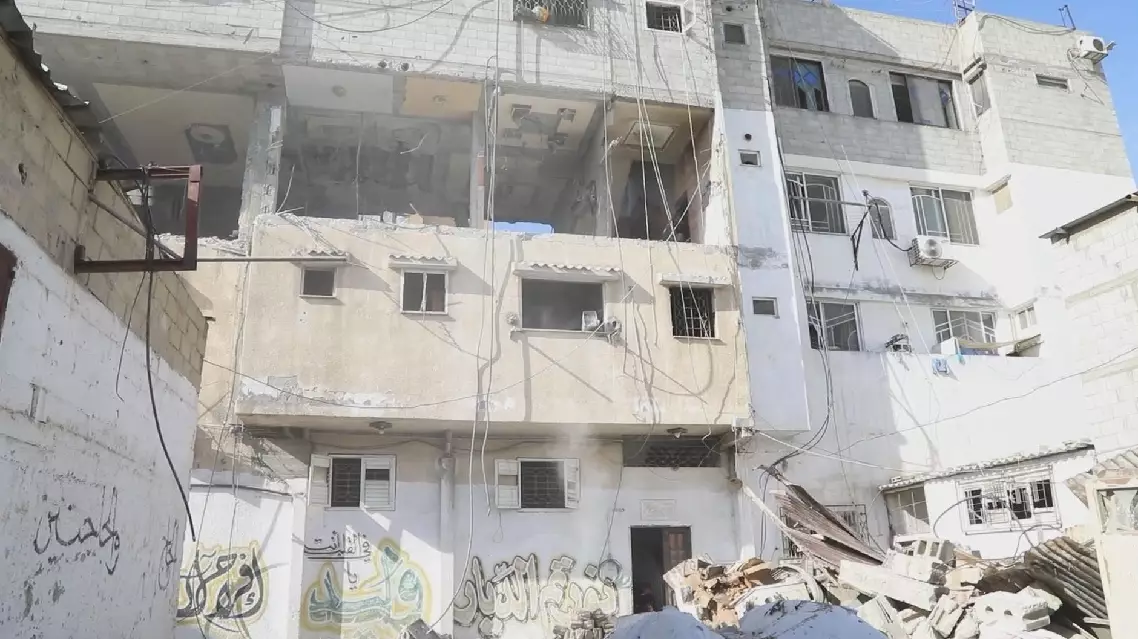
In the Nuseirat refugee camp in central Gaza, an apartment building was hit, resulting in massive destruction and injuries to several people, including a woman.
Eyewitnesses recounted the terrifying moments of Thursday's strike.
"We suddenly heard the sound of shelling. At first, we didn’t know where it was, then we realized the strike had hit our neighbors' home. The explosion was sudden, with massive rubble and destruction. It was purely a civilian house, with children inside," said Ibrahim Al-Majdalawi, an eyewitness.
"I had just stepped out of my shop when the explosion happened. Smoke filled the area and we all ran back inside. The strike hit the Al-Majdalawi family's home, and we are still in shock," said Ali Ballour, another eyewitness.
Other airstrikes targeted the Al-Bureij refugee camp, located near Nuseirat.
These Israeli airstrikes affected various parts of the territory, including al-Mawasi in southern Gaza Strip, where tents were struck, resulting in two fatalities.
In the Askula neighborhood of Gaza City, two more individuals were killed and several others injured.
Since a ceasefire took effect on Oct. 10, 2025, Gaza's death toll has risen to 439 with 1,223 injuries, according to local health authorities. Rescue teams have recovered 688 bodies during that period. In the broader conflict, at least 71,409 Palestinians have been killed and 171,304 wounded since Israel's military campaign in Gaza began in October 2023.
Thursday's Israeli airstrikes across Gaza kill at least 14
China's two major power grid operators -- the State Grid Corporation of China (State Grid) and China Southern Power Grid (CSG) -- reported a surge in investment in the first quarter of 2026, underscoring efforts to strengthen infrastructure construction and support high-quality socioeconomic development in China.
The State Grid said it completed fixed-asset investment worth 129 billion yuan (about 18.77 billion U.S. dollars) in the first three months of this year, up 37 percent the corresponding period of the previous year. The spending has driven more than 250 billion yuan (36 billion U.S. dollars) of investment across the wider industrial chain.
Key projects such as the Panxi ultra-high-voltage (UHV) alternating current (AC) line and the Anhui-Hubei back-to-back direct current (DC) project have seen ground broken for their construction, while several west-to-east power transmission projects have been upgraded.
Investment in connecting renewable energy generation to the grid was reported to have exceeded 10 billion yuan (1.45 billion U.S. dollars) from January to March, a year-on-year rise of more than 50 percent.
The CSG also reported robust growth in investment in the three-month period, with fixed-asset investment reaching 38.45 billion yuan (5.58 billion U.S. dollars), up about 50 percent from a year earlier.
Among its achievements, the company completed and commissioned 80 key projects, including the 220 kV cross-sea power grid interconnection project, which was officially put into operation on March 20. The project ended years of grid isolation on the Weizhou Island in south China by linking it to the main power system of the Guangxi Zhuang Autonomous Region.
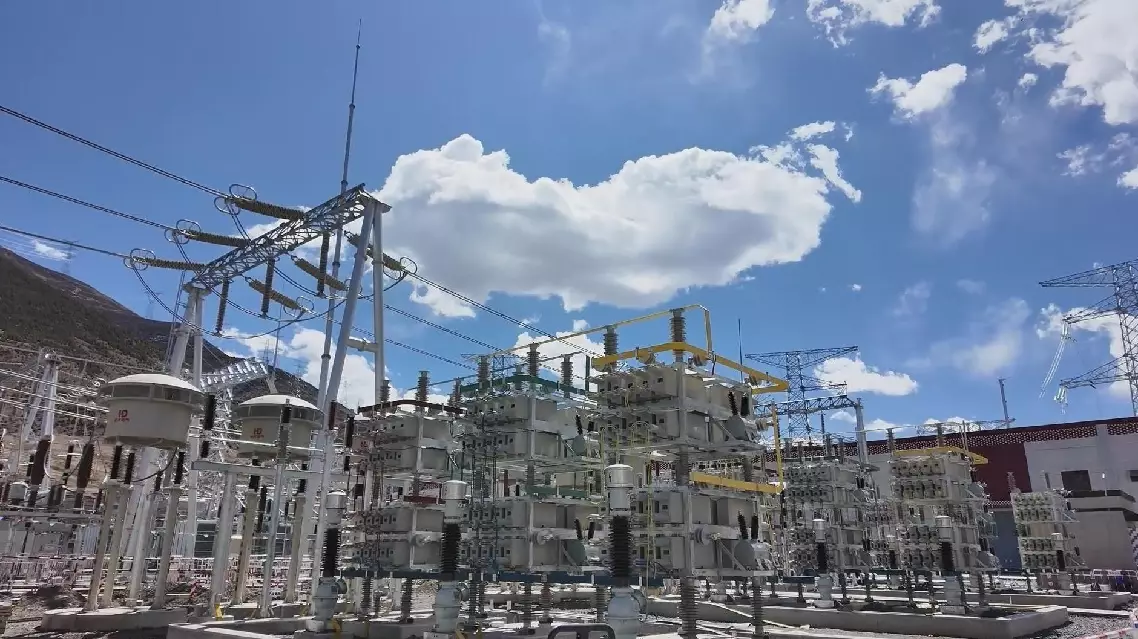
The construction of 17 other major energy projects, including one linking the power grid of the Xizang Autonomous Region in southwest China with that of Guangdong Province in south China, is advancing rapidly. These projects are expected to bolster regional industries, the maritime economy, digital collaboration and the transition to green energy.
"By accelerating major project construction, investment during the 15th Five-Year Plan period (2026-2030) is expected to approach 1 trillion yuan (145 billion U.S. dollars), driving a further 2 trillion yuan (290 billion U.S. dollars) of investment across upstream and downstream industries," said Dong Yanle, deputy general manager of the Engineering Construction Department under the China Southern Power Grid.
China ramps up power grid investment in January-March to boost growth