The Greater Bay Area (GBA), a vibrant city cluster in south China, is integrating Hong Kong's research edge with the mainland's industrial strength and policy support, opening up powerful new possibilities for startups.
In just three years, the Hong Kong University of Science and Technology (Guangzhou) has seen 150 startups launched by students and faculty, more than 70 of them already officially registered companies.
Guangzhou Smart Tech Automation is such a startup that specializes in what its COO Eric Zhang calls hybrid manufacturing, combining metal 3D printing and precision cutting into a single process. Zhang is also a PhD candidate of smart manufacturing at HKUST (GZ).
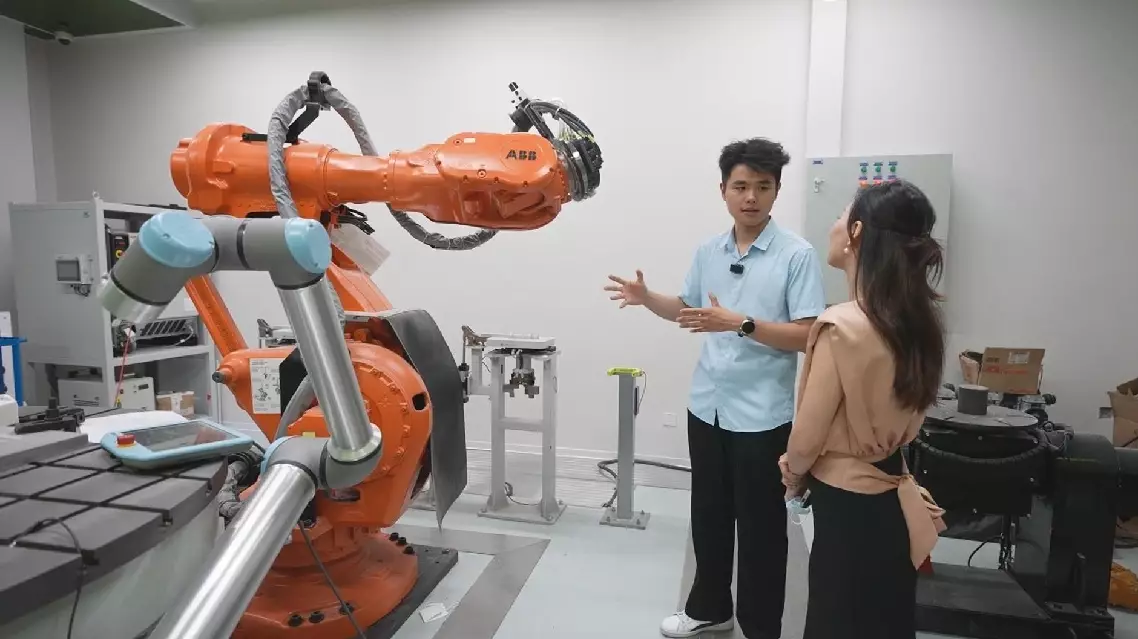
"This is the largest of its kind in the world. It's a printer for titanium alloy. Machine tools do not have such a big working space, and not precise enough. This one could be as precise as being less than 10 micrometers," said Zhang while introducing a massive 3D printer for titanium alloy, a key material for aerospace, energy and advanced machinery.
Zhang said that this process is faster, more efficient and delivers better results. It's ideal for producing or repairing lightweight, complex parts for energy pipelines and offshore wind turbines.
"This is very suitable for our products to do processing and manufacturing. Because in a traditional way, it cannot be shaped in a single process, it could only be done separately, in several tubes, before they were welded together," he said.
The concept originated from Zhang's mentor, Professor Tang Kai, a pioneer in smart manufacturing. At HKUST (GZ), decades of research are now aligned with real-world industrial demand and production capabilities.
"This is essentially an industrial prototype. Based on it, beyond research, we have made attempts to promote industrialization, such as prototyping for our clients. The university has provided many high-end testing instruments and devices, the equipment in the school labs is probably worth 250 million yuan," Zhang said.
That support is paying off. In less than two years, Zhang's team secured 16 million yuan in venture capital and is now expanding into a 1,200-square-meter factory.
"As a university run by the Hong Kong-mainland partnership, we can leverage some of Hong Kong's systems to streamline commercialization. On the whole, the more open, inclusive and connected the ecosystem, the more dynamic it becomes. That is why the state is pushing for policy alignments, capital flows, and cross-border data sharing, and we at HKUST (GZ) are also actively involved in these efforts," said Bai Yu, director of the Entrepreneurship Center and professor of practice at Thrust of Microelectronics at HKUST (GZ).
The local government in Nansha District, where HKUST (GZ) is located, is playing a big role too. It has set up a "patient capital" fund to support companies at every stage of growth. That long-term commitment, paired with Hong Kong's strengths, is aimed to turn the GBA into a world-class innovation powerhouse.
Hong Kong startups thrive with developing Greater Bay Area