Experts, officials, and scholars from China and Hungary stressed the importance of dialogue among civilizations and the need for balanced, inclusive approaches to global human rights governance at a recent seminar on international human rights in Budapest, capital of Hungary.
With the theme "Consensus on International Human Rights: Retrospect of the Past 80 Years and Prospects of the Future," the event was held during a three-day visit by a Chinese delegation, led by Baima Chilin, president of the China Society for Human Rights Studies, with an aim to strengthen exchanges and mutual understanding in the field of human rights. The visit ran from June 23 to 25.
Speaking at the seminar, Baima stressed the importance of international exchanges on human rights. He also called on the international community to respect the diversity of world civilizations and promote fairness and justice in human rights practices.
Also at the seminar, Chinese Ambassador to Hungary Gong Tao underscored the long-standing consensus between the two nations on non-interference and mutual respect regarding human rights matters.
Both countries firmly oppose politicizing human rights issues and reject double standards, he said.
Participants from both sides voiced their shared view that all countries deserve the right to independently choose their own path of advancing human rights, and different civilizations and countries should respect, accommodate, interact with and learn from each other.
"I've maintained a close contact with China over the past 20 years. I first visited China in 2005. I see that they also place a great importance on the development and protection of human rights. It is very important to have a more peaceful dialogue between different cultures in order to understand them better," said Levente Horvath, director of the Eurasia Center of Hungary.
"We believe that China's exemplary policy is a significant contribution to the correct international interpretation of the law. It's not just about the formally announced improvement of human rights, but also about the material guarantees behind it. The eradication of extreme poverty in China, the creation of the social security system, the construction of the world's largest education system all serve human rights. We would like to take over and learn from these experiences," said Thurmer Gyula, president of the Hungarian Workers' Party.
Co-hosted by the China Society for Human Rights Studies, the Chinese Embassy in Hungary, and the Eurasia Center of Hungary, the seminar gathered more than 20 participants, including government officials, scholars, political figures, and media representatives.
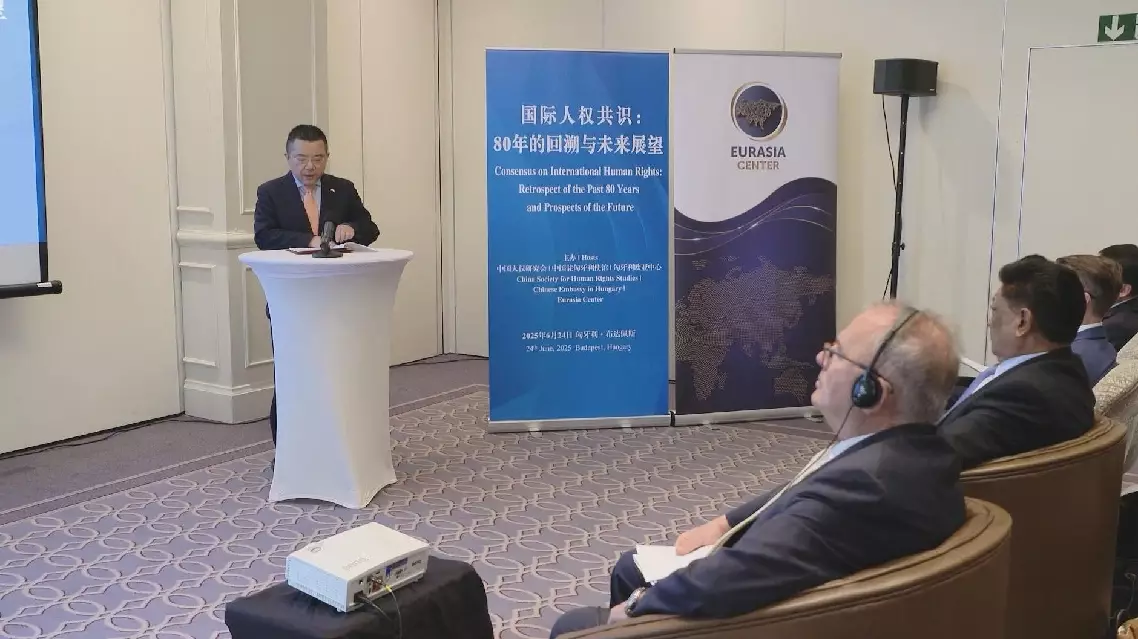
China, Hungary hold seminar on int'l human rights in Budapest