TOPEKA, Kan. (AP) — The U.S. government is preparing to breed billions of flies and dump them out of airplanes over Mexico and southern Texas to fight a flesh-eating maggot.
That sounds like the plot of a horror movie, but it is part of the government's plans for protecting the U.S. from a bug that could devastate its beef industry, decimate wildlife and even kill household pets. This weird science has worked well before.
“It’s an exceptionally good technology,” said Edwin Burgess, an assistant professor at the University of Florida who studies parasites in animals, particularly livestock. “It’s an all-time great in terms of translating science to solve some kind of large problem.”
The targeted pest is the flesh-eating larva of the New World Screwworm fly. The U.S. Department of Agriculture plans to ramp up the breeding and distribution of adult male flies — sterilizing them with radiation before releasing them. They mate with females in the wild, and the eggs laid by the female aren't fertilized and don't hatch. There are fewer larvae, and over time, the fly population dies out.
It is more effective and environmentally friendly than spraying the pest into oblivion, and it is how the U.S. and other nations north of Panama eradicated the same pest decades ago. Sterile flies from a factory in Panama kept the flies contained there for years, but the pest appeared in southern Mexico late last year.
The USDA expects a new screwworm fly factory to be up and running in southern Mexico by July 2026. It plans to open a fly distribution center in southern Texas by the end of the year so that it can import and distribute flies from Panama if necessary.
Most fly larvae feed on dead flesh, making the New World screwworm fly and its Old World counterpart in Asia and Africa outliers — and for the American beef industry, a serious threat. Females lay their eggs in wounds and, sometimes, exposed mucus.
“A thousand-pound bovine can be dead from this in two weeks,” said Michael Bailey, president elect of the American Veterinary Medicine Association.
Veterinarians have effective treatments for infested animals, but an infestation can still be unpleasant — and cripple an animal with pain.
Don Hineman, a retired western Kansas rancher, recalled infected cattle as a youngster on his family's farm.
“It smelled nasty,” he said. “Like rotting meat.”
The New World screwworm fly is a tropical species, unable to survive Midwestern or Great Plains winters, so it was a seasonal scourge. Still, the U.S. and Mexico bred and released more than 94 billion sterile flies from 1962 through 1975 to eradicate the pest, according to the USDA.
The numbers need to be large enough that females in the wild can't help but hook up with sterile males for mating.
One biological trait gives fly fighters a crucial wing up: Females mate only once in their weekslong adult lives.
Alarmed about the fly's migration north, the U.S. temporarily closed its southern border in May to imports of live cattle, horses and bison and it won't be fully open again at least until mid-September.
But female flies can lay their eggs in wounds on any warm-blooded animal, and that includes humans.
Decades ago, the U.S. had fly factories in Florida and Texas, but they closed as the pest was eradicated.
The Panama fly factory can breed up to 117 million a week, but the USDA wants the capacity to breed at least 400 million a week. It plans to spend $8.5 million on the Texas site and $21 million to convert a facility in southern Mexico for breeding sterile fruit flies into one for screwworm flies.
In one sense, raising a large colony of flies is relatively easy, said Cassandra Olds, an assistant professor of entomology at Kansas State University.
But, she added, “You’ve got to give the female the cues that she needs to lay her eggs, and then the larvae have to have enough nutrients.”
Fly factories once fed larvae horse meat and honey and then moved to a mix of dried eggs and either honey or molasses, according to past USDA research. Later, the Panama factory used a mix that included egg powder and red blood cells and plasma from cattle.
In the wild, larvae ready for the equivalent of a butterfly’s cocoon stage drop off their hosts and onto the ground, burrow just below the surface and grow to adulthood inside a protective casing making them resemble a dark brown Tic Tac mint. In the Panama factory, workers drop them into trays of sawdust.
Security is an issue. Sonja Swiger, an entomologist with Texas A&M University’s Extension Service, said a breeding facility must prevent any fertile adults kept for breeding stock from escaping.
Dropping flies from the air can be dangerous. Last month, a plane freeing sterile flies crashed near Mexico’s border with Guatemala, killing three people.
In test runs in the 1950s, according to the USDA, scientists put the flies in paper cups and then dropped the cups out of planes using special chutes. Later, they loaded them into boxes with a machine known as a “Whiz Packer.”
The method is still much the same: Light planes with crates of flies drop those crates.
Burgess called the development of sterile fly breeding and distribution in the 1950s and 1960s one of the USDA’s “crowning achievements.”
Some agriculture officials argue now that new factories shouldn’t be shuttered after another successful fight.
“Something we think we have complete control over — and we have declared a triumph and victory over — can always rear its ugly head again,” Burgess said.
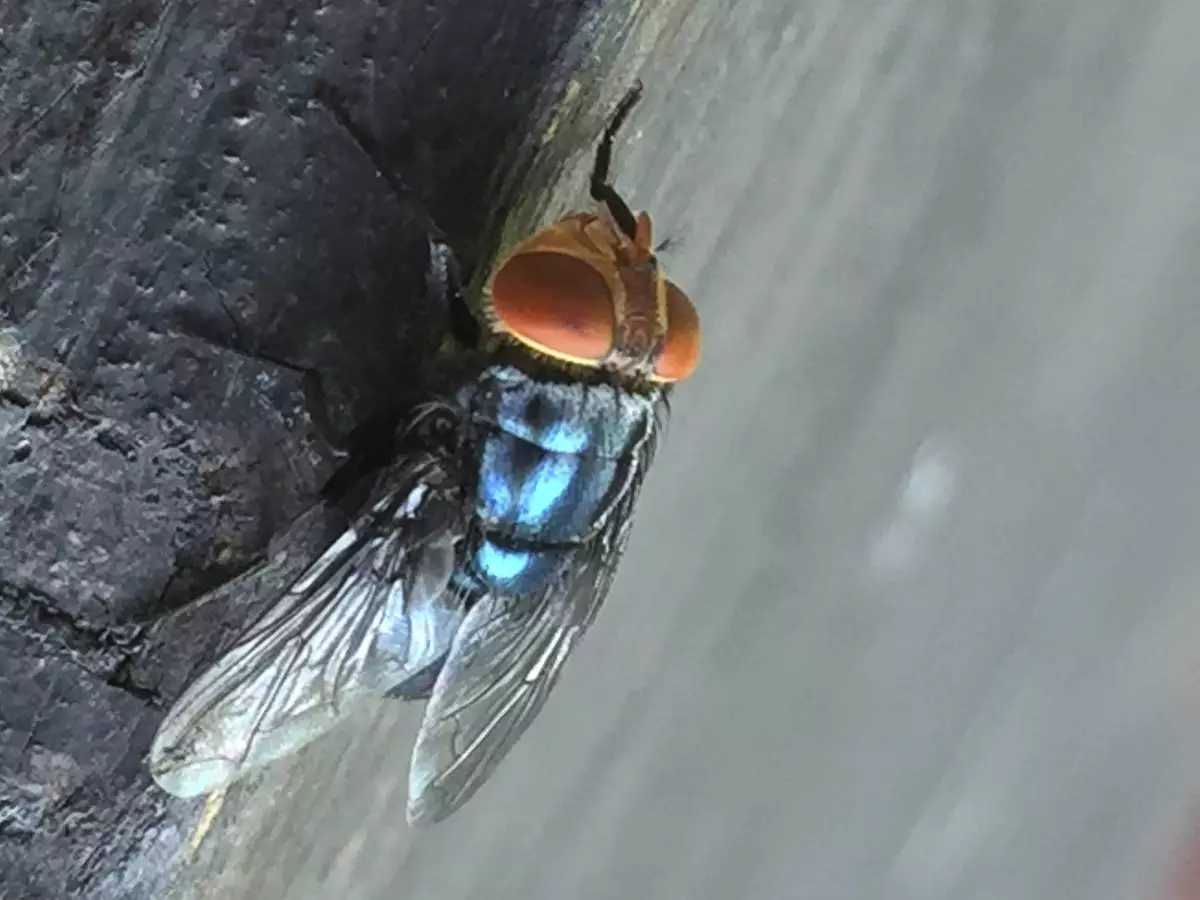
An adult New World screwworm fly sits at rest in this undated photo. (Denise Bonilla/U.S. Department of Agriculture via AP)
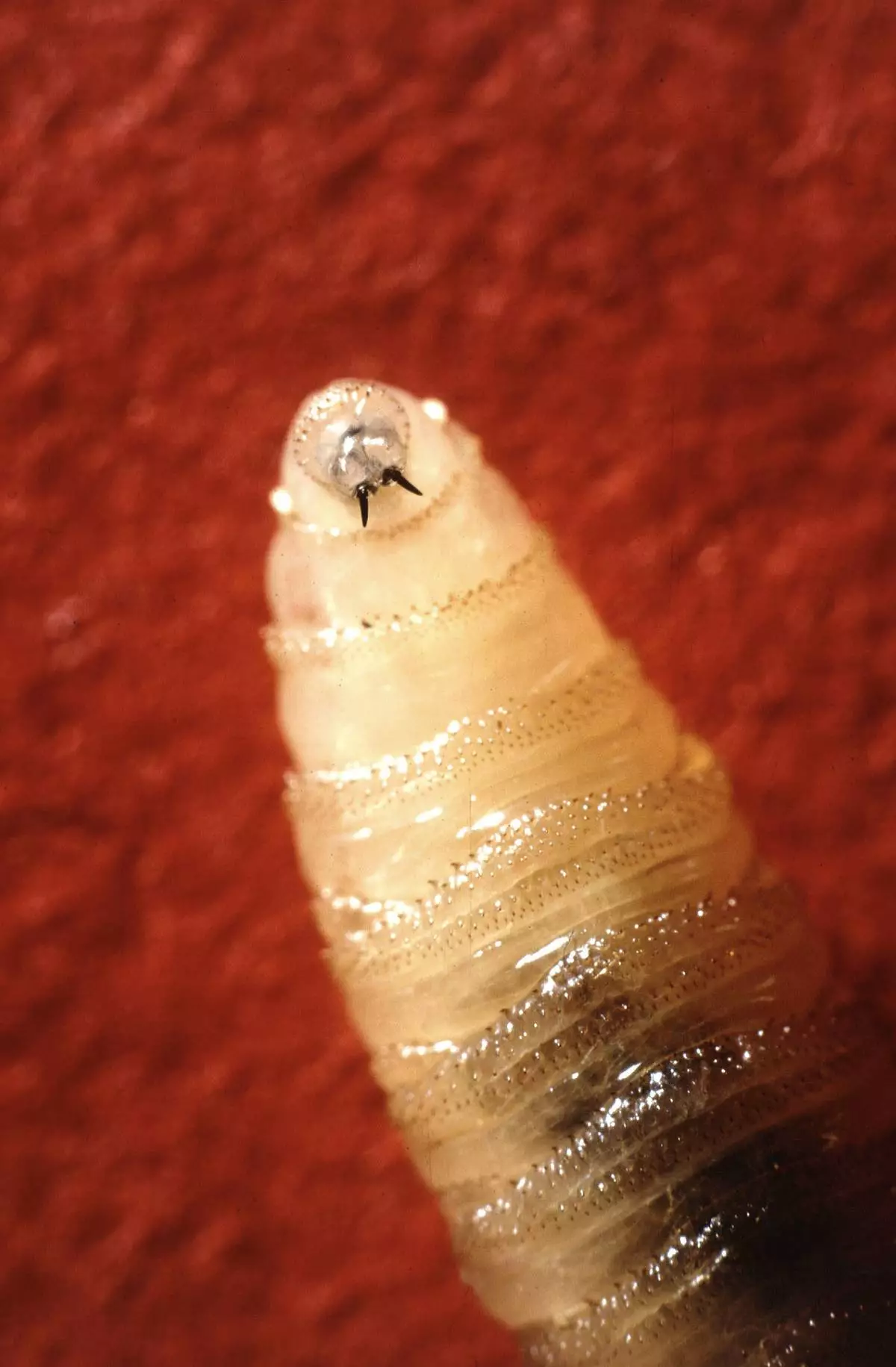
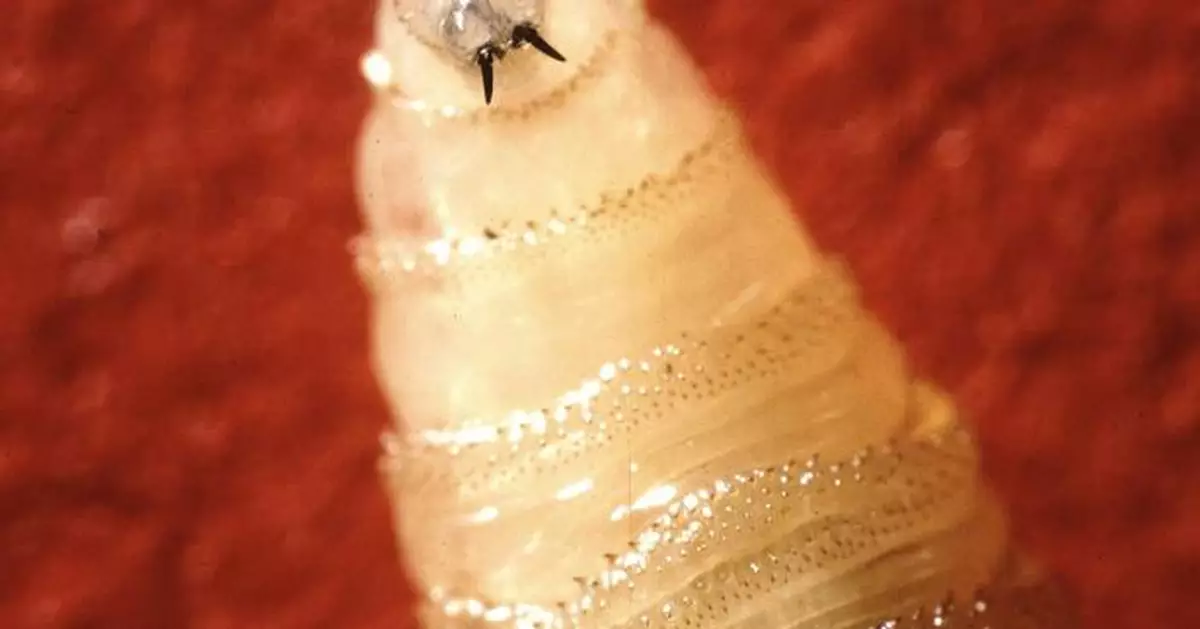
A New World screwworm larvae sits at rest in this undated photo. (USDA Agricultural Research Service via AP)
NEW YORK (AP) — Reviving a campaign pledge, President Donald Trump wants a one-year, 10% cap on credit card interest rates, a move that could save Americans tens of billions of dollars but drew immediate opposition from an industry that has been in his corner.
Trump was not clear in his social media post Friday night whether a cap might take effect through executive action or legislation, though one Republican senator said he had spoken with the president and would work on a bill with his “full support.” Trump said he hoped it would be in place Jan. 20, one year after he took office.
Strong opposition is certain from Wall Street in addition to the credit card companies, which donated heavily to his 2024 campaign and have supported Trump's second-term agenda. Banks are making the argument that such a plan would most hurt poor people, at a time of economic concern, by curtailing or eliminating credit lines, driving them to high-cost alternatives like payday loans or pawnshops.
“We will no longer let the American Public be ripped off by Credit Card Companies that are charging Interest Rates of 20 to 30%,” Trump wrote on his Truth Social platform.
Researchers who studied Trump’s campaign pledge after it was first announced found that Americans would save roughly $100 billion in interest a year if credit card rates were capped at 10%. The same researchers found that while the credit card industry would take a major hit, it would still be profitable, although credit card rewards and other perks might be scaled back.
About 195 million people in the United States had credit cards in 2024 and were assessed $160 billion in interest charges, the Consumer Financial Protection Bureau says. Americans are now carrying more credit card debt than ever, to the tune of about $1.23 trillion, according to figures from the New York Federal Reserve for the third quarter last year.
Further, Americans are paying, on average, between 19.65% and 21.5% in interest on credit cards according to the Federal Reserve and other industry tracking sources. That has come down in the past year as the central bank lowered benchmark rates, but is near the highs since federal regulators started tracking credit card rates in the mid-1990s. That’s significantly higher than a decade ago, when the average credit card interest rate was roughly 12%.
The Republican administration has proved particularly friendly until now to the credit card industry.
Capital One got little resistance from the White House when it finalized its purchase and merger with Discover Financial in early 2025, a deal that created the nation’s largest credit card company. The Consumer Financial Protection Bureau, which is largely tasked with going after credit card companies for alleged wrongdoing, has been largely nonfunctional since Trump took office.
In a joint statement, the banking industry was opposed to Trump's proposal.
“If enacted, this cap would only drive consumers toward less regulated, more costly alternatives," the American Bankers Association and allied groups said.
Bank lobbyists have long argued that lowering interest rates on their credit card products would require the banks to lend less to high-risk borrowers. When Congress enacted a cap on the fee that stores pay large banks when customers use a debit card, banks responded by removing all rewards and perks from those cards. Debit card rewards only recently have trickled back into consumers' hands. For example, United Airlines now has a debit card that gives miles with purchases.
The U.S. already places interest rate caps on some financial products and for some demographics. The Military Lending Act makes it illegal to charge active-duty service members more than 36% for any financial product. The national regulator for credit unions has capped interest rates on credit union credit cards at 18%.
Credit card companies earn three streams of revenue from their products: fees charged to merchants, fees charged to customers and the interest charged on balances. The argument from some researchers and left-leaning policymakers is that the banks earn enough revenue from merchants to keep them profitable if interest rates were capped.
"A 10% credit card interest cap would save Americans $100 billion a year without causing massive account closures, as banks claim. That’s because the few large banks that dominate the credit card market are making absolutely massive profits on customers at all income levels," said Brian Shearer, director of competition and regulatory policy at the Vanderbilt Policy Accelerator, who wrote the research on the industry's impact of Trump's proposal last year.
There are some historic examples that interest rate caps do cut off the less creditworthy to financial products because banks are not able to price risk correctly. Arkansas has a strictly enforced interest rate cap of 17% and evidence points to the poor and less creditworthy being cut out of consumer credit markets in the state. Shearer's research showed that an interest rate cap of 10% would likely result in banks lending less to those with credit scores below 600.
The White House did not respond to questions about how the president seeks to cap the rate or whether he has spoken with credit card companies about the idea.
Sen. Roger Marshall, R-Kan., who said he talked with Trump on Friday night, said the effort is meant to “lower costs for American families and to reign in greedy credit card companies who have been ripping off hardworking Americans for too long."
Legislation in both the House and the Senate would do what Trump is seeking.
Sens. Bernie Sanders, I-Vt., and Josh Hawley, R-Mo., released a plan in February that would immediately cap interest rates at 10% for five years, hoping to use Trump’s campaign promise to build momentum for their measure.
Hours before Trump's post, Sanders said that the president, rather than working to cap interest rates, had taken steps to deregulate big banks that allowed them to charge much higher credit card fees.
Reps. Alexandria Ocasio-Cortez, D-N.Y., and Anna Paulina Luna, R-Fla., have proposed similar legislation. Ocasio-Cortez is a frequent political target of Trump, while Luna is a close ally of the president.
Seung Min Kim reported from West Palm Beach, Fla.
President Donald Trump arrives on Air Force One at Palm Beach International Airport, Friday, Jan. 9, 2025, in West Palm Beach, Fla. (AP Photo/Julia Demaree Nikhinson)
FILE - Visa and Mastercard credit cards are shown in Buffalo Grove, Ill., Feb. 8, 2024. (AP Photo/Nam Y. Huh, File)