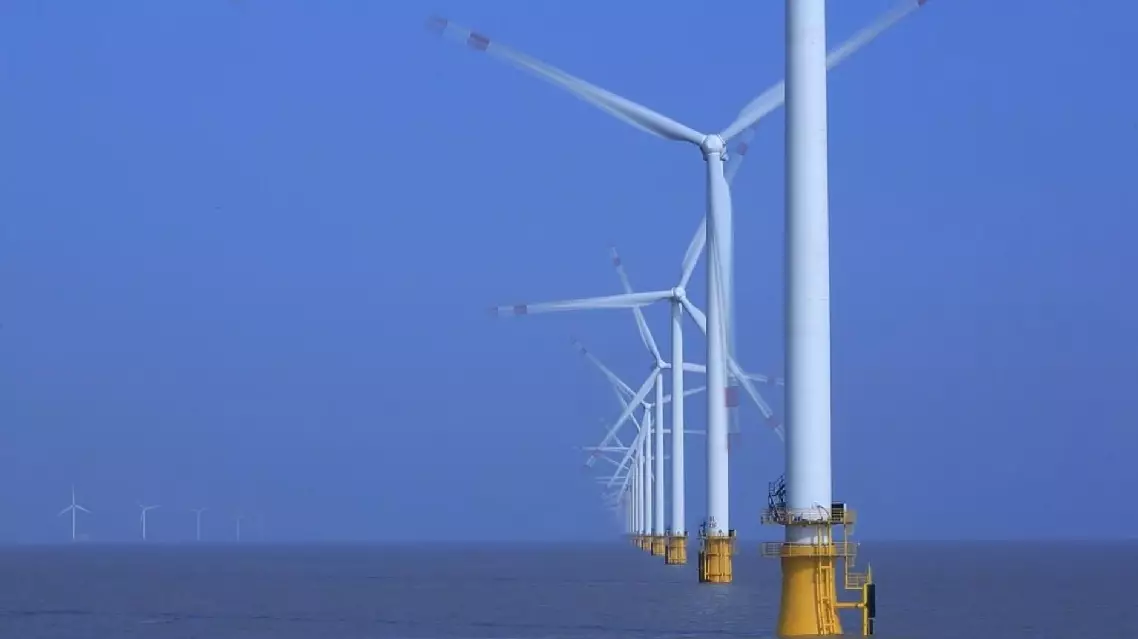
China took a major leap in far-offshore wind power on Friday as the first turbine of the country's farthest-reaching offshore wind project was connected to the national grid.
Located 85.5 kilometers off the coast at its farthest point, the 800-megawatt Dafeng Offshore Wind Farm marked its initial grid connection on Friday morning, as the blades of Turbine No. 9 began turning in the sea northeast of Yancheng City's Dafeng District.
"The successful grid connection of this project has validated the feasibility of deep-sea offshore wind power development, significantly expanding the scope of wind energy utilization. We are striving to achieve full-capacity grid connection as early as possible this year. Once operational, the project is expected to deliver over 2.6 billion kWh of clean electricity annually to the grid -- enough to power approximately 1.1 million three-person households for a full year," said Liu Yu, project manager of the 800 MW Dafeng Offshore Wind Power Project, contracted by the Jiangsu Branch of China Three Gorges Corporation.
Global offshore wind resources exceed 710 billion kW, with more than 70 percent located in far-offshore areas, though less than 0.5 percent of this potential has been utilized.
Far-offshore locations offer stronger and more consistent winds, with average speeds reaching over nine meters per second compared to nearshore areas.
The Dafeng project's successful grid connection demonstrates China's progress in overcoming the technical challenges of operating far-offshore wind farms, including long-distance power transmission and maintenance in harsh open-sea conditions.
China's farthest offshore wind farm connects to grid