LONDON (AP) — Emma Raducanu expressed frustration with having to get a couple of her rackets re-strung during her third-round loss to top-ranked Aryna Sabalenka at Wimbledon on Friday.
The British player let leads slip in both sets of her 7-6 (6), 6-4 loss at Centre Court with the retractable roof closed.
“I felt like the ball was flying. I had all my rackets strung up fresh for the match, and it just felt like it was pinging completely different,” Raducanu said. "It could have been a little bit because the roof was on. I sent a couple rackets to be re-strung.
“But it takes, like, 20 minutes by the time they turn it over. Still, it was a bit difficult. So I’m frustrated with that part maybe, small details. But I don’t think I could have made different choices. I think I should have just executed better.”
Sabalenka agreed “the balls were flying more,” she suspected, because of higher humidity with the roof closed.
The three-time Grand Slam champion said her team typically has extra rackets ready.
“They always have like two extra rackets with the higher tension and two extra rackets with lower tension. They prepare it. You don’t have to wait for another racket,” Sabalenka said.
Sabalenka said she lost in the 2023 French Open semifinals to Karolina Muchova “because I didn’t have racket” with the right tension.
“We weren’t prepared. I didn’t have a right tension. I had to play with a lower tension. I didn’t control the ball, didn’t feel well,” she said.
“After that experience," she continued, "we learned it’s four extra rackets in my team’s bag just in case. You never know. You can wake up and feel great with one tension. Another day you wake up and you don’t feel at all. You got to be prepared.”
AP tennis: https://apnews.com/hub/tennis

Emma Raducanu of Britain returns to Aryna Sabalenka of Belarus during a third round women's singles match at the Wimbledon Tennis Championships in London, Friday, July 4, 2025. (AP Photo/Kin Cheung)

Emma Raducanu of Britain returns to Aryna Sabalenka of Belarus during a third round women's singles match at the Wimbledon Tennis Championships in London, Friday, July 4, 2025. (AP Photo/Kin Cheung)
The U.S. government admitted Wednesday that the actions of an air traffic controller and Army helicopter pilot played a role in causing the collision last January between an airliner and a Black Hawk near the nation's capital, killing 67 people.
It was the deadliest crash on American soil in more than two decades.
The official response to the first lawsuit filed by one of the victims’ families said that the government is liable in the crash partly because the air traffic controller violated procedures about when to rely on pilots to maintain visual separation that night. Plus, the filing said, the Army helicopter pilots' “failure to maintain vigilance so as to see and avoid” the airline jet makes the government liable.
But the filing suggested that others, including the pilots of the jet and the airlines, may also have played a role. The lawsuit also blamed American Airlines and its regional partner, PSA Airlines, for roles in the crash, but those airlines have filed motions to dismiss.
And the government denied that any air traffic controllers or officials at the Federal Aviation Administration or Army were negligent.
At least 28 bodies were pulled from the icy waters of the Potomac River after the helicopter collided with the American Airlines regional jet while it was landing at Ronald Reagan National Airport in northern Virginia, just across the river from Washington, D.C., officials said. The plane carried 60 passengers and four crew members, and three soldiers were aboard the helicopter.
Robert Clifford, one of the attorneys for the family of victim Casey Crafton, said the government admitted “the Army’s responsibility for the needless loss of life” and the FAA’s failure to follow air traffic control procedures while “rightfully” acknowledging others –- American Airlines and PSA Airlines -– also contributed to the deaths.
The families of the victims “remain deeply saddened and anchored in the grief caused by this tragic loss of life,” he said.
The government's lawyers said in the filing that “the United States admits that it owed a duty of care to plaintiffs, which it breached, thereby proximately causing the tragic accident.”
An American spokesman declined to comment on the filing, but in the airline's motion to dismiss, American said "plaintiffs’ proper legal recourse is not against American. It is against the United States government ... The Court should therefore dismiss American from this lawsuit.” The airline said that since the crash it has focused on supporting the families of the victims.
The National Transportation Safety Board will release its report on the cause of the crash early next year, but investigators have already highlighted a number of factors that contributed, including the helicopter flying 78 feet higher (24 meters) than the 200-foot (61-meter) limit on a route that allowed only scant separation between planes landing on Reagan's secondary runway and helicopters passing below. Plus, the NTSB said, the FAA failed to recognize the dangers around the busy airport even after 85 near misses in the three years before the crash.
The government admitted in its filing that the United States “was on notice of certain near-miss events between its Army-operated Black Hawk helicopters and aircraft traffic transiting in and around helicopter routes 1 and 4” around Washington.
Before the collision, the controller twice asked the helicopter pilots whether they had the jet in sight, and the pilots said they did and asked for visual separation approval so they could use their own eyes to maintain distance. FAA officials acknowledged at the NTSB’s investigative hearings that the controllers at Reagan had become overly reliant on the use of visual separation. That’s a practice the agency has since ended.
Witnesses told the NTSB that they have serious questions about how well the helicopter crew could spot the plane while wearing night vision goggles and whether the pilots were even looking in the right spot.
Investigators have said the helicopter pilots might not have realized how high they were because the barometric altimeter they were relying on was reading 80 to 100 feet (24 to 30 meters) lower than the altitude registered by the flight data recorder.
The crash victims included a group of elite young figure skaters, their parents and coaches who had just attended a competition in Wichita, Kansas, and four union steamfitters from the Washington area.
.

FILE - Attorney Bob Clifford speaks during a news conference regarding the Jan. 29, 2025, mid-air collision between American Eagle flight 5342 and a U.S. Army Black Hawk Helicopter, at the National Press Club, Sept. 24, 2025, in Washington. (AP Photo/Rod Lamkey, Jr., File)
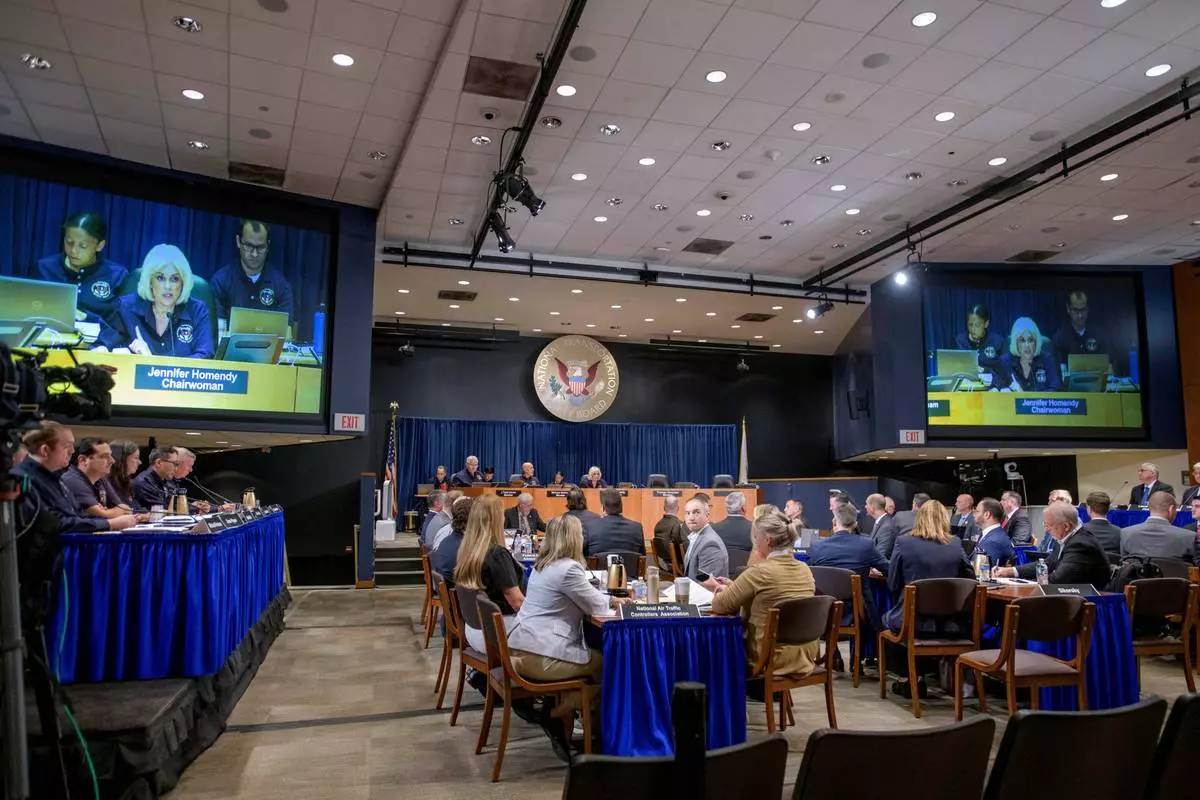
FILE - National Transportation Safety Board Chairwoman Jennifer Homendy speaks during the NTSB fact-finding hearing on the DCA midair collision accident, at the National Transportation and Safety Board boardroom, July 30, 2025, in Washington. (AP Photo/Rod Lamkey, Jr., File)