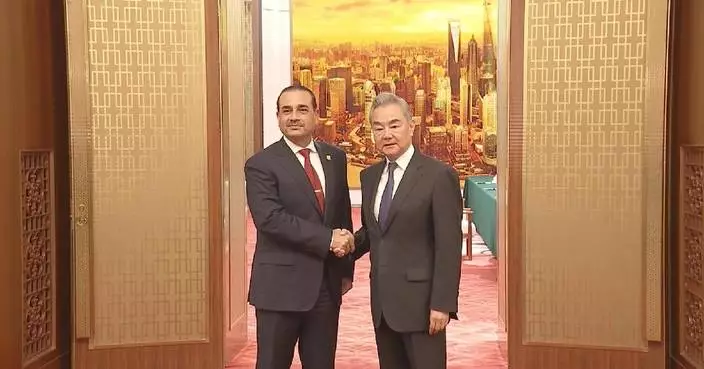
Mari Elka Pangestu, Indonesian President's Special Envoy for International Trade and Multilateral Cooperation, shared her insights what Indonesia hopes to gain from joining the BRICS mechanism amid global trade uncertainties.
The 17th BRICS Summit is held in Rio de Janeiro, Brazil, on Sunday and Monday.
Originally composed of Brazil, Russia, India, China, and South Africa, the BRICS group admitted six new members -- Ethiopia, Egypt, Iran, Indonesia, Saudi Arabia and the United Arab Emirates from 2024 to 2025.
In an exclusive interview with China Global Television Network (CGTN), Pangestu, also the former managing director of Development Policy and Partnerships in the World Bank, noted that uncertainties brought by U.S. tariffs and conflicts in the Middle East force many nations including Indonesia to face the ripple effects, and take a toll on global economic growth.
"It's basically a lot of uncertainty related to the reciprocal tariffs imposed by the U.S., it's related to the conflicts that are happening in the Middle East, and a lot of other uncertainty about how will the impact of the tariffs affect the U.S., affect China, because it will then have knock-on effects on countries like Indonesia. So that's why if you look at the growth projections, most recent growth projections, they've all been revised downwards, right? So I think at the broad level, we know that the global economy is going to be growing at a much slower pace because of so much uncertainty," she said.
When asked about the impacts of U.S. tariffs on Indonesia, Pangestu said certain labor-intensive industries, including textiles, garments, footwear, furniture, and seafood, are vulnerable to tariff increases with a lot of jobs expected to be at risk.
"So certain sectors will be hard hit. And these are the sectors which are labor intensive, so employing a lot of labor. In fact, I think there's an estimate there that it can endanger unemployment up to 1.5 million. And we also need to worry about if there is an actual trade war and there's an impact on China, that will also have an impact on us to the extent that China is going to have a slowdown that's going to affect our exports. So for now, we probably, hopefully we'll see a bit more positive outlook of avoiding a trade war," she said.
Pangestu expressed optimism about the potential benefits for Indonesia after it joined the BRICS mechanism, particularly in terms of investment opportunities and economic cooperation.
She noted that one of the key advantages of joining BRICS is access to the New Development Bank (NDB), an institution that aims to mobilize resources for infrastructure and sustainable development projects in BRICS member nations and other emerging-market economies and developing countries.
"If you look at the economic benefits of joining BRICS is the New Development Bank, which is still quite small, but, you know, potentially it can become also a regional or maybe a multilateral bank, which is really based and founded by developing countries. So participating in that and having the financing, the access to the financing for projects are benefiting the BRICS countries," she said.
Pangestu also highlighted how Indonesia's experience in regional cooperation, especially within the Association of Southeast Asian Nations (ASEAN), could prove valuable in shaping the future of BRICS.
"So we would think that we could bring our experience within ASEAN and the ASEAN values into BRICS, like ASEAN values, like mutual respect for sovereignty, peaceful resolution of conflict, and non-interference, for instance, are basic ASEAN values, which I think would work also in the context of where we're having developing countries in a BRICS platform, trying to work together and cooperate together," she said.

Indonesian presidential trade envoy highlights BRICS opportunities amid global trade uncertainties