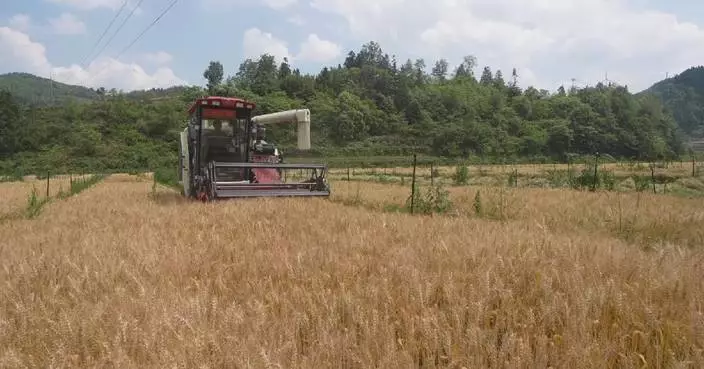
Kunyu City of northwest China's Xinjiang Uygur Autonomous Region has started its first-ever oat harvest on the edge of the Taklamakan Desert, the largest desert in China.
At a 2,000-mu (about 133 hectares) oat planting base, harvesters are working in circular patterns in the round oat fields.
Oat planting was introduced to the city in April this year, when local farmers used bulldozers to flatten the sand dunes and deployed self-propelled sprinklers to irrigate the fields.
The sprinkler system rotates and sprays water around a central point, functioning like the hands of a clock.
To accommodate to the sprinkler system, the oat fields were also designed in a circular layout.
Alfalfa has been intercropped between the rows of oat crops to enhance soil quality and fertilize the fields.
"Why do we cultivate alfalfa in the desert? Because it improves soil quality and is well-suited for sandy land due to its well-developed root system. Alfalfa can conserve water, prevent wind, fix drifting sand, and enriches the soil," said Xu Zhaoyang, a technical consultant at the oat planting base.
Alfalfa is a drought-resistant, high-quality forage grass that can be harvested three to four times a year. Therefore, intercropping oats with alfalfa increases land utilization, boosts yields, and benefits the environment.

Oats harvested on edge of Taklamakan Desert for first time
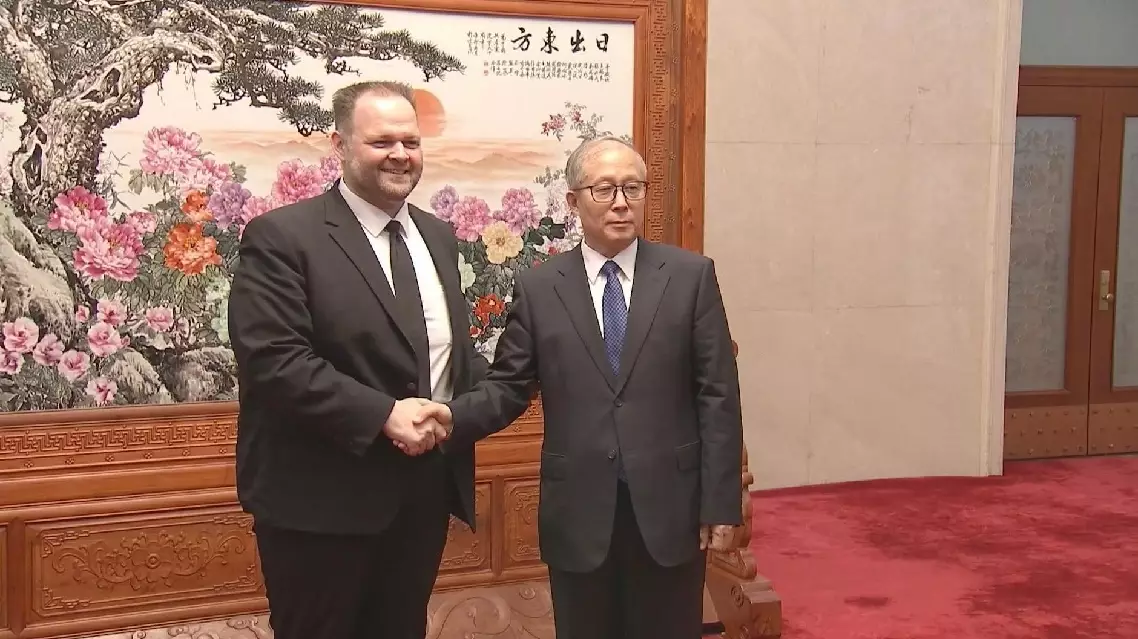
President of the Republic of Korea (ROK) Lee Jae Myung has expressed his hope that his upcoming visit to China will help eliminate past misunderstandings and issues, underscoring the importance of ties between the two countries.
At the invitation of Chinese President Xi Jinping, Lee will pay a state visit to China from Jan 4 to 7. It will be Lee's first visit to China since he took office.
In an interview with China Media Group (CMG) in Seoul on Wednesday, Lee acknowledged the existing misunderstandings and issues between the two countries, noting that addressing these issues is a key goal of his visit.
"The current international landscape is turbulent, with escalating issues among various countries. In this context, the relationship between the Republic of Korea and China holds significant importance for us. the ROK and China are deeply interconnected in many areas, including history, economy, geopolitics, politics and security. Northeast Asia's peace, stability, mutual respect, and common prosperity are crucial for both countries," said Lee.
"Admittedly, there have been some misunderstandings and issues between the ROK and China, which have hindered the development of bilateral relations to some extent. Therefore, the purpose of my upcoming visit to China is to minimize or eliminate these past issues, foster a leap in our bilateral relations to a new level, and solidify the ROK and China as partners that mutually support each other's development," he said.
ROK President hopes to reduce misunderstandings with China during upcoming visit