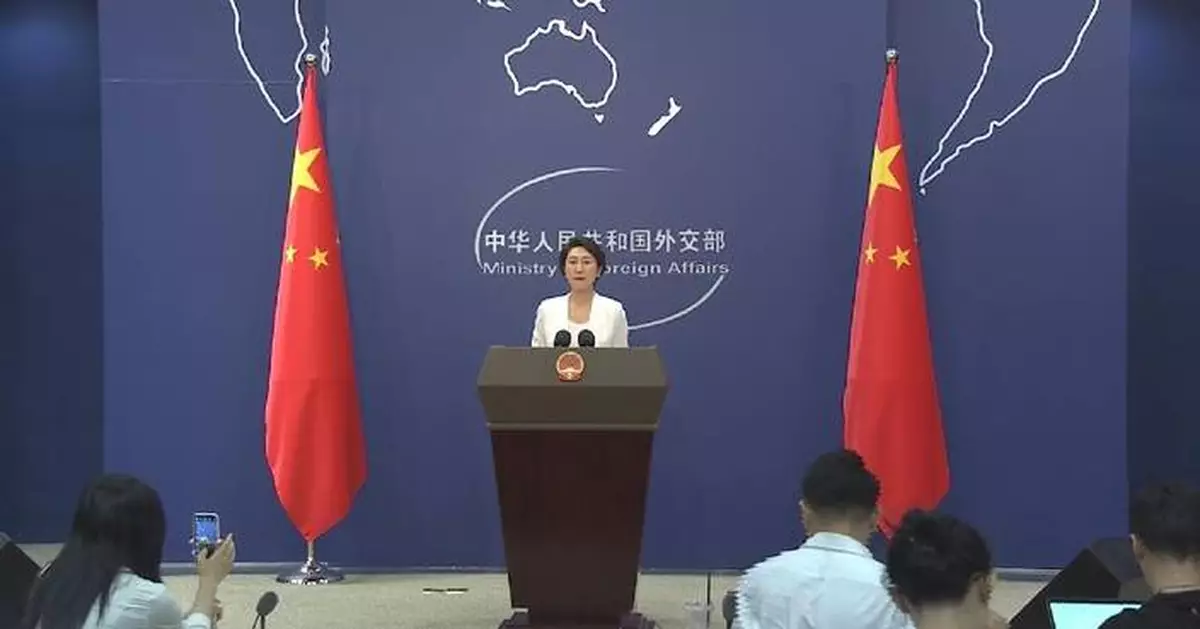
China is willing to work with BRICS partners to push for more just, reasonable, efficient and orderly global governance, said Foreign Ministry spokeswoman Mao Ning at a press briefing in Beijing on Tuesday when commenting on the 17th BRICS Summit held in Rio de Janeiro.
"Premier Li Qiang attended the 17th BRICS Summit in Rio de Janeiro from July 6 to 7. Premier Li Qiang pointed out that changes unseen in a century are unfolding now at a faster pace, international rules and order face serious challenges, and the authority and efficacy of multilateral mechanisms are weakening. The vision of global governance featuring extensive consultation, joint contribution and shared benefits put forward by President Xi Jinping has further demonstrated its contemporary value and practical significance. All parties need the spirit of equality and respect to enable more extensive consultation, united and collaborative actions to enhance our joint contribution, and wholehearted embrace of other’s success as our own to expand shared benefits," Mao said.
"As the leading forces of the Global South, BRICS countries should uphold independence and self-reliance, and strive to become a vanguard in promoting the reform of global governance. It is necessary to hold fast to morality and justice, safeguard world peace and tranquility, focus on development and bolster the drivers of economic growth, foster inclusiveness and advance exchanges and mutual learning among civilizations," she said.
"Greater BRICS cooperation should safeguard and practice multilateralism. It should be committed to building an open world economy, enhancing international financial cooperation and unlocking new, promising areas in economic growth. It should unequivocally oppose unilateralism and protectionism, and keep the industrial and supply chains stable and smooth," Mao said.
The meeting adopted the Rio de Janeiro Declaration, the Statement on Global Governance of Artificial Intelligence and the Climate Finance Framework Declaration, she added.
"China is willing to take this leaders' meeting as an opportunity to continue to uphold the 'BRICS spirit' and work with BRICS partners to promote common values, safeguard common interests, promote self-improvement through unity, and push the development of global governance toward a more just, reasonable, efficient and orderly direction, and join hands in building a better world," she said.
Spokeswoman on BRICS Summit in Rio
China's embodied intelligence and robotics sectors are experiencing rapid growth as Chinese tech firms have won greater capital support and raised more funds in 2025 than a year earlier.
In the first five months of 2025, startups specializing in embodied intelligence secured more than 23 billion yuan (3.2 billion U.S. dollars), already exceeding the total investment recorded for the full year of 2024.
Embodied AI integrates artificial intelligence (AI) into physical bodies, such as robots, enabling them to perceive, learn, and dynamically interact with their environment as humans do. Relying on computation and logical reasoning, embodied AI can continuously learn, adapt, and complete tasks through perception, action, and environmental feedback, thus improving autonomy and practical application in real world.
For humanoid robots nowadays, although people want them to do tasks independently like humans, many still require an operator or pre-programmed instructions to function properly. Fully autonomous intelligence remains elusive.
Wang Xiaogang, chairman of ACE Robotics, emphasized the importance of intelligence in robot development in a recent interview with China Global Television Network (CGTN).
"Of course the hardware and the control are important to make the robots stable. But meanwhile, it's very important to have special intelligence. They can solve all kinds of problems independently. I think this is really the gap we have in robotics, and this is also what we're focused on," said Wang.
ACE Robotics doesn't build robot bodies, but builds their brains. The company's software enables robots, quadrupedal robotic dogs, and robotic arms to understand their surroundings and carry out tasks with real autonomy.
Although fully autonomous robots still face challenges, China's combination of hardware capabilities and AI innovation could help bring that future closer, according to Wang.
"We have a very good supply chain on the hardware side. And now I also think we have a lot of AI talents. In China, we have a good chance [of success]," he said.
From research labs to venture capital money, the race for embodied intelligence is well underway. Zhang Wenlang, managing director and chief macro analyst at CICC Research, believes this race will become a driving force of China's economy.
"With the emergence of DeepSeek in early 2025, market confidence in China's technological progress has been further reinforced. So, in fact, the stock market's tech sector has seen a notable rebound since the start of the year. Looking forward, we believe the new wave of technological revolution led by AI and robotics will keep driving up China's total factor productivity, and boosting its potential economic growth," said Zhang.
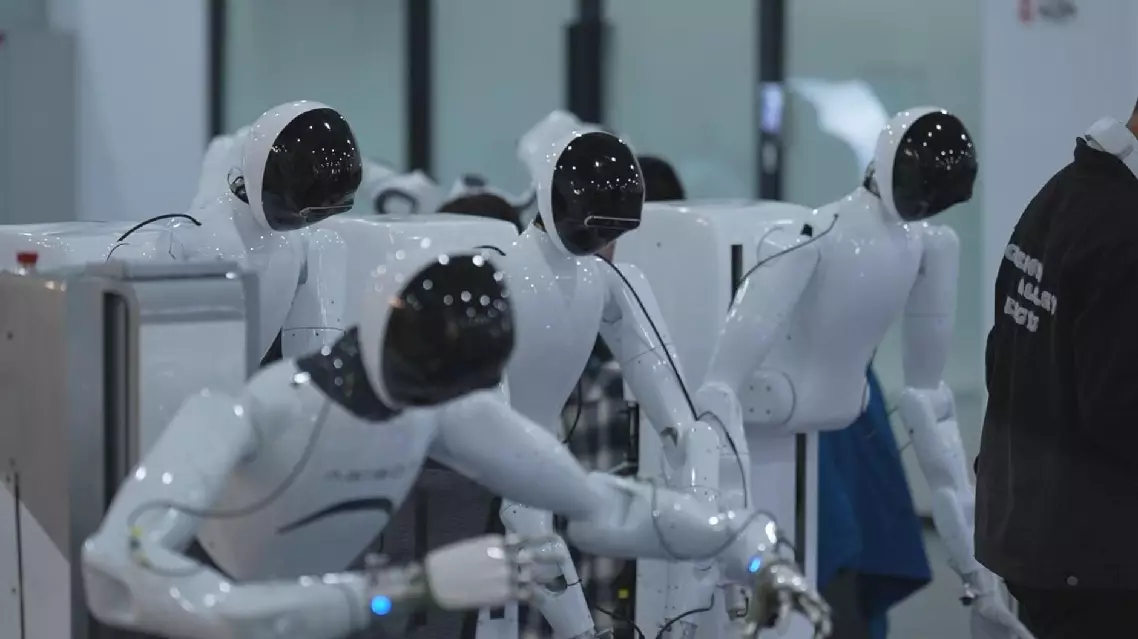
China eyes greater advances in embodied intelligence, robots