MILWAUKEE (AP) — Alexis Díaz is back in the major leagues and ready to make his debut with the Los Angeles Dodgers, who acquired the 2023 All-Star reliever from the Cincinnati Reds over a month ago.
Los Angeles called up Díaz and sent right-hander Julian Fernández to Triple-A Oklahoma City before the NL West-leading Dodgers fell 3-1 to the Milwaukee Brewers for their fifth straight loss.
The 28-year-old Díaz came to the Dodgers in a May 29 trade that sent minor league pitcher Mike Villani to the Reds. He had been with Triple-A Oklahoma City ever since, going 0-1 with a 9.64 earned run average in six appearances.
While at Oklahoma City, Díaz walked seven and struck out three over 4 2/3 innings.
“I think that there’s been some good and some not-so-good, just trying to be consistent with the delivery,” Dodgers manager Dave Roberts said. “The arm still works. The stuff is still good. But the consistency of strike-throwing is what we haven’t seen yet from Alexis.”
This has been a difficult season for Díaz. He opened the season on the injured list with a left hamstring strain, then went 0-0 with a 12.00 ERA in six appearances with Cincinnati. He lost his job as the Reds’ closer and was eventually sent to the minors before getting traded to the Dodgers.
Díaz is the younger brother of New York Mets closer Edwin Díaz. He totaled 75 saves with the Reds from 2022-24.
The 29-year-old Fernández was called up Monday and allowed two runs over two innings in a 9-1 loss to the Brewers. He is 3-0 with a 4.08 ERA in 24 games with Oklahoma City.
In other Dodgers pitching news, right-hander Tyler Glasnow is expected to return from the injured list and start Wednesday’s game at Milwaukee. Glasnow has been dealing with shoulder inflammation and last pitched for the Dodgers on April 27.
“I’m excited to get him back on the mound," Roberts said. "He’s excited to be back on the mound. We’ll see, but I’m expecting him to pitch well.”
AP MLB: https://apnews.com/hub/MLB

FILE - Cincinnati Reds relief pitcher Alexis Díaz works in the eighth inning of a baseball game, April 26, 2025, in Denver. (AP Photo/David Zalubowski, File)
LONDON (AP) — Britain’s government is expected to approve a “mega” Chinese Embassy close to London’s financial district after years of controversy and political wrangling over the potential security risks it poses to the U.K.
Lawmakers from across the spectrum have urged planning officials to reject China’s application for the new embassy. Critics fear the proposed new building, on a huge site close to London’s financial district and crucial data cables, will be used as a base for espionage. Others say the supersized embassy — set to be the biggest Chinese Embassy in Europe — will pose a heightened threat of surveillance and intimidation to Chinese dissidents in exile.
The decision was initially slated for October, but it was repeatedly postponed after multiple allegations of Chinese spying and political interference piled pressure on the British government.
British media have reported that the decision to approve the embassy will come this week, ahead of Prime Minister Keir Starmer's expected trip to China. The closely watched visit would be the first made by a British prime minister since 2018.
A final decision on the embassy is expected by Jan. 20, the deadline set by the government.
Here's a look at why the embassy has been the focus of protests and Sino-British tensions for years:
The proposed embassy at Royal Mint Court — the former site of the U.K.’s coin maker, near the Tower of London — will cover about 20,000 square meters (215,278 square feet) and replace several Chinese official buildings across London.
Critics say the new site sits too close to underground fiber optic cables carrying sensitive financial information between London’s two main financial districts.
Conservative Party lawmaker Alicia Kearns said that risks handing over access to data that would give China’s government “a launchpad for economic warfare against our nation.” She cited news reports that the building complex would include 208 secret basement rooms close to the data cables.
Dissidents have also been among hundreds of people who have protested the plans, saying a mega-embassy housing large numbers of officials would further China’s repression of activists abroad.
Lawmakers from the governing Labour Party who oppose the plan say concerns include “the recent track record of Chinese espionage cases, interference activities and issuing of bounties against U.K.-based Hong Kongers.”
The site was bought by China’s government for 225 million pounds ($301 million) in 2018, but plans for the embassy have been delayed since.
Local officials rejected the initial application over concerns that the embassy would attract many large protests, affecting the safety of residents and tourists. China resubmitted its proposals after the Labour government took power last year.
Bronwen Maddox, director of the London think tank Chatham House, said she believed Britain's government should approve the proposed mega-embassy “given that MI5 and MI6 (U.K. intelligence agencies) have said they are not worried about the city cables underneath it."
“I guess that you could see why there is cause for concern, but what I think the government should be much tougher on is what exactly is China going to do with that embassy, never mind the building; what about the people in it? Why does it need so many? What are they going to do?"
China has complained about the seven-year delay in approving the project, saying the U.K. was “constantly complicating and politicizing the matter.”
“The development scheme of the new Chinese Embassy is of high quality and has been highly recognized by local professional bodies,” the Chinese embassy said in a statement in October. “The application complies with diplomatic practice and local regulations and procedures.”
Chinese Foreign Ministry spokesman Lin Jian has warned that if the embassy isn’t approved, “the consequences arising therefrom shall be borne by the U.K. side.”
Recent high-profile cases involving alleged Chinese espionage have raised alarms about the embassy.
In November, the domestic intelligence agency, MI5, issued an alert to lawmakers warning that Chinese agents were making “targeted and widespread” efforts to recruit and cultivate them using LinkedIn or cover companies.
Authorities believe the alleged “headhunters” were trying to gain access to sensitive information about Parliament and Britain’s government.
Beijing has strongly denied the claims, calling them “pure fabrication and malicious slander.”
Earlier, Britain’s government faced questions on whether it had interfered in the trial of two alleged Chinese spies in order to preserve good ties with China.
Former parliamentary researcher Christopher Cash and academic Christopher Berry were charged last year with spying for Beijing. But their trial collapsed at the last minute because the U.K. government refused to brand China a threat to national security, the country’s chief prosecutor said.
Facing criticism that he is not taking a tough enough stance on the security risks, Starmer has stressed that while protecting national security is non-negotiable, Britain needs to keep up diplomatic dialogue and cooperation with the Asian superpower.
“This is not a question of balancing economic and security considerations. We don’t trade off security in one area, for a bit more economic access somewhere else,” he has said.
Last year, Starmer said Chinese President Xi Jinping personally raised the matter during a phone call.
Opposition lawmaker Priti Patel derided Starmer as “Beijing’s useful idiot in Britain.”
“Starmer’s ‘reset’ with Beijing is a naive one-way street, which puts Britain at risk while Beijing gets everything it wants,” she said.
Associated Press writer Danica Kirka contributed to this report.
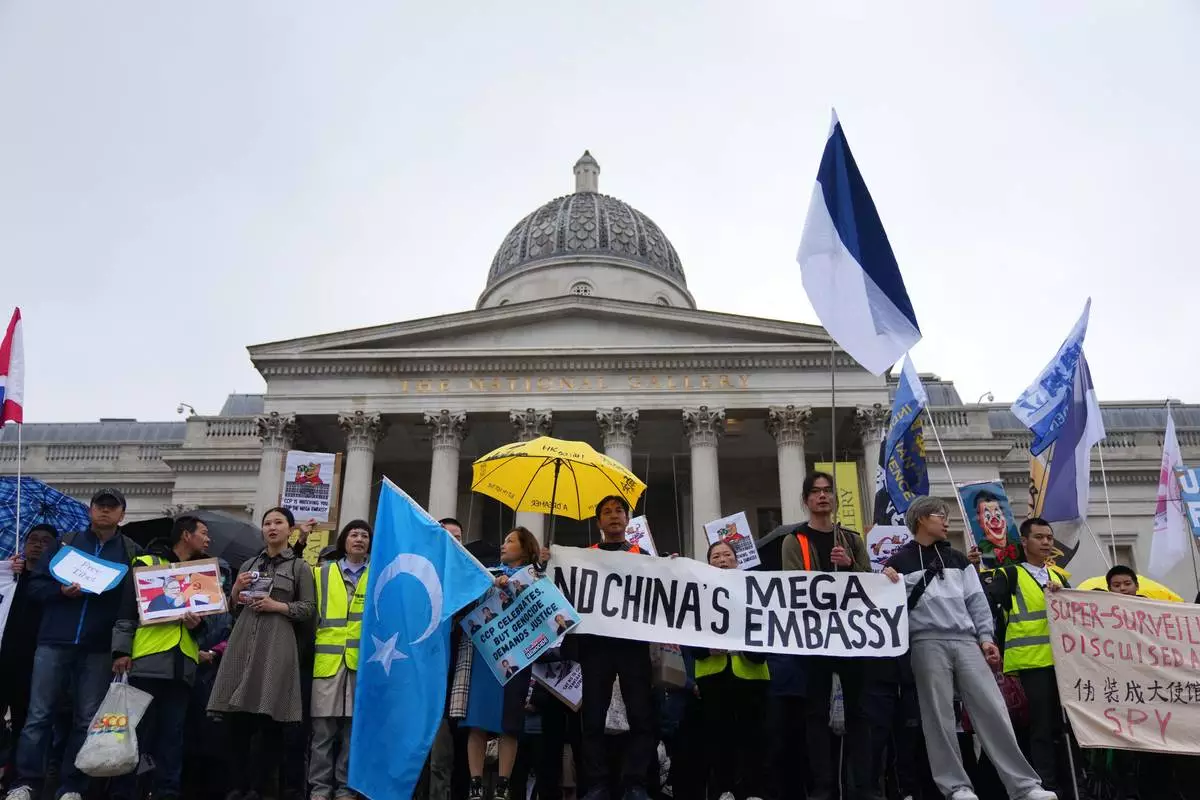
FILE - Protesters hold umbrellas, placards, and flags as they demonstrate against the proposed building of a new Chinese embassy, and to mark the 11th year of the Umbrella Revolution in Hong Kong, in London, Sunday, Sept. 28, 2025. (AP Photo/Joanna Chan, file)
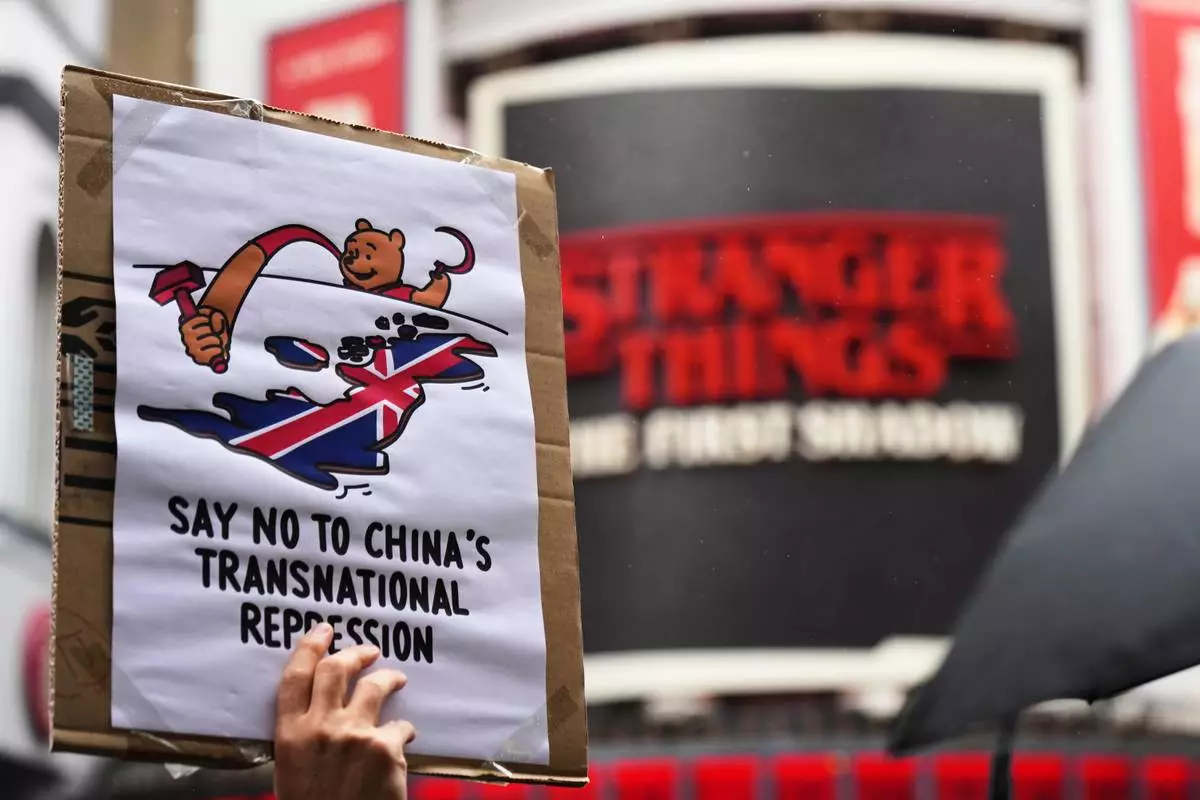
FILE - Protesters hold umbrellas, placards, and flags as they demonstrate against the proposed building of a new Chinese embassy, and to mark the 11th year of the Umbrella Revolution in Hong Kong, in London, Sunday, Sept. 28, 2025. (AP Photo/Joanna Chan, file)