LONDON--(BUSINESS WIRE)--Jan 14, 2026--
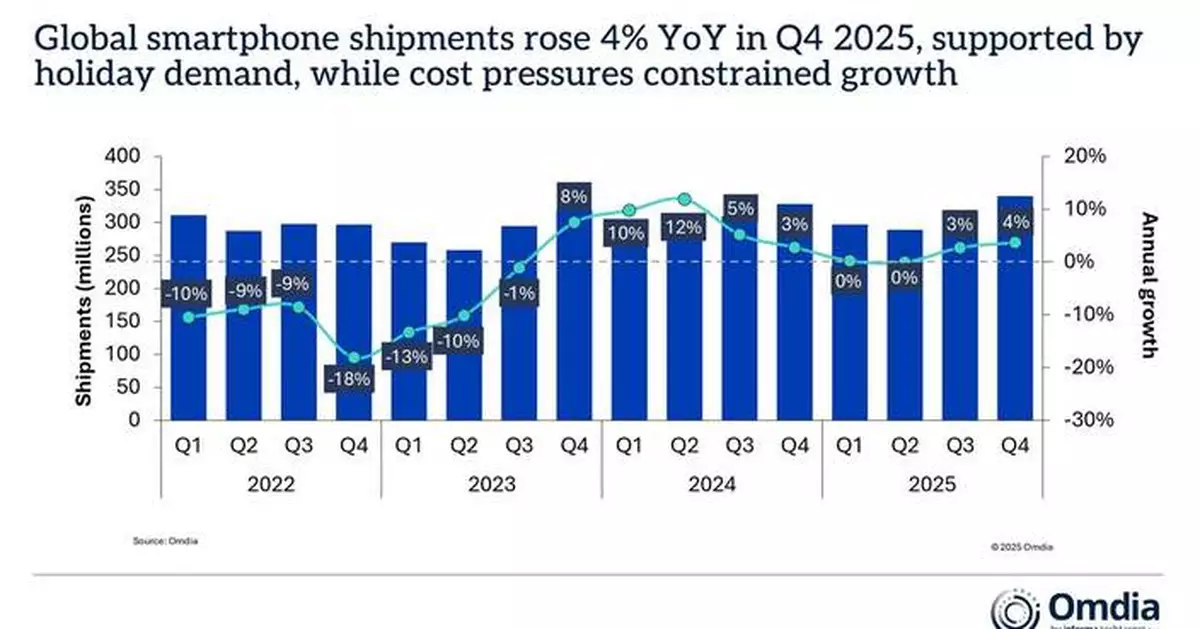
According to Omdia’s latest research, the global smartphone market grew 4% year on year in Q4 2025, supported by seasonal demand and improved inventory discipline, even as rising component costs began to weigh on a few vendors. Growth was concentrated among leading vendors, including Apple and Samsung, across key regions. Apple led the smartphone market in 4Q25 with a 25% market share, delivering a record fourth quarter driven by strong demand for the iPhone 17 series. Apple also ranked as the world’s largest smartphone vendor for the third consecutive year, finishing marginally ahead of Samsung.
This press release features multimedia. View the full release here: https://www.businesswire.com/news/home/20260114416098/en/
In 4Q25, Samsung followed in second with 18% share, driven by strong momentum in the sub-$300 segment, particularly for the Galaxy A17 4G and 5G models. Xiaomi retained its third place for both 4Q and full year 2025, despite its share declining to 11% in Q4 amid hurdles to volume in some of its key markets. vivo captured 8% share, delivering another strong quarter predominantly driven by its leadership in India. OPPO re-entered the global top five as it returned to growth in 4Q, marking a positive turnaround ahead of its integration of realme into its business from January 2026.
For the full year 2025, global shipments grew 2% year-on-year to 1.25 billion units, reflecting a stable but uneven recovery year in which a weaker 1H25 was followed by a stronger second half, defined by booming emerging economies and positive reception of flagship launches. However, rising memory costs and shortages have started to impact the market and constrain the broader volume upside in 4Q25. Mounting cost pressures toward year-end point to a stronger focus on pricing discipline, profitability and operational efficiency heading into 2026.
“Apple recorded its highest-ever fourth-quarter shipment volumes in 4Q25,” said Sanyam Chaurasia, Principal Analyst at Omdia. “The performance was driven by solid demand for the iPhone 17 series alongside continued traction from older-generation models during the holiday season. The base iPhone 17 exceeded expectations following storage upgrades at unchanged pricing, while Pro models gained momentum as Apple ramped up production through the quarter. Meanwhile, the iPhone Air acted as a portfolio showcase, with its slim form factor enhancing retail marketing and reinforcing the premium appeal of the Pro lineup.
“DRAM supply tightness has added considerable supply-side pressures to the smartphone industry, and is expected to be a key defining factor in 2026, said Runar Bjørhovde, Senior Analyst at Omdia. “Amid restricted DRAM supply of both LPDDR4 and LPDDR5, the battle to secure supply and limit cost increases is intense amongst all vendors. All vendors are utilizing mitigating tactics, for example, by emphasising long-term partnerships, utilizing scale to secure capacity, and focusing on their supplier base. The situation is particularly critical for vendors with heavier exposure to entry-level smartphones, which are highly price elastic and where memory and storage costs make up a higher share of the bill-of-materials.”
“Rising cost pressures are reshaping how smartphone vendors approach 2026,” added Sanyam Chaurasia, Principal Analyst at Omdia. “Higher semiconductor costs, alongside a slowing refresh cycle, are expected to weigh on shipment momentum. In response, vendors are tightening configurations, aligning launch strategies closer with component availability and using channel-led levers such as services, trade-ins and ecosystem bundling to support higher price points. The push toward greater scale and supply-side leverage is already becoming evident, exemplified by realme moving under OPPO’s umbrella, reflecting early signs of consolidation as vendors seek greater scale to manage rising costs to maintain competitiveness in the decade’s second half.”
ABOUT OMDIA
Omdia, part of Informa TechTarget, Inc. (Nasdaq: TTGT), is a technology research and advisory group. Our deep knowledge of tech markets grounded in real conversations with industry leaders and hundreds of thousands of data points, make our market intelligence our clients’ strategic advantage. From R&D to ROI, we identify the greatest opportunities and move the industry forward.

Worldwide smartphone shipment market share, top vendors, 1Q23 to 4Q25
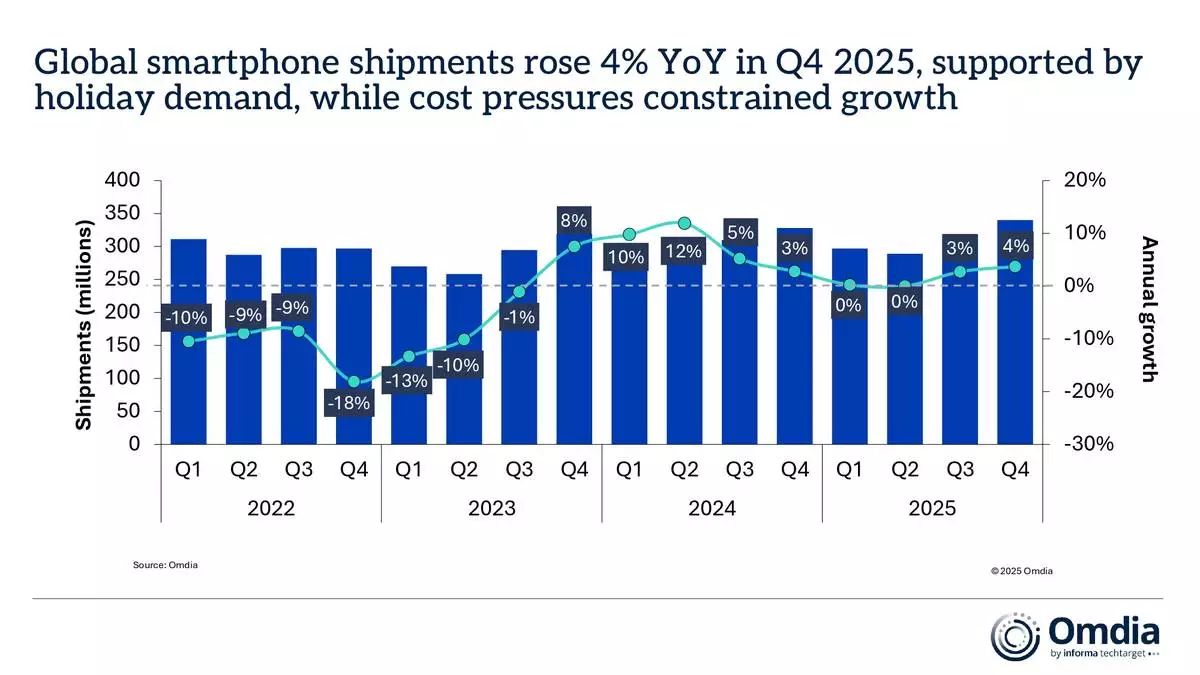
Global smartphone shipments rose 4% YoY in Q4 2025, supported by holiday demand, while cost pressures constrained growth
BEIJING (AP) — In China, the names of things are often either ornately poetic or jarringly direct. A new, wildly popular app among young Chinese people is definitively the latter.
It's called, simply, “Are You Dead?"
In a vast country whose young people are increasingly on the move, the new, one-button app — which has taken the country by digital storm this month — is essentially exactly what it says it is. People who live alone in far-off cities and may be at risk — or just perceived as such by friends or relatives — can push an outsized green circle on their phone screens and send proof of life over the network to a friend or loved one. The cost: 8 yuan (about $1.10).
It's simple and straightforward — essentially a 21st-century Chinese digital version of those American pendants with an alert button on them for senior citizens that gave birth to the famed TV commercial: “I've fallen, and I can't get up!”
Developed by three young people in their 20s, “Are You Dead?” became the most downloaded paid app on the Apple App Store in China last week, according to local media reports. It is also becoming a top download in places as diverse as Singapore and the Netherlands, Britain and India and the United States — in line with the developers' attitude that loneliness and safety aren't just Chinese issues.
“Every country has young people who move to big cities to chase their dreams,” Ian Lü, 29, one of the app's developers, said Thursday.
Lü, who worked and lived alone in the southern city of Shenzhen for five years, experienced such loneliness himself. He said the need for a frictionless check-in is especially strong among introverts. “It's unrealistic,” he said, “to message people every day just to tell them you're still alive.”
Against the backdrop of modern and increasingly frenetic Chinese life, the market for the app is understandable.
Traditionally, Chinese families have tended to live together or at least in close proximity across generations — something embedded deep in the nation's culture until recent years. That has changed in the last few decades with urbanization and rapid economic growth that have sent many Chinese to join what is effectively a diaspora within their own nation — and taken hundreds of millions far from parents, grandparents, aunts and uncles.
Today, the country has more than 100 million households with only one person, according to an annual report from the National Bureau of Statistics of China in 2024.
Consider Chen Xingyu, 32, who has lived on her own for years in Kunming, the capital of southern China’s Yunnan province. “It is new and funny. The name ’Are You Dead?' is very interesting,” Chen said.
Chen, a “lying flat” practitioner who has rejected the grueling, fast-paced career of many in her age group, would try the app but worries about data security. “Assuming many who want to try are women users, if information of such detail about users gets leaked, that’d be terrible,” she said.
Yuan Sangsang, a Shanghai designer, has been living on her own for a decade and describes herself as a “single cow and horse.” She's not hoping the app will save her life — only help her relatives in the event that she does, in fact, expire alone.
"I just don’t want to die with no dignity, like the body gets rotten and smelly before it is found," said Yuan, 38. “That would be unfair for the ones who have to deal with it.”
While such an app might at first seem best suited to elderly people — regardless of their smartphone literacy — all reports indicate that “Are You Dead?” is being snapped up by younger people as the wry equivalent of a social media check-in.
“Some netizens say that the 'Are you dead?' greeting feels like a carefree joke between close friends — both heartfelt and gives a sense of unguarded ease,” the business website Yicai, the Chinese Business Network, said in a commentary. ""It likely explains why so many young people unanimously like this app."
The commentary, by writer He Tao, went further in analyzing the cultural landscape. He wrote that the app's immediate success “serves as a darkly humorous social metaphor, reminding us to pay attention to the living conditions and inner world of contemporary young people. Those who downloaded it clearly need more than just a functional security measure; they crave a signal of being seen and understood.”
Death is a taboo subject in Chinese culture, and the word itself is shunned to the point where many buildings in China have no fourth floor because the word for “four” and the word for “death” sound the same — “si.” Lü acknowledged that the app's name sparked public pressure.
“Death is an issue every one of us has to face,” he said. “Only when you truly understand death do you start thinking about how long you can exist in this world, and how you want to realize the value of your life.”
A few days ago, though, the developers said on their official account on China’s Weibo social platform that they’d pivot to a new name. Their choice: the more cryptic “Demumu,” which they said they hoped could "serve more solo dwellers globally.”
Then, a twist: Late Wednesday, the app team posted on its Weibo account that workshopping the name Demumu didn’t turn out “as well as expected.” The app team is offering a reward for whoever offers a new name that will be picked this weekend. Lü said more than 10,000 people have weighed in.
The reward for the new moniker: $96 — or, in China, 666 yuan.
Fu Ting reported from Washington. AP researcher Shihuan Chen in Beijing contributed.
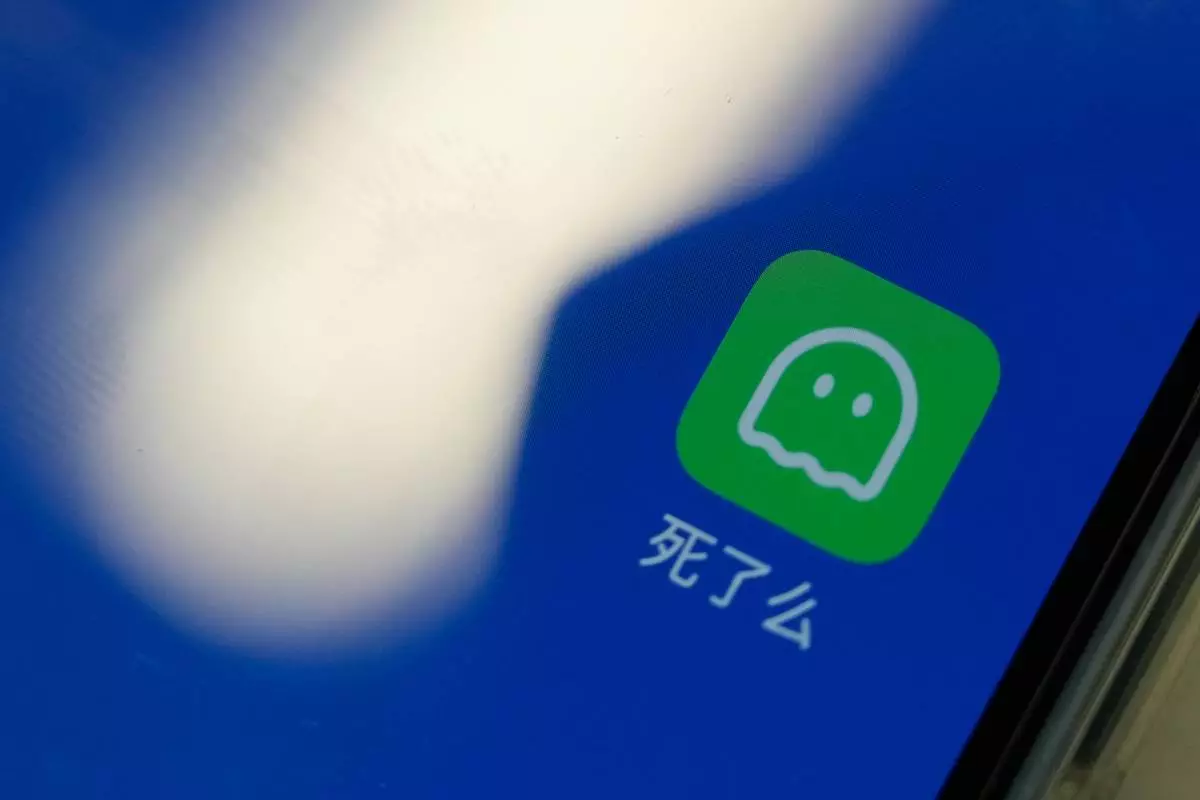
The app Are You Dead? is seen on a smartphone in Beijing, China, Thursday, Jan. 15, 2026. (AP Photo/Ng Han Guan)

A woman looks at her smartphone in a cafe in Beijing, China, Thursday, Jan. 15, 2026. (AP Photo/Ng Han Guan)
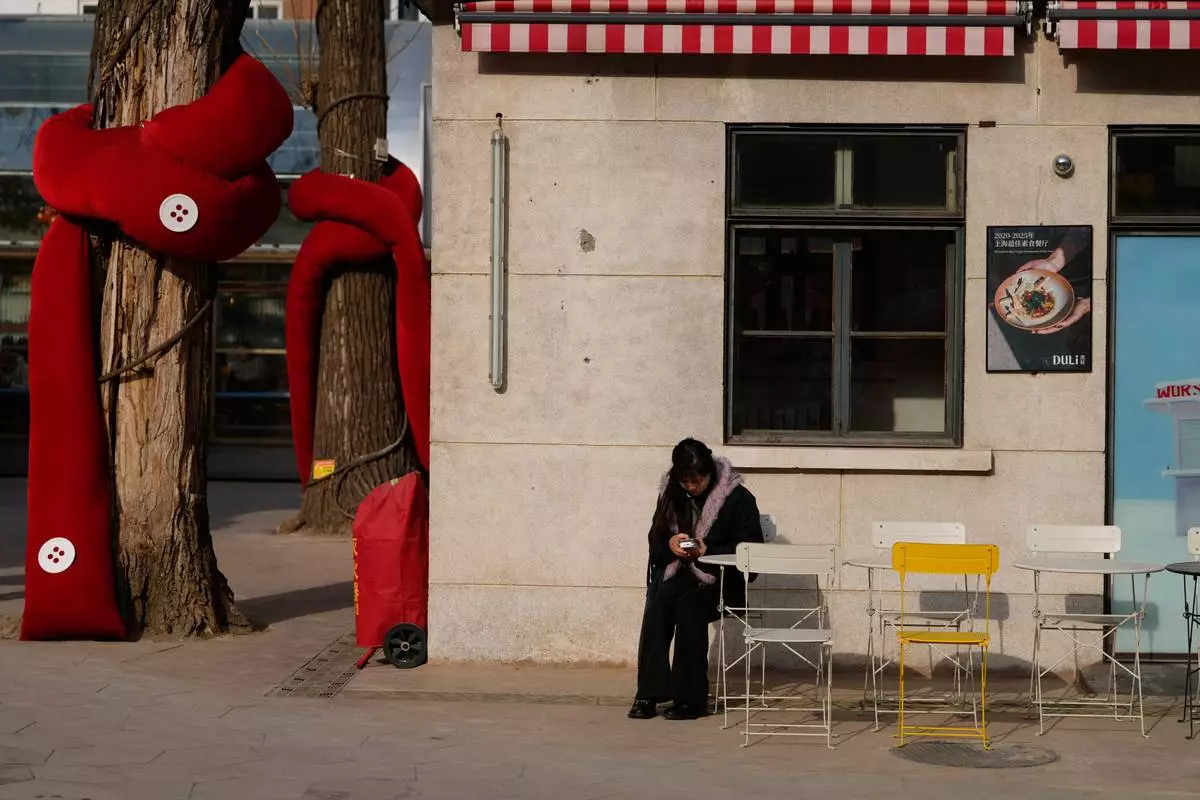
A woman looks at her smartphone outside a restaurant in Beijing, China, Thursday, Jan. 15, 2026. (AP Photo/Ng Han Guan)

A man looks down near his smartphone in Beijing, China, Thursday, Jan. 15, 2026. (AP Photo/Ng Han Guan)
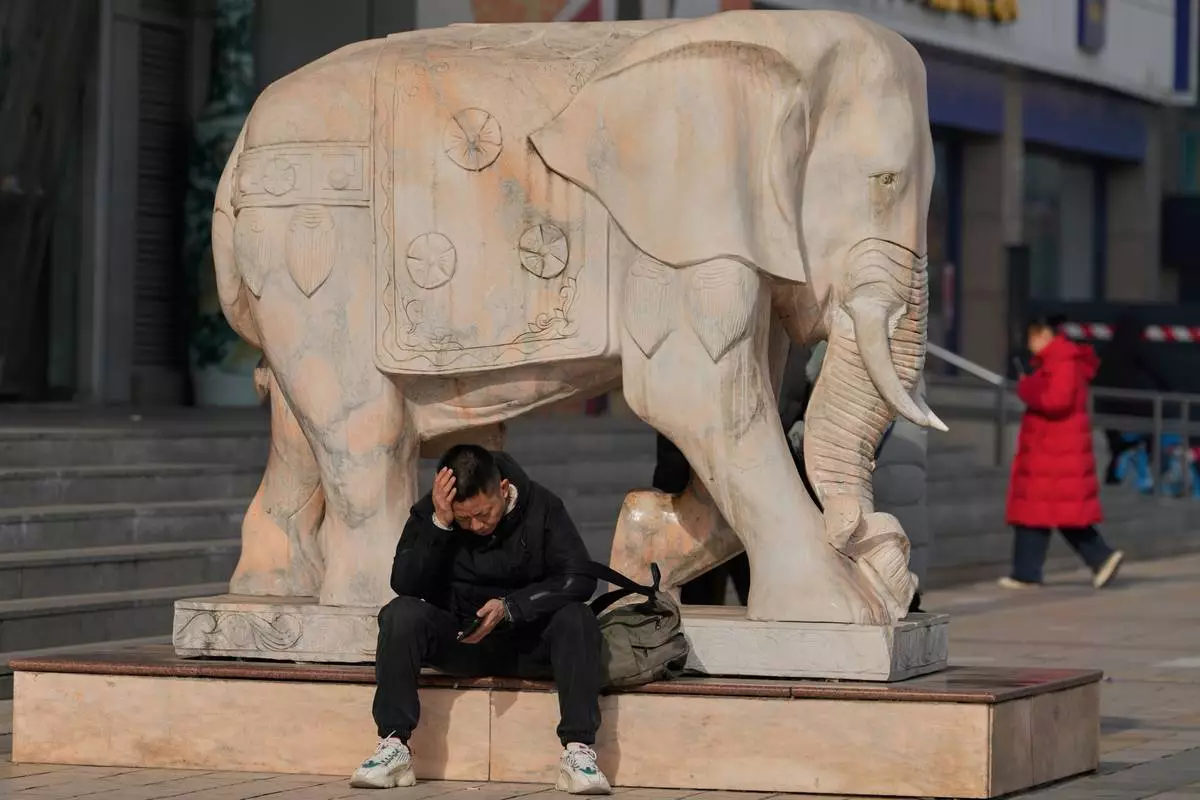
A man reacts while holding his smartphone in Beijing, China, Thursday, Jan. 15, 2026. (AP Photo/Ng Han Guan)