
Skip to Content Facebook Feature Image

Flu vaccines didn't work that well in the US, officials find

TECH

Flu vaccines didn't work that well in the US, officials find
TECH

TECH

Flu vaccines didn't work that well in the US, officials find

2026-03-14 01:59 Last Updated At:02:10

NEW YORK (AP) — As the U.S. flu season winds down, health officials say the flu vaccine didn't work very well, with one of its worst effectiveness rates in more than a decade.

A new strain that dominated the early winter was not well matched to the vaccine, leading to an intense early onslaught of flu.

The Centers for Disease Control and Prevention on Friday posted data that showed a continued decline in doctor's office and hospital visits for flu symptoms through last week. The number of states reporting high flu activity dropped to 16, many of them in a belt stretching from Colorado to Virginia.

“The winter respiratory virus season is slowly coming to a close, and we’re all very grateful for that,” said Dr. William Schaffner, a Vanderbilt University vaccine expert.

This season's vaccines were around 25% to 30% effective in preventing adults from getting sick enough from the flu that they had to go to a doctor’s office, clinic or hospital, according to a CDC report this week. Children who were vaccinated were about 40% less likely to get treatment at a doctor’s office or hospital.

Officials generally are pleased if a flu vaccine is 40% to 60% effective. Judging from past CDC research, this season saw one of the lowest effectiveness rates in the last two decades.

Flu infections surged in late December and were especially intense in some parts of the country. New York City health officials called it the most intense season in 20 years.

Relatively low flu vaccination rates did not help, but experts also blamed the new flu strain that was causing most infections.

The new strain belonged to a category of flu virus, called A H3N2. This new version, subclade K, seemed to spread more easily — though it did not necessarily cause more severe illness.

The vaccine available for this season was built to address a different version of H3N2, and the new strain's explosion is a likely explanation for why the vaccine was less effective, Schaffner said.

CDC scientists estimate there have been at least 27 million illnesses, 350,000 hospitalizations and 22,000 deaths from flu so far this season. At the same point last year, the estimates were at least 40 million illnesses, 520,000 hospitalizations, but about the same number of deaths.

At least 101 children have died so far this season. For those whose vaccination status is known, about 85% were not fully vaccinated against flu.

The flu vaccine may not protect everyone from getting sick, but it can prevent people from becoming severely ill and dying. That's why getting a flu shot remains worthwhile, Schaffner said.

CDC data suggests adult vaccination rates are up slightly this season, to 46.5%, following an unusually bad season last year that set a record for the most child deaths this century.

An estimated 48% of U.S. kids were vaccinated against flu around the end of last month. That's about the same as last year, but down from the 52% vaccinated at this point in 2024, according to CDC data.

Starting in 2010, the government recommended annual flu vaccinations for Americans 6 months and older. In January, however, the Trump administration stopped broadly recommending flu shots for all children, saying instead that it’s up to parents and family doctors to decide.

Meanwhile, work is already underway for next winter’s flu season. Last month, the World Health Organization announced its recommendations for which virus strains to address in the vaccines for the 2026-27 northern hemisphere flu season. The vaccines should be built to handle subclade K, the organization said. This week, a U.S. Food and Drug Administration advisory committee endorsed the WHO recommendations.

The Associated Press Health and Science Department receives support from the Howard Hughes Medical Institute’s Department of Science Education and the Robert Wood Johnson Foundation. The AP is solely responsible for all content.

FILE - A pharmacist gives a patient a flu shot in Miami on Sept. 9, 2025. (AP Photo/Daniel Kozin, File)

FILE - A pharmacist gives a patient a flu shot in Miami on Sept. 9, 2025. (AP Photo/Daniel Kozin, File)

BATON ROUGE, La. (AP) — Louisiana’s congressional primaries won’t be going forward as scheduled in May, as a result of a U.S. Supreme Court ruling that struck down a majority Black congressional district, the state’s top elected officials said Thursday.

Gov. Jeff Landry and Attorney General Liz Murrill, both Republicans, said in a joint statement that Wednesday’s high court ruling effectively prohibits the state from carrying out the primaries under the current districts. Early voting had been scheduled to begin Saturday in advance of the May 16 primary.

“The State is currently enjoined from carrying out congressional elections under the current map," Landry and Murrill said in the statement posted to social media. “We are working together with the Legislature and the Secretary of State’s office to develop a path forward.”

The election suspension was denounced by some Democrats.

“This is going to cause mass confusion among voters -- Democrats, Republicans, white, Black, everybody,” said Louisiana state Sen. Royce Duplessis, a Democrat who represents the New Orleans area. “What they’re effectively doing is changing the rules of the game in the middle of the game. It’s rigging the system.”

Louisiana currently is represented in the U.S. House by four Republicans and two Democrats. A revised map could give Republicans a chance to pick up at least one more seat in the November midterm elections — adding to Republican gains elsewhere in an unusual national redistricting battle.

Voting districts typically are redrawn once a decade, after each census. But President Donald Trump last year urged Texas Republicans to redraw House districts to give the GOP an edge in the midterms. California Democrats reciprocated, and redistricting efforts soon cascaded across states.

On Wednesday, Florida became the latest state to redraw its U.S. House districts, adopting a new map backed by Republican Gov. Ron DeSantis that could give the GOP a chance at winning several additional seats.

The Florida vote occurred just hours after the U.S. Supreme Court's conservative majority issued a ruling that significantly weakened minority protections under the federal Voting Rights Act. The court said Louisiana officials had relied too heavily on race when drawing a congressional district that is represented by Democrat Cleo Fields.

After the 2020 census, Louisiana officials had drawn House voting district boundaries that maintained one Black majority district and five mostly white districts, in a state with a population that is about one-third Black.

A federal judge later struck down the map for violating the Voting Rights Act. And the following year the Supreme Court found that Alabama had to create its own second majority Black congressional district.

In response, Louisiana’s legislature and governor adopted a new House map that created a second Black majority district. But that map also was subsequently challenged in court, leading to the most recent Supreme Court ruling.

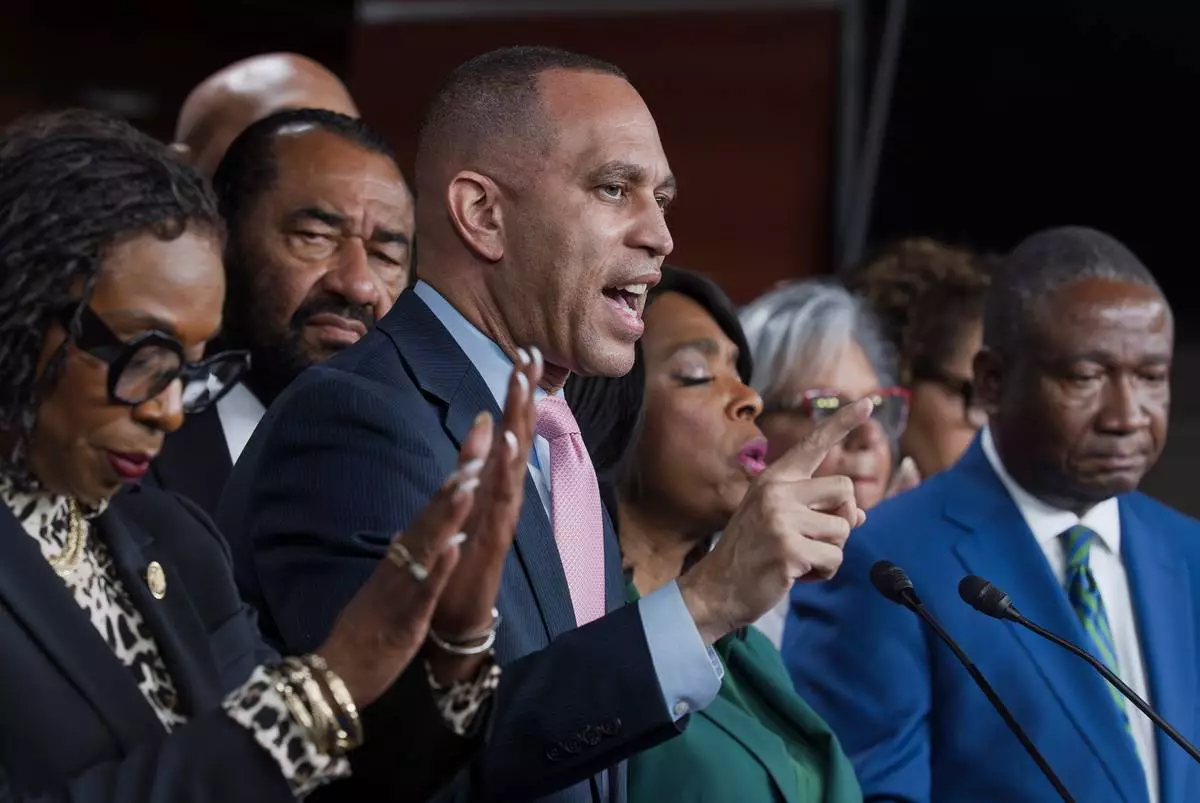
House Minority Leader Hakeem Jeffries, D-N.Y., and members of the Congressional Black Caucus speak to reporters in the wake of the Supreme Court ruling to strike down a majority Black congressional district in Louisiana, at the Capitol in Washington, Wednesday, April 29, 2026. (AP Photo/J. Scott Applewhite)

House Minority Leader Hakeem Jeffries, D-N.Y., and members of the Congressional Black Caucus speak to reporters in the wake of the Supreme Court ruling to strike down a majority Black congressional district in Louisiana, at the Capitol in Washington, Wednesday, April 29, 2026. (AP Photo/J. Scott Applewhite)

Recommended Articles