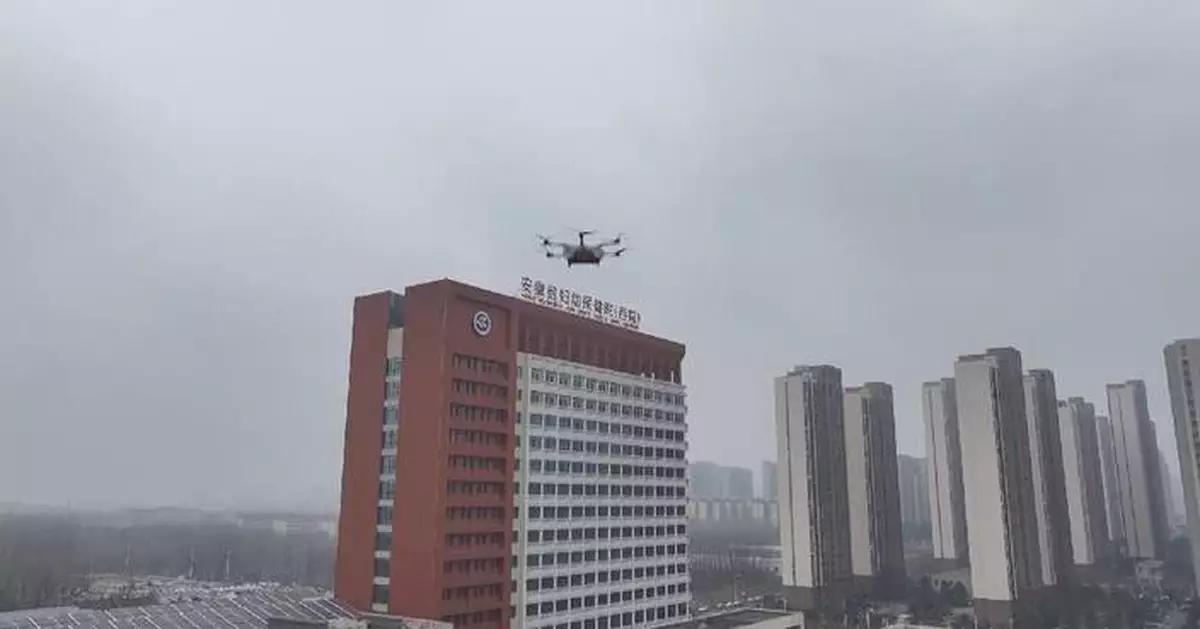
China's low-altitude economy is taking flight as industry leaders tackle critical technological, regulatory, and infrastructural hurdles to drive the sector's high-quality development.
The low-altitude economy refers to activities involving both manned and unmanned aircraft typically operating in airspace ranging from 1,000 meters and 3,000 meters above the ground.
China's government work report this year spotlighted the low-altitude economy as a strategic emerging sector which has the huge potential to transform urban mobility with air taxis, vertiports and drone deliveries.
At the 2025 Aerospace Information Conference which took place from Monday to Wednesday in Hefei, Anhui Province, discussions focused on airspace management, operation safety, technological safeguards, and data and network support, among others, in the rapidly growing sector.
So far, 15 Chinese cities including Beijing, Shanghai, Shenzhen and Hefei have announced a joint initiative to establish a low-altitude economy ecosystem, targeting the development of 100 demonstration projects by the end of the year.
This has given rise to the need of building intelligent integrated infrastructure and safety supervision systems, to support the operations of more than 2,000 electric vertical take-off and landing (eVTOL) points and over 20,000 unmanned aerial vehicle (UAV) operation units across the country which see hundreds of thousands of UAV test flights daily.
"To develop the low-altitude economy, we need to plan the airspace, flight routes, and the eVTOL sites, which depend on reliable telecommunications, navigation and remote sensing infrastructure. If security is not guaranteed, there will be no low-altitude economy to speak of. And the essential security guarantee calls for all sorts of intelligent networked facilities and the supervision of many departments at the same time," Shao Zongyou, president of Geovis Technology, a Chinese geographic information systems and location-based services provider, told China Central Television on the sidelines of the conference on Tuesday.
At the conference on Tuesday, Geovis Technology released China's first comprehensive low-altitude infrastructure solution for the industry.
The solution comprises a low-altitude planning platform, an escort platform for low-altitude Internet of Intelligence, a low-altitude flight assistant platform, a military-civilian coordination platform, and a unified flight management platform, providing solutions covering all major aspects of low-altitude operations from planning, safety guaranteeing, coordination, supervision, operational services, to application scenarios.
"First of all, we have built a low-altitude holographic grid system based on our data cloud. It divides up an airspace into small grids and fills each grid with all the flight-related data and algorithms. This is a breakthrough we have made. And secondly, we have built-in rules guiding low-altitude operations in our products, such as those regulating airspace management, flight routes, flight operations, and flight safety. All these low-altitude flight standards have been embedded in our systems," said Shao, who also serves as deputy head of the National Engineering Research Center for Remote Sensing Satellite Applications.
"Only by putting in place integrated infrastructure systems at the national level that smoothly link up the user ends and the technological ends into complete chains, can we make sure that the ecosystem of the sector gets better and better," said Liu Qinhuo, a researcher at the Aerospace Information Research Institute.
According to the Civil Aviation Administration of China, the country's low-altitude economy is expected to reach a market size of 1.5 trillion yuan (about 210 billion U.S. dollars) by the end of the year and soar to 3.5 trillion yuan (487 billion U.S. dollars) by 2035.
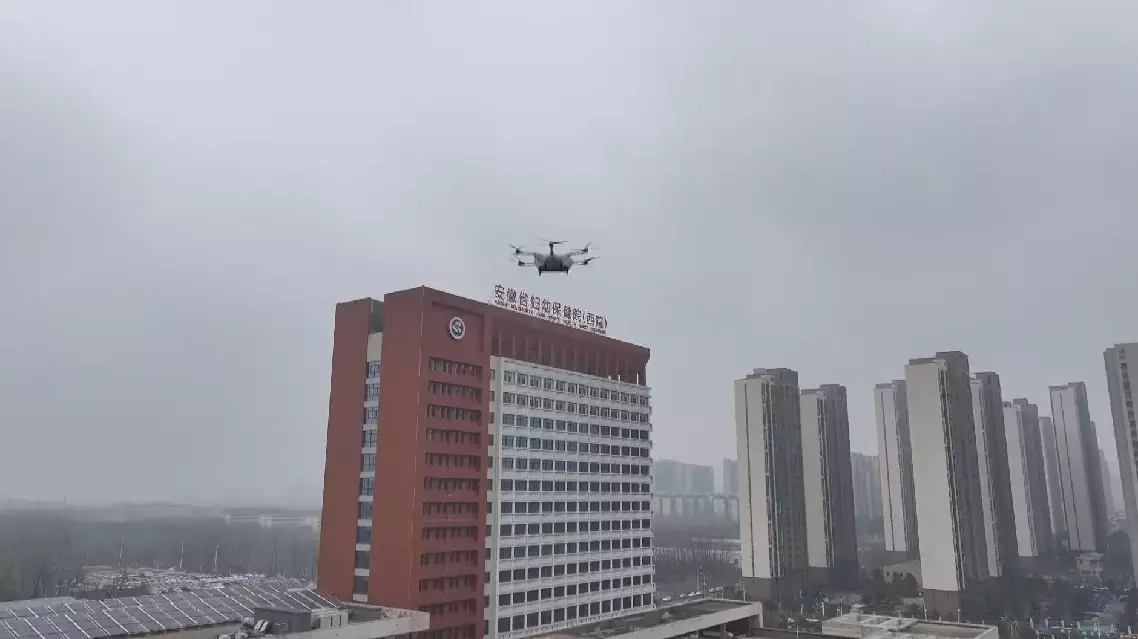
China aims for high-quality growth in emerging low-altitude economy