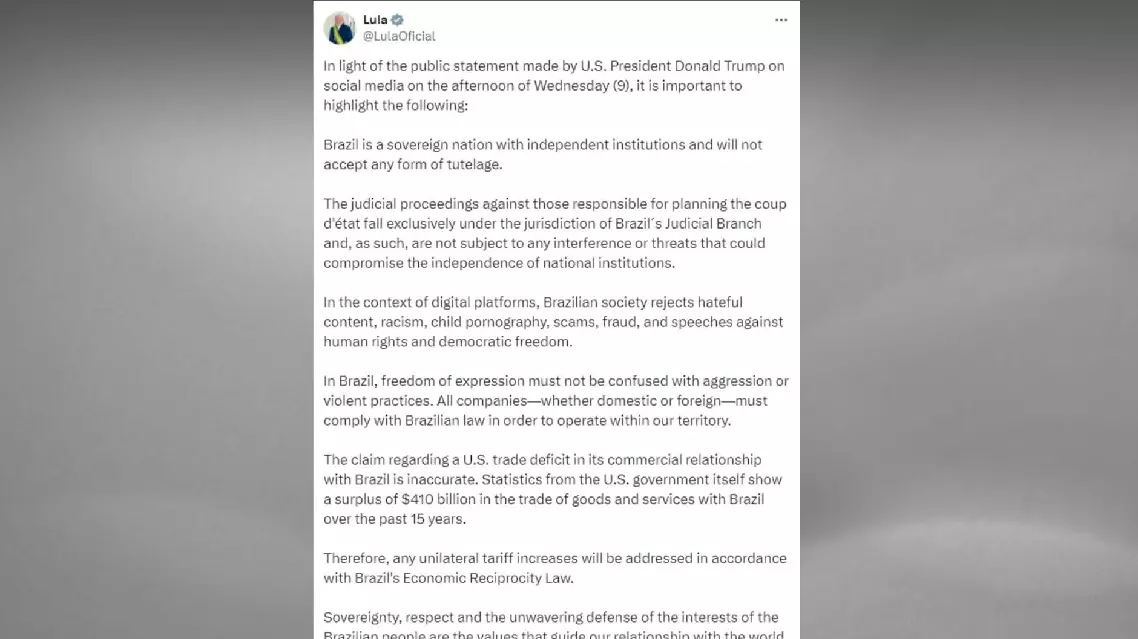
Brazilian President Luiz Inacio Lula da Silva announced on Thursday that Brazil will negotiate with the United States but is prepared to implement reciprocal countermeasures if necessary, in the wake of U.S. threats to impose additional tariffs on Brazilian exports.
After U.S. President Donald Trump stated in a letter on Wednesday that a 50-percent tariff will be imposed on Brazilian goods, Lula said Brazil will pursue bilateral negotiations while filing a lawsuit with the World Trade Organization against the unilateral tariffs imposed by the U.S.
He warned that if talks fail, Brazil would lawfully impose reciprocal 50 percent tariffs on U.S. exports.
Lula also held a meeting with heads of government departments on Wednesday. According to the Presidential Chief of Staff's Office, the Brazilian government will establish a task force handling U.S. tariff issues.
Brazilian Finance Minister Fernando Haddad stated on Thursday that the country has accumulated a trade deficit with the U.S. exceeding 400 billion U.S. dollars over the past 15 years. He criticized the newly announced U.S. tariffs as being politically motivated rather than grounded in economic theory.
In his letter sent earlier to Lula, Trump accused the Brazilian president of politically persecuting former President Jair Bolsonaro and demanded an immediate end to his criminal prosecution.
The Brazilian government has notified the U.S. Embassy in Brazil of its decision to return Trump's letter and summon the acting charge d'affaires to request an explanation regarding the section concerning Bolsonaro.
Bolsonaro, who lost the presidential election in October 2022, is currently under investigation by Brazil's Supreme Federal Court.
The probe follows the attacks on January 8, 2023, when Bolsonaro's supporters stormed key government buildings, including the Congress, the Presidential Palace, and the Supreme Federal Court. Prosecutors have charged Bolsonaro and top aides with plotting a coup to overturn the election results through military intervention.
After Trump claimed on social media on Monday that Bolsonaro is "being persecuted," Lula responded that Brazil does not accept any interference in its sovereignty.
Also on Thursday, Brazilian Agriculture Minister Carlos Favaro criticized the new U.S. tariffs on Brazilian goods as unjust. He further expressed that Brazil will focus on key markets in the Middle East, South Asia, and the Global South with significant consumption potential as alternative options for exports.
Favaro said he had contacted representatives from the hardest-hit industries, including orange juice, beef, and coffee, to discuss measures for market expansion, trade barrier reduction, and new development opportunities in Brazil's agriculture and livestock sectors.
Brazilian president warns of retaliation if US-Brazil tariff talks fail