100 Years of DEKRA: Safety in a Changing World
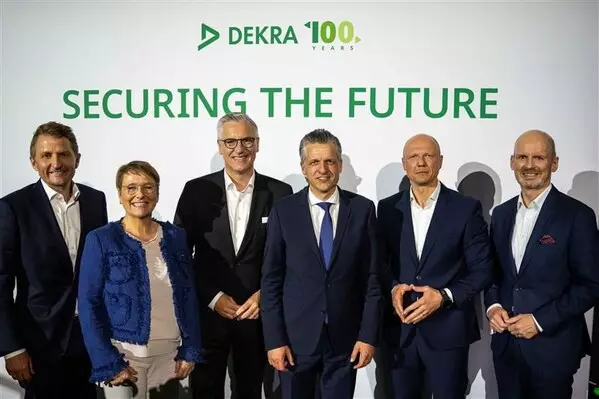
STUTTGART, Germany, July 12, 2025 /PRNewswire/ -- On June 30, 2025, DEKRA celebrated its 100th anniversary – with a clear focus on the future. What began in 1925 with voluntary vehicle inspections is now a global expert organization for safety, sustainability, and digital trust. On its centennial, DEKRA reaffirms its commitment to tackling the major challenges of our time – in line with its anniversary motto: "Securing the Future."
DEKRA was founded on June 30, 1925, in Berlin as the "Deutscher Kraftfahrzeug-Überwachungs-Verein" (German Motor Vehicle Inspection Association) – at a time when the automobile was beginning to reshape the world. Its mission: voluntary technical inspections to bring safety to a new era of mobility. A century later, this initiative has evolved into a global expert organization with 48,000 employees in around 60 countries – all pursuing one clear goal: enabling safety and trust in a changing world.
What began in 1925 with vehicle inspections has grown into a comprehensive portfolio across mobility, industry, environment, and digital technologies. DEKRA tests both physical and digital products, processes, and systems. "Safety is not static – it evolves with the world we live in," says CEO Stan Zurkiewicz. "Our task is to help shape key areas of transformation – mobility, digitalization, artificial intelligence, and sustainability – with expertise, responsibility, and foresight."
Shaping Germany – Expanding Globally
DEKRA's history is marked by constant progress. When periodic vehicle inspections became mandatory in Germany in 1951, DEKRA played a key role in their implementation. The 1960s and 1970s brought a focus on education and research, including the founding of DEKRA Akademie (1974), the Research and Development department (1968), and Accident Research (1978) – the latter with the aim of learning from data.
After German reunification, DEKRA took over responsibilities from the former East German vehicle authority and built a comprehensive inspection network in the new federal states. Shortly thereafter, the company entered international markets, including France, Spain, China, and the United States. Since then, DEKRA has pursued a globally focused strategy – while maintaining strong roots in its home market of Germany.
New Fields – Same Mission: Safety in Transition
Starting in the mid-2000s, DEKRA systematically expanded its competencies in industrial inspection, infrastructure, and environmental technologies – with the founding of DEKRA Industrial GmbH as a major milestone.
In 2017, the acquisition of the Lausitzring racetrack in Brandenburg, Germany, marked an important step toward future mobility. Together with the neighboring DEKRA Technology Center, it now forms Europe's largest independent test center for automated and connected driving – a symbol of mobility transformation and the safe, responsible implementation of new technologies. Today, DEKRA's scope ranges from AI validation and cybersecurity to hydrogen safety and sustainability certifications. The common thread remains: building trust where transformation happens.
Testing Expertise for Tomorrow's World
"Digitalization, connected systems, and artificial intelligence are increasingly shaping our everyday lives – at home, on the road, and in the workplace. To fully harness their potential and drive innovation, we must understand their risks and manage them effectively. Only then can we truly trust them," says Petra Finke, Chief Digitalization Officer at DEKRA. "Safety is the foundation for that trust. That's why we've developed an integrated testing approach that combines functional safety, cybersecurity, and AI validation."
DEKRA bundles these services under the term Digital Trust Services. This means the organization doesn't just assess whether software or systems function properly and pose no danger to users – it also examines whether they are resilient against cyberattacks, transparent in their decision-making logic, and ethically sound in their use of AI. "At DEKRA, we view digitalization not only from a technical angle but also strategically – as a driver for more efficient processes, intelligently connected data, and new, trustworthy services, both internally and externally," Finke adds.
Global Growth with Focus – People at the Center
DEKRA is also expanding its geographical footprint in future-relevant markets. "We are making targeted investments in regions where transformation is tangible – in Asia, North America, and Europe," says Peter Laursen, Chief Operating Officer for DEKRA's global regions. "These are the places where new technologies, new industries, and new safety requirements are emerging. And we want to help shape that future – not just respond to it." At the same time, DEKRA's operational backbone – such as vehicle inspection, industrial inspection, product testing, and audits – remains central. "These are our core services, where we also see great growth potential," Laursen continues.
However, sustainable growth in new markets requires more than technology – it needs people who understand and drive change. "The future is not decided by technology alone – but by people who use it responsibly," emphasizes Chief Financial Officer and Head of Human Resources Wolfgang Linsenmaier. "That's why we are consistently investing in employee development, strengthening leadership, and fostering digital skills at all levels." DEKRA is also modernizing internal structures – with clearer career paths, more efficient systems, and a globally connected HR approach. The goal: a learning, values-based organization with strong customer focus.
UNICEF Partnership: Securing Water Means Securing the Future
As part of its centennial, DEKRA is also breaking new ground in social responsibility – through a partnership with UNICEF for the Water Security for All initiative. Together, the two organizations are implementing programs to provide access to clean drinking water in regions highly affected by climate change – including solar-powered water pumps, technical training centers, and modern groundwater treatment. "Water is essential for life – and increasingly scarce," says CEO Zurkiewicz. "Our partnership with UNICEF demonstrates what 'Securing the Future' means to us: the future begins with responsibility – for products and systems, but above all, for people."
The centennial is being celebrated in Berlin, DEKRA's founding location, with partners from business, politics, and society.
About DEKRA
For 100 years, DEKRA has been a trusted name in safety. Founded in 1925 with the original goal of improving road safety through vehicle inspections, DEKRA has grown to become the world's largest independent, non-listed expert organization in the field of testing, inspection, and certification. Today, as a global partner, the company supports its customers with comprehensive services and solutions to drive safety and sustainability forward—fully aligned with DEKRA's anniversary motto, "Securing the Future." In 2024, DEKRA generated revenue of 4.3 billion euros. Around 48,000 employees are providing qualified and independent expert services in approximately 60 countries across five continents. DEKRA holds a Platinum rating from EcoVadis, placing it among the top 1% of the world's most sustainable companies.
** The press release content is from PR Newswire. Bastille Post is not involved in its creation. **
Expert Organization Celebrates Centennial
- New framework brings together Aon's Risk Capital and Human Capital data with public sentiment analysis from Gallup to create a portfolio view of risk
- Creates further clarity into how risks compound across four megatrends, how resilience is built and activated and where targeted actions can most effectively influence performance
DUBLIN, Jan. 16, 2026 /PRNewswire/ -- Aon plc (NYSE: AON), a leading global professional services firm, announced today that it is releasing insights from a new, data-driven tool to help organizations build sustainable resilience and unlock growth: Aon's Resilience Quotient.
Developed in collaboration with Gallup, Aon's Resilience Quotient responds to a critical insight: in a time of increasing populism and fragmented sources of information, quantitative data alone is not enough to make long-term decisions. Combining public sentiment on global issues with risk and people data and analytics enables greater clarity and confidence to invest and grow amidst uncertainty and volatility.
By integrating Aon's proprietary Risk Capital and Human Capital analytics with the results of Gallup's World Poll covering 140 countries for more than 20 years, the firm's Resilience Quotient captures both objective conditions and subjective sentiment, revealing where sentiment signals hidden risks and potential opportunities to achieve greater resilience. This system-level view enables leaders to spot emerging risks sooner, prioritize resilience investments and move from reactive risk management to proactive decision-making.
"When making decisions around investment, workforce or managing geopolitical risk, a portfolio view is far superior to a siloed perspective," said Greg Case, president and CEO of Aon. "Understanding sentiment can be an opportunity signal or an early warning. Leaders who are limited to only some of the relevant metrics risk missing the signals that matter most. Aon's Resilience Quotient delivers an integrated view to help organizations act decisively, strengthen resilience and unlock sustainable growth."
Four interconnected megatrends – Trade, Technology, Weather and Workforce – are reshaping the global operating environment in ways that traditional models struggle to anticipate. Aon's Resilience Quotient provides a clearer view of the tradeoffs within these interactions: how trade volatility can amplify technology risk, how climate pressures influence workforce mobility and how sentiment can either reinforce resilience or heighten operational risk, even when the fundamentals appear strong.
To illustrate the insights from its Resilience Quotient, the firm published three case studies addressing some of the most relevant and urgent issues facing the 2026 global economy:
- Realizing the Opportunity of AI: Securing Data Center Growth
Data centers are the backbone of the digital economy and with nearly $1.3 trillion projected to be invested globally in data centers by 2030, their rapid expansion brings unprecedented risks. Aon's Resilience Quotient shows that resilience varies sharply at the sub-national level, often more than underlying risk. Within the U.S., Iowa emerges as the most resilient destination for data center development, combining very low overall risk with exceptionally strong trade and weather resilience. "Aon's Resilience Quotient shows that Iowa's resilience–risk balance is roughly twice the national median, demonstrating how governance quality, institutional confidence and preparedness materially shape long-term infrastructure outcomes," said Joe Peiser, CEO of Commercial Risk Solutions at Aon. "This underscores the opportunity for leaders who understand the combined effect of low risk, resilient trade and weather systems and a strong foundation of public trust — factors that ultimately determine where AI infrastructure can grow at scale."
DUBLIN, Jan. 16, 2026 /PRNewswire/ -- Aon plc (NYSE: AON), a leading global professional services firm, announced today that it is releasing insights from a new, data-driven tool to help organizations build sustainable resilience and unlock growth: Aon's Resilience Quotient.
Developed in collaboration with Gallup, Aon's Resilience Quotient responds to a critical insight: in a time of increasing populism and fragmented sources of information, quantitative data alone is not enough to make long-term decisions. Combining public sentiment on global issues with risk and people data and analytics enables greater clarity and confidence to invest and grow amidst uncertainty and volatility.
By integrating Aon's proprietary Risk Capital and Human Capital analytics with the results of Gallup's World Poll covering 140 countries for more than 20 years, the firm's Resilience Quotient captures both objective conditions and subjective sentiment, revealing where sentiment signals hidden risks and potential opportunities to achieve greater resilience. This system-level view enables leaders to spot emerging risks sooner, prioritize resilience investments and move from reactive risk management to proactive decision-making.
"When making decisions around investment, workforce or managing geopolitical risk, a portfolio view is far superior to a siloed perspective," said Greg Case, president and CEO of Aon. "Understanding sentiment can be an opportunity signal or an early warning. Leaders who are limited to only some of the relevant metrics risk missing the signals that matter most. Aon's Resilience Quotient delivers an integrated view to help organizations act decisively, strengthen resilience and unlock sustainable growth."
Four interconnected megatrends – Trade, Technology, Weather and Workforce – are reshaping the global operating environment in ways that traditional models struggle to anticipate. Aon's Resilience Quotient provides a clearer view of the tradeoffs within these interactions: how trade volatility can amplify technology risk, how climate pressures influence workforce mobility and how sentiment can either reinforce resilience or heighten operational risk, even when the fundamentals appear strong.
To illustrate the insights from its Resilience Quotient, the firm published three case studies addressing some of the most relevant and urgent issues facing the 2026 global economy:
"Aon's Resilience Quotient shows that Iowa's resilience–risk balance is roughly twice the national median, demonstrating how governance quality, institutional confidence and preparedness materially shape long-term infrastructure outcomes," said Joe Peiser, CEO of Commercial Risk Solutions at Aon. "This underscores the opportunity for leaders who understand the combined effect of low risk, resilient trade and weather systems and a strong foundation of public trust — factors that ultimately determine where AI infrastructure can grow at scale."
- Workforce Transformation: AI Adoption and the Next Generation Workforce
The acceleration of AI adoption is transforming the workforce, but most organizations face a critical gap between the demand for AI skills and their readiness to adapt. The Resilience Quotient highlights how workforce engagement, trust and institutional preparedness are essential to harnessing AI's potential, making resilience the key differentiator between organizations that thrive through change and those that risk falling behind. "Aon's Resilience Quotient equips leaders to navigate rapid AI change with confidence," said Lisa Stevens, chief administrative officer at Aon. "These insights help create the conditions for early‑career employees to build the skills and confidence they need — so instead of losing a generation of talent, we cultivate one that is more capable and resilient than ever."
"Aon's Resilience Quotient equips leaders to navigate rapid AI change with confidence," said Lisa Stevens, chief administrative officer at Aon. "These insights help create the conditions for early‑career employees to build the skills and confidence they need — so instead of losing a generation of talent, we cultivate one that is more capable and resilient than ever."
- Rethinking Humanitarian Finance: A New Approach to Forced Migration
Over 120 million people are currently displaced by conflict, climate and systemic crises, reshaping societies and economies worldwide. Aon's Resilience Quotient highlights Venezuela and Colombia to illustrate the tradeoffs between investing resources at the source of migration — supporting those facing institutional erosion, food insecurity and economic collapse — or directing investment to more stable countries like Colombia that are absorbing people fleeing unlivable conditions. "Forced displacement results from extreme weather and man-made disasters like conflict and economic failure," said Bridget Gainer, chief public affairs officer at Aon. "If we could leverage the forecasting and financial capability of insurance to better predict and more quickly mitigate the impact of this volatility, we could help create conditions that allow populations to remain and rebuild in their home countries."
"Forced displacement results from extreme weather and man-made disasters like conflict and economic failure," said Bridget Gainer, chief public affairs officer at Aon. "If we could leverage the forecasting and financial capability of insurance to better predict and more quickly mitigate the impact of this volatility, we could help create conditions that allow populations to remain and rebuild in their home countries."
"Resilience is not a single blueprint, it's the way systems mitigate, adapt and transform under pressure. Aon's Resilience Quotient functions as a pressure gauge, surfacing the trade‑offs and early signals that help leaders strengthen resilience where it matters most," said Joe Daly, managing partner at Gallup. "We're proud to collaborate with Aon to combine Gallup's global sentiment analytics with Aon's Risk Capital and Human Capital data, turning confidence into actionable insight."
New insights from Aon's Resilience Quotient suggest that going forward, resilience priorities will shift from static risk management to dynamic, localized strategies. As disruptions become more complex and frequent, organizations will need to tailor resilience investments to specific geographies, sectors and even sub-regional contexts. Aon's Resilience Quotient is supported with a real-time analytics and AI-enabled insights platform, built by Quantum Rise, providing deeper visibility into evolving risk and resilience signals as conditions change.
Aon and Gallup will join global decision-makers at the World Economic Forum Annual Meeting to advance these critical discussions on restoring confidence and unlocking sustainable growth.
Learn more about Aon's Resilience Quotient and explore the case studies here.
About Aon
Aon plc (NYSE: AON) exists to shape decisions for the better — to protect and enrich the lives of people around the world. Through actionable analytic insight, globally integrated Risk Capital and Human Capital expertise, and locally relevant solutions, our colleagues provide clients in over 120 countries with the clarity and confidence to make better risk and people decisions that help protect and grow their businesses.
Follow Aon on LinkedIn, X, Facebook and Instagram. Stay up-to-date by visiting Aon's newsroom and sign up for news alerts here.
Media Contact
mediainquiries@aon.com
Toll-free (U.S., Canada and Puerto Rico): +1 833 751 8114
International: +1 312 381 3024
** The press release content is from PR Newswire. Bastille Post is not involved in its creation. **

Aon's Resilience Quotient Cuts Through Uncertainty and Volatility to Help Businesses Move from Risk to Resilience and Growth