The run-down Philippine naval vessel BRP Sierra Madre which has been illegally grounded at the Ren'ai Jiao in the South China Sea for about 26 years is causing damages to the nearby coral reef ecosystem while violating China's territorial sovereignty, said Chinese experts.
In May 1999, the Philippines "grounded" the tank landing ship at the Ren'ai Jiao with excuses.
"The reason it gave was that the warship was damaged and needed repair. And it chose the timing when China had to deal with the aftermath of a brutal missile attack by the U.S.-led NATO forces on the former Chinese Embassy in Belgrade," explained Shi Yubing, dean of South China Sea Institute at the Xiamen University. "The Philippines is solely aiming to use this illegal occupation as a means, with the vessel as an external manifestation, to assert its so-called territorial sovereignty. This intention is very clear," said Pan Junwu, vice dean of the School of International Law at the Northwest University of Politics and Law.
Military vessel is a sign for this intention, and under international law, warships enjoy sovereign immunity, which generally exempts them from the jurisdiction of foreign states. This immunity protects them from legal proceedings in foreign courts for actions such as unauthorized berthing and also prevents being sued due to environmental pollution caused by ship dismantling and other issues.
But BRP Sierra Madre's status afterwards is not that of a warship as defined by United Nations Convention on the Law of the Sea (UNCLOS).
"It was put into service during World War II and has been in use for over 80 years. In this case, we should consider it as a wreck rather than an active and operational warship," said Zheng Zhihua, Associate Professor at the Shanghai Jiao Tong University.
The Philippines promised to tow away the vessel, but it didn't do so. Based on the so-called ruling of the South China Sea Arbitration in 2016, it claimed that the Ren'ai Jiao was within its exclusive economic zone and thereby asserted "sovereign rights" over it, changing the tactics while calling the vessel its outpost.
However, China was the first to discover, name and have long-term use and jurisdiction over the Ren'ai Jiao, and there is ample basis in international law for this.
Therefore, the logic of the Philippines is not fact-based, according to Chinese experts.
"From the perspective of the Philippines, Ren'ai Jiao is a so-called low-tide elevation. According to their interpretation of the so-called 2016 South China Sea Arbitration Ruling, it cannot be occupied as a territory. However, the Philippines' actions are aimed at occupying Ren'ai Jiao as their own territory," Zheng said.
From the Chinese side, properly handling the issue based on laws is important. China said that in the period of time between the present and when the warship is towed away, should the Philippines need to send living necessities, China is willing to allow it in a humanitarian spirit if the Philippines informs China in advance and after on-site verification is conducted.
"Considering the relationship between China and the Philippines, as well as the overall peace and stability of the South China Sea, a relatively restrained attitude has been adopted. The disputes between China and the Philippines over the South China Sea could be resolved through negotiation and dialogue," said Wu Shicun, chairman of the Huayang Research Center for Maritime Cooperation and Ocean Governance.
However, over the years, the Philippines has insisted on sending personnel to it and has kept sending official vessels and warships to forcibly intrude into the adjacent waters of the Ren'ai Jiao in an attempt to send construction materials for repairing and reinforcing the "grounded" military vessel on a large scale in an attempt to permanently occupy the Ren'ai Jiao.
But these vessels were intercepted, driven away or captured by the China Coast Guard.
China's stance has been clear and firm -- China would not accept any move by the Philippines to send large amounts of construction materials to the illegally grounded vessel and attempt to build fixed facilities or a permanent outpost and would resolutely act to stop the Philippines' actions.
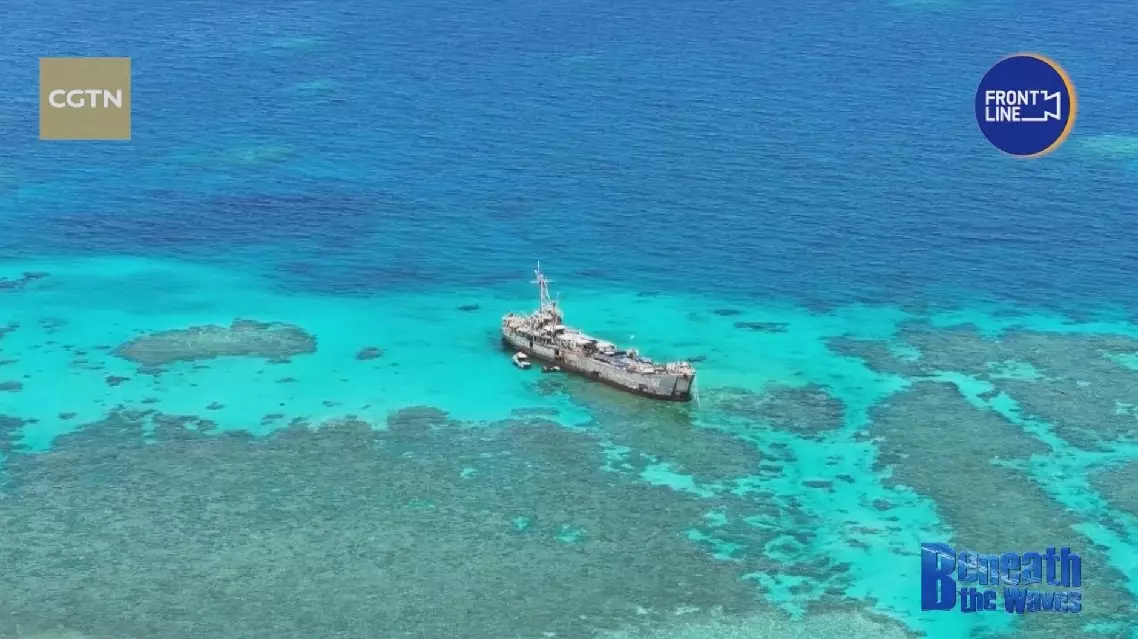
Grounded Philippine warship causes environmental damages, violates China's territorial integrity: experts