The 2025 International Congress of Basic Science (ICBS 2025) opened in Beijing on Sunday, bringing together experts and scholars from home and abroad for in-depth discussions on cutting-edge achievements in the field of basic science while looking ahead to future developments.
The congress features over 50 academic presentations and satellite meetings. More than 80 Chinese and international academicians, along with nearly other 1,000 experts and scholars, will share cutting-edge achievements, engage in academic exchanges, and explore future developments with a focus on mathematics, physics, and information science and engineering at the event.
Meanwhile, the event, which will run until July 25, will also spotlight the latest advancements in artificial intelligence, considering its rapid growth, to explore the close relationship between this technology and basic science.
"Artificial intelligence is a crucial discipline that heavily relies on the contributions of basic science, especially mathematics. Therefore, we hope for in-depth cooperation, with scientists from around the globe exchanging ideas and collectively contributing to the future of humanity," said Shing-Tung Yau, chairman of the ICBS and a winner of Fields Medal, the highest international award for mathematics.
Additionally, the congress will also host a special event where outstanding young representatives from different age groups will engage in close dialogues with top scientists. The academic achievements of university and high school students will be showcased through a poster exhibition.
It marks the third consecutive year in which the congress is held in Beijing's Huairou Science City.
As of now, out of the 37 major sci-tech infrastructure facilities, science educational infrastructure facilities and interdisciplinary research platforms built at the Huairou Science City, 29 have been put into research operation, and 16 of the sci-tech infrastructure facilities are open to the world, with a total of 386 achievements having been rolled out.
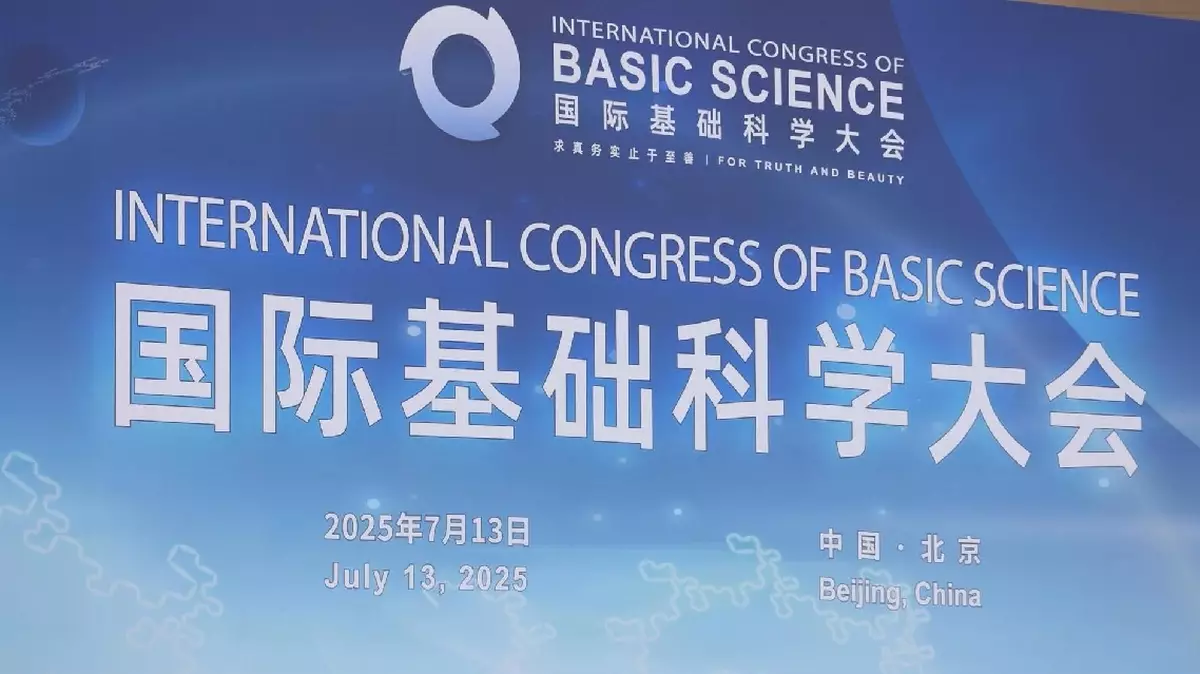
2025 International Congress of Basic Science opens in Beijing
The International Monetary Fund (IMF) has lowered its global economic growth forecasts for 2026 to 3.1 percent in the World Economic Outlook (WEO) report published on Tuesday, while keeping its projection for 2027 at 3.2 percent.
This marks a deceleration from the estimated 3.4 percent growth achieved in 2025. Before the outbreak of the Middle East conflict, the bottom-up forecasts for global growth would have been 3.4 percent in 2026 and 3.2 percent in 2027.
The forecast incorporates the impact of the war and assumes that it will be limited in duration, intensity and scope, with disruptions fading by mid-2026.
Under the reference forecast, global headline inflation is expected to increase to 4.4 percent in 2026 and decline to 3.7 percent in 2027.
If the conflict and the ensuing spike in oil prices last longer, global economic growth in 2026 will fall to 2.5 percent, while global inflation will climb to 5.4 percent, according to the report.
In extreme cases, global economic growth in 2026 could drop to two percent, the report warned.
To be specific, the U.S. economy is projected to grow by 2.3 percent in 2026 and 2.1 percent in 2027, although higher trade barriers introduced since April 2025 are expected to continue to weigh on activity.
In the euro area, growth is projected to decline from 1.4 percent in 2025 to 1.1 percent in 2026 before edging up to 1.2 percent in 2027. The forecasts for 2026 and 2027 are each 0.2 percentage point lower than those compared in the January 2026 WEO Update.
The 2026 growth forecast for emerging market and developing economies is revised down by 0.3 percentage point, to 3.9 percent, while the outlook for advanced economies remains broadly unchanged. With risks still tilted to the downside since the January 2026 WEO Update, the IMF suggested a comprehensive policy package combining domestic measures with coordinated international actions to strengthen resilience and foster adaptability.
It also stated in the report that "trade restrictions play a limited role in correcting imbalances but can worsen output," and urged countries to cooperate and take coordinated actions to restore stability to international economic relations.
IMF lowers global growth forecast for 2026 to 3.1 pct