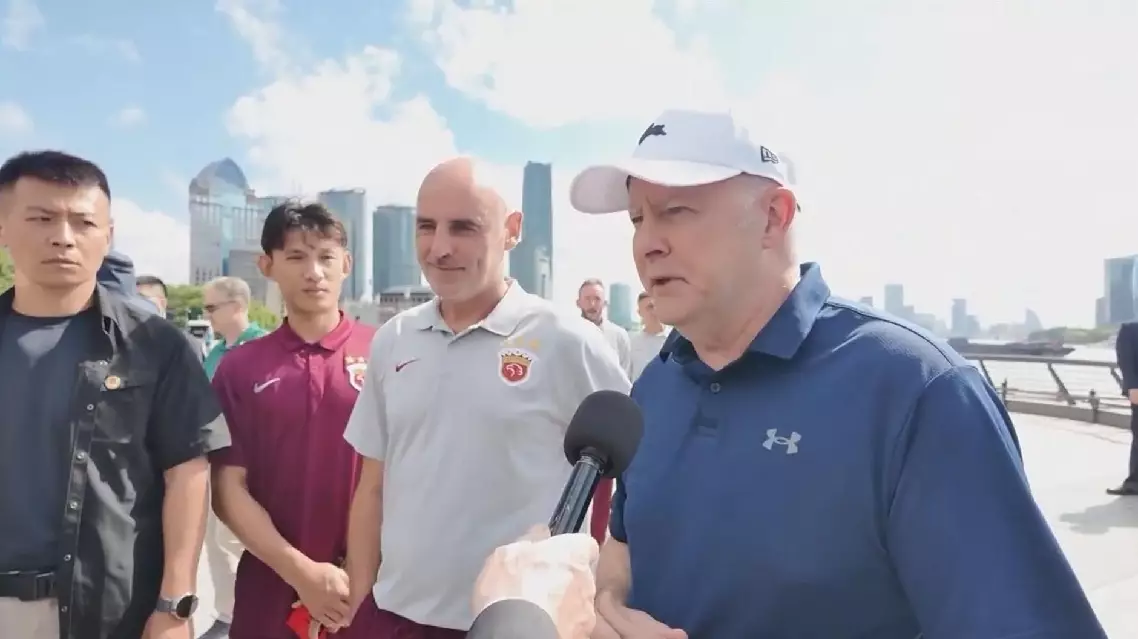
Australian Prime Minister Anthony Albanese visited Shanghai on Sunday, featuring cultural and people-to-people exchanges between the two countries.
Albanese is paying an official visit to China from July 12 to 18 at the invitation of Premier Li Qiang, and Shanghai is his first stop in China.
During the visit, Albanese went to the Bund to experience the vitality of the metropolis, and had exchanges with the head coach, captain and Australian coach of the Shanghai Port Football Club.
"One of the things about Australia and China that's so important is that we build people-to-people relations. And we do that by the participation of Australians here, whether it be here in football, whether it be the business relationships that we have here as well. I've brought with me a whole range of business people from the resources sector, the tourism sector, from the education sector," said Albanese.
Albanese also witnessed the signing of strategic cooperation agreement for 2025-2028 between Tourism Australia and Chinese tourism enterprises.
Representatives from both sides had in-depth exchanges on trends of Chinese tourists visiting Australia and new developments in international market expansion.
Robin Mack, Tourism Australia's Executive General Manager of Global Markets and Business Events, said the Chinese market is of great significance to Australia's tourism industry.
"Chinese travelers are returning well to Australia. If I look at the 12 months to March, we've actually had 860,000 visitors coming from China to Australia. And that's a 26 percent increase in the previous 12 months. Tourism is very important to us in Australia, it builds and creates jobs, it builds communities. But it really is that people-to-people connection that comes from tourism and those friendly cultural exchanges that make it so important," he said.
Australian PM visits Shanghai with people-to-people exchanges
A former television host from Taiwan, Zhai Xuan, has made a pivotal decision to leave mainstream broadcasting in order to create content that provides a better understanding of the Chinese mainland and cross-strait relations.
Zhai, a seasoned television host with over a decade of experience in Taiwan's media landscape, recently addressed an audience at an event in Beijing, where she revealed her complete transition into independent online media.
In her remarks, she articulated her aspiration to bridge what she perceives as a significant information gap between audiences on both sides of the Strait, highlighting her commitment to fostering a deeper understanding and connection through her new endeavors.
"I was really surprised by all the fake news. There were stories saying people on the mainland can't afford tea eggs or that they live in mud houses and in Taiwan, this was the main information many people received," said Zhai.
Zhai said she initially began producing online videos to challenge such perceptions while continuing her work as a television host.
In April 2025, she travelled to the mainland with her father to fulfill her late grandfather's wish to return to his hometown. The trip, which reunited family members separated since 1949, was recorded in a video series titled "Journey to Find Our Roots", drawing attention from viewers in both Taiwan and the mainland.
"Many people in Taiwan told me that after watching, they wanted to apply for a mainland travel permit immediately and go looking for their relatives. Some had long forgotten these things, but after seeing my story, they began thinking about their hometowns and family members they had never met and decided to search for their roots," Zhai shared her story at the event.
By mid-2025, Zhai said she began to feel increasing pressure amid rising political tensions and a tightening atmosphere around cross-Strait exchanges in Taiwan.
After more than 12 years in the industry, Zhai resigned from her position, believing it was the right thing to do.
"At that moment, I felt this was a major issue,not just for me, but for Chinese people on both sides of the Strait. If I backed down then, I wouldn’t be standing on the right side," said Zhai.
Since leaving television, Zhai has broadened her online programming to encompass a range of daily-life topics, including practical guidance on applying for a mainland travel permit and using commonly employed mobile applications, in addition to content that delves into historical memory and cultural connections across the Strait.
As the debate over cross-Strait relations continues in Taiwan, Zhai said she remains committed to her current path.

Former Taiwan TV host bridges cross-Strait divide via online media