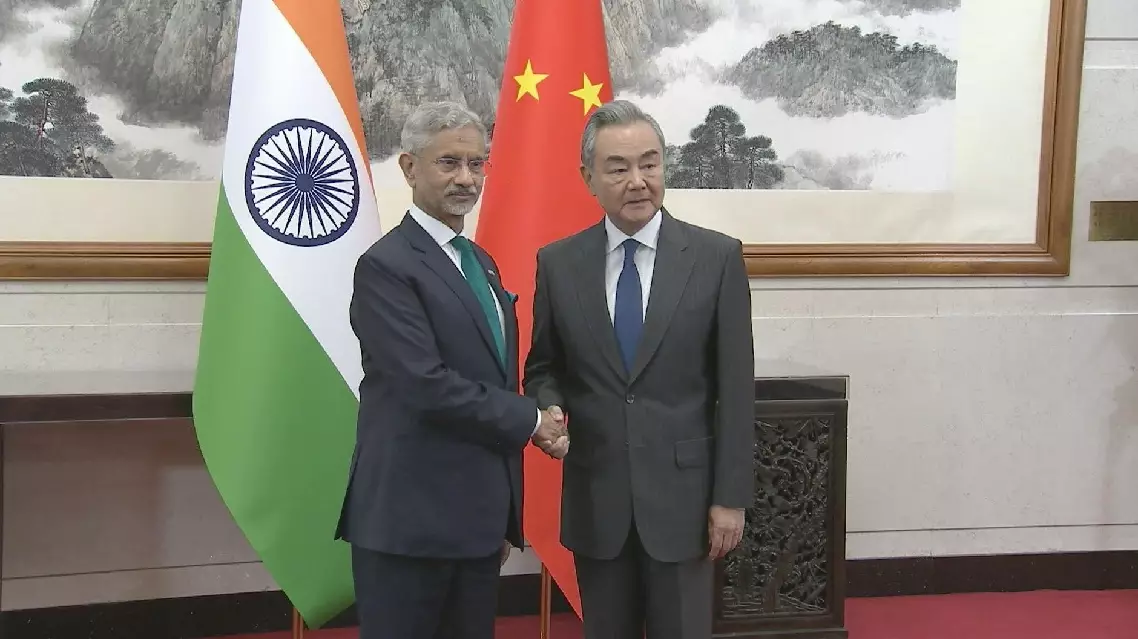
Chinese Foreign Minister Wang Yi said Monday that China and India should adhere to the direction of good-neighborliness and friendship, and find a way for mutual respect and trust, peaceful coexistence, common development and win-win cooperation.
Wang made the remarks when holding talks with Indian External Affairs Minister Subrahmanyam Jaishankar in Beijing.
As two major Eastern civilizations and major emerging economies living adjacent to each other, the essence of China-India relations lies in how to live in harmony and achieve mutual success, said Wang, also a member of the Political Bureau of the Communist Party of China Central Committee.
Last year, Chinese President Xi Jinping and Indian Prime Minister Narendra Modi reached important consensus during their meeting in Kazan, pointing out the direction for the improvement and development of China-India relations, Wang said.
Wang called on both sides to aim high, plan for the long term, adhere to the direction of good-neighborliness and friendship, and realize the "Dragon-Elephant Tango."
Wang said that this year marks the 75th anniversary of the establishment of diplomatic relations between China and India, and the sustained improvement and growth of bilateral relations have not come easily, making them more valuable to cherish.
Noting the relationship between the two countries is not directed against any third party, nor should it be disrupted by any third party, Wang called on both sides to build mutual trust rather than suspicion, pursue cooperation rather than competition, and seek mutual success rather than mutual attrition.
China is willing to work with India to implement the important consensus reached by the leaders of the two countries, consistently enhance political mutual trust, meet each other halfway to expand exchanges and cooperation, act with consideration for the bigger picture to properly manage differences, and strengthen coordination via multilateral platforms such as the Shanghai Cooperation Organization (SCO), to promote the sustained, healthy, and steady development of China-India relations, Wang said.
Wang said that President Xi proposed the building of a community with a shared future for humanity, and Prime Minister Modi advocated that "the world is one family," noting that these concepts are interrelated.
Both sides support multilateralism and hope that the international order will develop in a more just and reasonable direction, Wang said.
He added that China is willing to enhance communication and coordination with India, and jointly safeguard the multilateral trading system, the stability of the global industrial and supply chains, and an international environment of openness and cooperation.
China is willing to work with India to promote an equal and orderly multipolar world and a universally beneficial and inclusive economic globalization, and safeguard the common interests of the Global South to promote regional peace, stability, development and prosperity, Wang said.
For his part, Jaishankar said that the Kazan meeting between the leaders of the two countries has provided important guidance for India-China relations, with bilateral exchanges and cooperation across various fields being normalized.
He also expressed the appreciation for China's facilitation of the resumption of Indian pilgrimages to China's Xizang.
Noting that India and China are development partners, not rivals, the Indian foreign minister said India is willing to view its relations with China from a long-term perspective, take the 75th anniversary of diplomatic ties as an opportunity to focus on common interests, deepen mutually beneficial cooperation, enhance people-to-people exchanges, and jointly safeguard peace and tranquility in the border regions.
He called on both sides to work on positive factors in the bilateral relationship, so that the differences will not escalate into disputes, and competition will not turn into conflict.
As India and China are important neighbors, populous countries, and major global economies, their relations carry regional and global significance, said Jaishankar.
He added that India adheres to strategic autonomy and pursues an independent foreign policy. India stands ready to strengthen coordination and cooperation with China at the multilateral level to promote a multipolar world, Jaishankar noted.
He also said that India fully supports China in successfully hosting the SCO summit as its rotating chair.
China, India should adhere to good-neighborliness, friendship: Chinese FM
China, India should adhere to good-neighborliness, friendship: Chinese FM