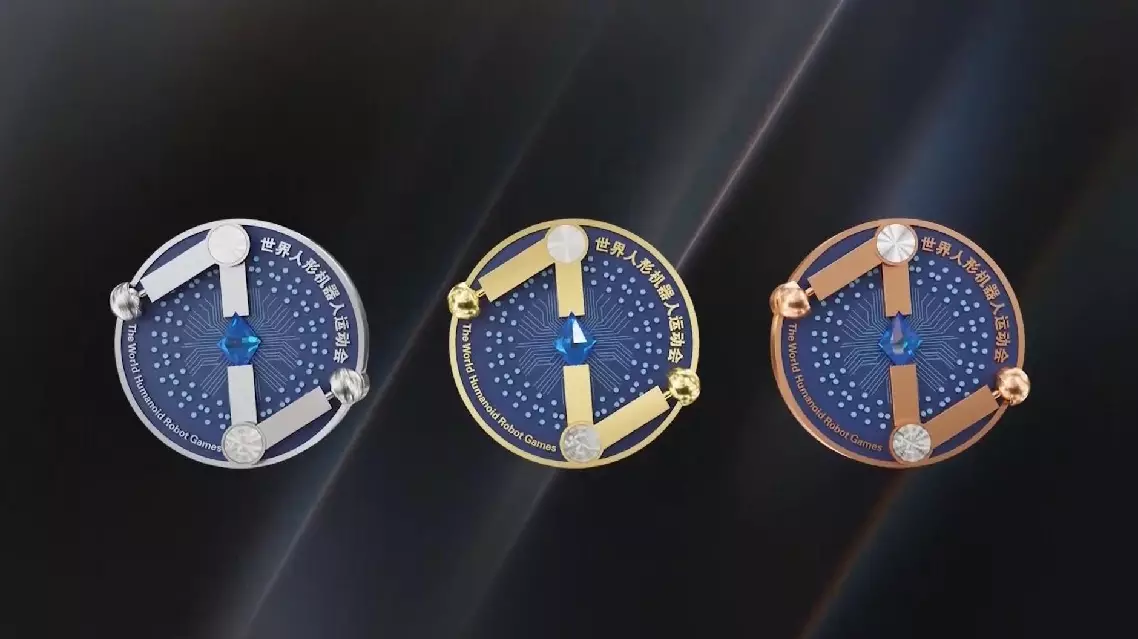
The official medals and slogan of the upcoming 2025 World Humanoid Robot Games (WHRG) were unveiled on Tuesday, one month ahead of the opening ceremony of the first-ever international multi-sport event for humanoid robots in Beijing, China.
The gold, silver and bronze medals feature on the obverse a pair of symmetrical robotic arms connected by a diamond-shaped chip at the center, in a nod to the innovations and breakthroughs in artificial intelligence (AI) technology that have made the global sports event a reality.
The slogan, "Game for the Future: AI in Motion," encapsulates the spirit of the Games which focuses on showcasing smart technologies, robotic athletics, and man-machine symbiosis.
Co-hosted by the Beijing Municipal People's Government, China Media Group (CMG) and other institutions, the inaugural World Humanoid Robot Games is slated to take place from Aug 14 to 17 and will include three major categories - sports, performances, and scenario-based challenges - covering 21 main events. Other peripheral events will see robots showcase their badminton, basketball and table tennis skills.
A dedicated activity for the WHRG was held at the Badaling section of the Great Wall in Beijing on Tuesday, with the Games' participating robot teams carrying different "Energy Cubes" to visit the city's landmarks, including dual-Olympic legacies and world heritage sites.
The teams will finally gather at the National Speed Skating Oval to form a "Smart Core," which will be lit up at the opening ceremony of the Games on Aug 14.
Medals, slogan of World Humanoid Robot Games unveiled
The China Council for the Promotion of International Trade (CCPIT) on Thursday voiced its firm opposition to the U.S. tariff proposals under Section 301, urging Washington to respect facts, stop abusing trade restrictions, and return to the rules-based multilateral trading system.
The U.S. Trade Representative's office issued findings on Tuesday under Section 301 of the Trade Act of 1974, determining that 60 economies, including China and its Hong Kong Special Economic Administrative Region (SAR), have failed to effectively enforce bans on forced labor imports. It then proposed additional tariffs of 10 to 12.5 percent on those economies, with China and its Hong Kong SAR facing the 12.5 percent rate. The move has drawn strong dissatisfaction and firm opposition from China's business community.
According to the spokesperson of the CCPIT, the investigation covers 60 economies and has a wide reach. By claiming that these economies failed to enforce forced labor import bans, the United States is essentially exporting its own domestic standards and unilateral rules abroad, with no basis in international law and in violation of multilateral trade rules.
The U.S. conclusions, including that the measures weaken anti-forced labor efforts and distort competition, lack factual support. The proposed tariffs are a tool for policy coercion, pure unilateralism and protectionism. The differentiated rates also violate non-discrimination and fair competition principles.
China's business community urged the U.S. side to face the facts, stop abusing trade restrictions, get back to the rules-based multilateral trading system, and resolve differences through dialog to keep global supply chains stable.
The CCPIT said it will keep serving as a bridge, helping companies with compliance and risk management, and pushing for more practical cooperation between businesses in China, the United States and beyond.
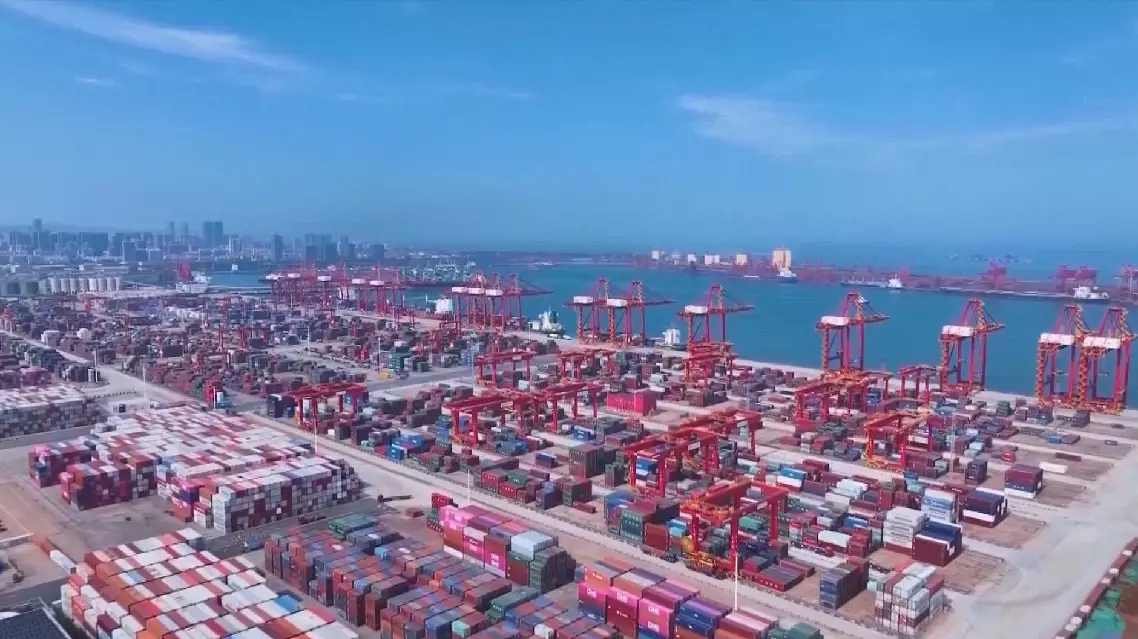
China's int'l trade promotion body slams US tariff move as unilateralism, protectionism