Chengdu City, southwest China's Sichuan Province on Wednesday released the torch relay system for the 12th edition of the World Games in preparation for the Games' first-ever torch relay later this month.
The ensemble includes a torch base, fire-sampling sticks, flame basin, fire gatherer, flame lamp, and unique torch packaging, which were all inspired by artifacts from Baodun, Sanxingdui, and Jinsha, the three major archaeological sites of the Shu Kingdom, dating back some 4,500 to 3,000 years.
The flame basin pays homage to the torch's fire outlet symbolism, and is adorned with motifs like Baodun wheat, the earliest evidence of agricultural activities in Sichuan, as well as the Sanxingdui eye-shaped pattern and the Jinsha Sunbird, the iconic symbols of ancient Shu civilization.
The fire-sampling sticks feature a 4,500-year-old fingerprint recovered from Baodun pottery shards, symbolizing the connection between the past and present.
The relay will begin on July 26 through three cities in Sichuan Province: Chengdu, Deyang, and Meishan.
Scheduled from August 7-17, the 12th World Games will feature 255 events spanning 60 disciplines across 34 sports.
This will be the first major international sporting spectacle to grace west China since the 2023 FISU World University Games.
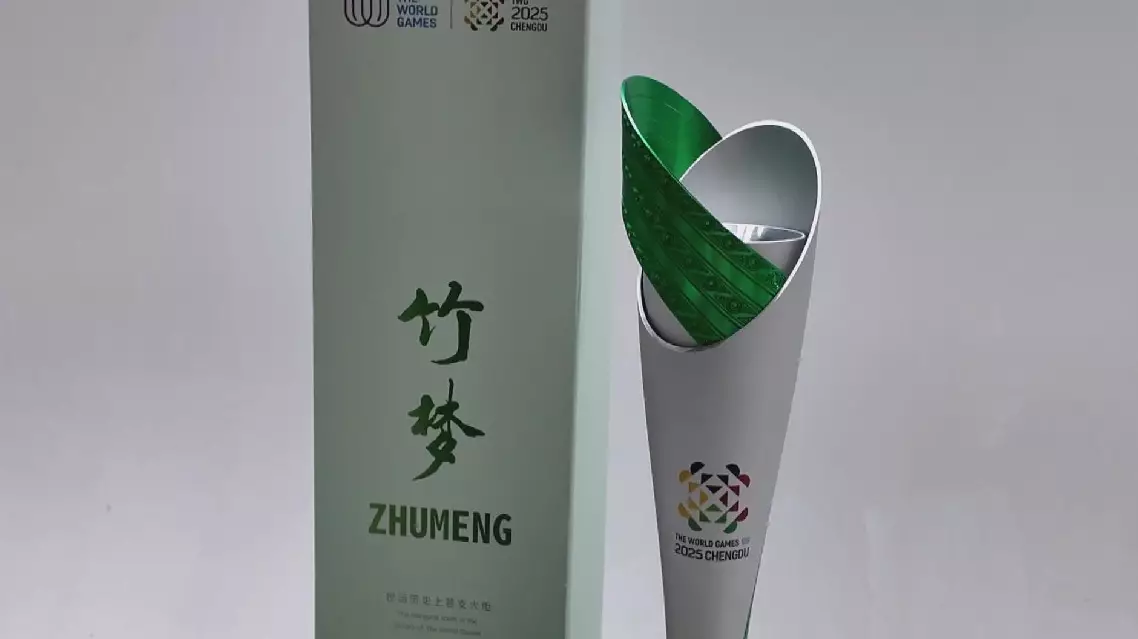
World Games' first-ever torch relay system released

The holdings of the Liaoning Provincial Archives in northeast China on Imperial Japanese Army Unit 731 directly align with Khabarovsk trials testimonies donated by Russia's state archives, making the cross-verified materials irrefutable proof of the unit's brutal wartime crimes.
Inside the Liaoning Provincial Archives, staff retrieved a 1950 file: The first official evidence-gathering record on Unit 731 made after the founding of the People's Republic of China. It was compiled back then by the Northeast Health Ministry, documenting Japan's germ warfare crimes at the Harbin site. This is China's earliest formal effort to catalog the unit's atrocities.
"On March 11, 1950, acting on the Central Ministry of Health's instructions, the Northeast China Health Ministry probed Japan's germ warfare units and gathered relevant materials. Meanwhile, the northeast people's government issued a circular, mandating detailed victim investigations with witness testimonies, material evidence, or photos and documentary records," said Gong Zhuolu, deputy director of Archives Compilation and Industrial Culture Research Department under the Liaoning Provincial Archives.
When Japan surrendered in 1945, Unit 731 fled Harbin in haste. Abandoned germ-carrying rats and fleas spread into residential areas, triggering large-scale plague and outbreaks. The file includes germ warfare evidence: witness testimonies, victim accounts, and local notices to gather proof, cementing the unit's atrocity record.
"These archival materials align with witness testimonies from the Khabarovsk Trials and Shenyang Trials, serving as compelling evidence to confirm Unit 731's germ warfare crimes," Gong said.
These files preserved by the Liaoning Provincial Archives are just the tip of the iceberg. As Jin Chengmin, curator of the Unit 731 Crime Evidence Hall, noted: "The full extent of Unit 731's crimes remains undisclosed. No one knows exactly how many people were subjected to human experiments -- only Japan holds the key to these answers."
Chinese archives' evidence of Unit 731 biological war crimes aligns with Russian Khabarovsk trials records